We earn a commission when you buy through our Amazon links, at no extra cost to you. It never decides a ranking, and where the best tool in a class is one we earn nothing on, we say so and link it anyway. How this works.
Cryogenically treated Cr-V hardened to around HRc 62, ground far finer than the standard line, with ash handles and stainless ferrules. This is where more money buys measurably more edge retention.
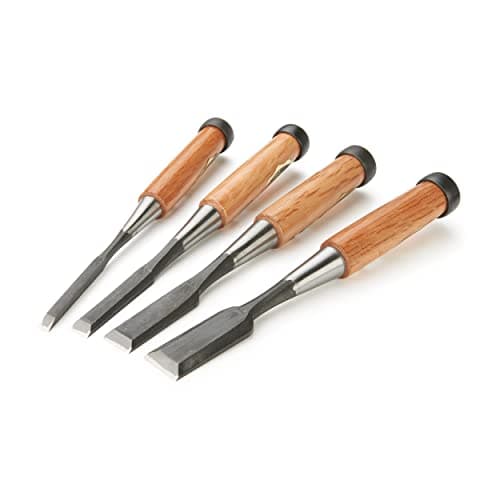
Hand-forged in Miki by one smith rather than pressed out in a factory, in the four widths that cover most joinery. On western retail there is nothing between the three-piece KAKURI sets and this, and the gap is what the forge costs.
A smith-forged Japanese set rather than a factory one
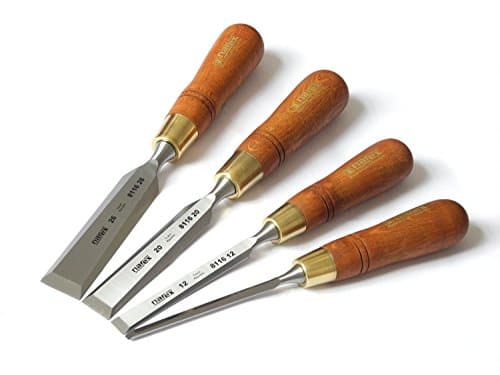
The classic set with hornbeam handles instead of beech and better fit and finish throughout. The steel is the same, which is the point: you are buying the handle and the finishing.
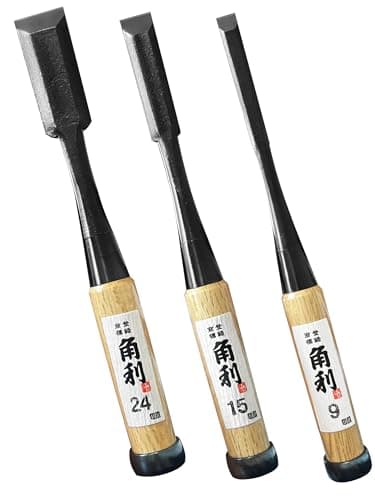
Laminated hard steel over soft iron, hollow-ground backs, hooped handles, made in Japan, at a price where the western equivalents are still using chrome-vanadium.
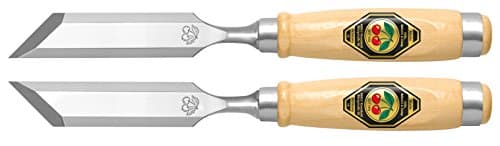
A left and right pair of 12 mm skew chisels from Hirsch's Two Cherries works in Remscheid. They exist for one problem a straight chisel genuinely cannot solve: the acute inside corner of a dovetail socket, where a square edge either misses the corner or bruises the opposite wall getting to it.
The set that makes the case for this whole site. Four sizes, Czech chrome-vanadium hardened properly, beech handles, and a price that leaves budget for the stone you will need anyway.
#ad· Live prices from the Amazon Product API, as of October 16, 2026. Where we have no verified live price we show none, and the cost-per-decade figure is suppressed with it — we would rather leave a gap than print a number that has rotted.
Buy the Narex Richter set of five. The side lands are ground thin enough to get into a dovetail's acute corner, the backs arrive ground and polished so your first evening is spent cutting rather than lapping, and the cryo-treated steel is published at about 62 HRc — which is the hardness that holds an edge through a drawer-full of sockets. If you want a smith-forged alternative, the Ioroi four-piece set is the pick. And whatever else you buy, a pair of skew chisels is the tool that actually solves the corner, and the Two Cherries pair is the only one on this site.
Dovetails are not a hard joint to cut. They are a hard joint to cut cleanly, and almost all of the difficulty lives in one place: the corner where the baseline meets the sloping side of a socket. That corner is sharper than a right angle. A chisel with thick flanks cannot enter it, so it compresses the wood instead of cutting it, and what you see when the joint goes together is a bruised shadow along the baseline that no amount of sanding removes.
A bevel-edge chisel has two sloping flanks and, at the point where each flank meets the back, a narrow flat called the side land. On a cheap chisel that land is a sixteenth of an inch of square steel; on a chisel ground for dovetails it is a few thousandths, almost a knife edge.
The consequence is geometric and unavoidable. A dovetail socket has sides sloping at something like 1:6 or 1:8, so the corner between the side and the baseline is roughly 80 degrees. A chisel with a thick land presented square to the baseline cannot get its cutting edge into that 80 degree corner, because the land fouls on the sloping side first. A chisel with thin lands can.
Almost nobody publishes a land thickness — not one listing for any product on this page gives a figure — so this is ranked on what the makers describe and what the grind is for. Narex grinds the Richter line with noticeably finer lands than its Classic line. Japanese oire nomi have fine lands by tradition. The German pattern chisels have more generous lands and compensate with a much thinner overall blade.
And here is the thing worth knowing before you spend anything: you can grind the lands yourself. Ten minutes per chisel on a coarse stone or a belt sander, taking the flanks back toward the back face, turns a thick-landed bench chisel into a usable dovetail chisel. It is the cheapest upgrade on this page and it works on every pick here.
What else actually matters
1. How narrow the smallest chisel goes. Half-blind dovetails in a drawer front need a chisel narrower than the narrowest part of the socket, and that is routinely 1/4 in or less. A set whose smallest chisel is 1/2 in leaves you levering, which is how edges chip. Narex sets start at 6 mm, the Ioroi set starts at 6 mm, and the Kakuri three-piece set covers the small end directly. Chisel sizes explained has the widths worth owning.
2. Whether the back arrives flat. A chisel registers on its back. If the back is hollow near the edge, the chisel will not pare to a line no matter how sharp it is, and flattening a back is the most tedious job in sharpening. Narex Richter publishes backs ground and polished; Japanese chisels are hollow ground (ura) so only a narrow rim needs lapping, which is faster. How to flatten a chisel back is the job you are trying to avoid.
3. Hardness, and the trade behind it. Narex Richter publishes about 62 HRc, which holds an edge longer and chips more readily if you lever with it. Japanese laminated chisels are harder still at the cutting layer and are backed by soft iron so the whole blade does not become a glass rod. The German high-carbon chisels sit lower and sharpen faster. Chisel steel explained covers the whole range, and A2 vs O1 steel covers the argument in the western alloys.
4. Handle length and shape. Dovetail work is mostly two-handed paring with hand pressure, not mallet work. A longer handle gives you more control; a hooped Japanese handle takes mallet blows the western pattern does not love. Neither is better, and chisel handle materials covers what lasts.
5. Socket or tang. A detail on a dovetail page rather than a decider, but it is the part that breaks when a handle is abused — socket vs tang chisels has the difference.
What the makers publish
Set
Smallest width
Steel as published
Backs
Narex Richter, 5 pc
6 mm
Cryo-treated Cr-V, approx 62 HRc
Ground and polished
Ioroi oire nomi, 4 pc
6 mm
Hard layer forge-welded to soft iron
Hollow ground (ura)
Narex Premium, 4 pc
6 mm
Czech Cr-Mn
Not published
Two Cherries, 6 pc
Not published per piece
High carbon, Solingen forged
Not published
Kakuri oire nomi, 3 pc
Not published per piece
Laminated hagane over jigane
Hollow ground (ura)
Two Cherries skew pair
12 mm, left and right
High carbon, Solingen forged
Not published
Narex Classic, 4 pc
Not published per piece
Cr-Mn / Cr-V, hardened
Not published
Three of seven publish a steel composition with a hardness, two publish a back preparation, and none publishes the side land thickness that this page argues is the deciding feature. That is the state of the category, and it is why the honest ranking leans on what the grind is for rather than on numbers that do not exist.
The skew chisel, which is the actual answer
There is a tool designed specifically for the problem this page opens with, and it is not a bevel-edge bench chisel. A skew chisel has its cutting edge ground at an angle across the blade, which puts a sharp point at one corner. That point reaches into an acute corner that no square-ended chisel can enter, regardless of how thin the lands are, and they come in matched left-hand and right-hand pairs because a dovetail socket has two corners that lean opposite ways.
The Two Cherries pair is the only skew chisel on this site. It is not a set and it will not chop a mortise; it does one job, does it better than anything else, and is the thing most people buy third after a bench set and a mallet. If you cut dovetails regularly and you have been fighting the baseline corner, this is the purchase that stops it.
Every pick, in full
The write-ups
01The upgrade that is actually an upgrade
Set
5 pieces
Steel
Cryo-treated Cr-V, HRc ~62
Handles
Ash with stainless ferrules
Prep
Backs ground and polished
Narex Richter Bevel Edge Chisel Set of 5
Narex
8.7/10
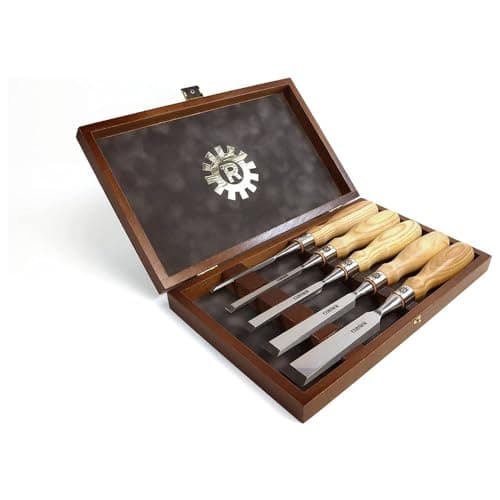
Cryogenically treated Cr-V hardened to around HRc 62, ground far finer than the standard line, with ash handles and stainless ferrules. This is where more money buys measurably more edge retention.
Cost per decade
$114.38
Horizon · tier C
20 years — No lifetime warranty; parts purchasable and resharpenable
A UK specialist retailer states a lifetime guarantee on Narex chisels; we could not find published warranty terms from Narex itself, so we do not rate it tier A. Unhandled blade blanks are sold separately, and the tool is resharpenable indefinitely.
Rebuy risk
Medium
parts listed, resharpenable
Steel & edge
9.5
Back flatness
9.5
Handle
9.0
Sizes covered
8.5
Value
7.0
What it gets right
+A published hardness figure, which most makers in this band do not give
+Backs arrive close enough to flat that first-use lapping is minimal
+Holds an edge in hardwood noticeably longer than the standard Narex
What it costs you
−Four to five times the price of the standard set for a real but incremental gain
−Harder steel is slower to bring back once it does dull
−Still no published warranty from the maker
Skip this if…
…you are still learning to sharpen. Harder steel punishes a poor technique more, not less.
02A smith-forged Japanese set rather than a factory one
Set
4 pieces — 6, 12, 18, 24 mm
Construction
Hard cutting layer forge-welded to soft iron
Back
Hollow ground (ura)
Origin
Hand forged in Miki, Japan
Ioroi Japanese Bench Chisel Set, 4 Piece (Oire Nomi)
Ioroi
8.1/10
Hand-forged in Miki by one smith rather than pressed out in a factory, in the four widths that cover most joinery. On western retail there is nothing between the three-piece KAKURI sets and this, and the gap is what the forge costs.
Cost per decade
$106.99
Horizon · tier C
20 years — No lifetime warranty; parts purchasable and resharpenable
No warranty terms published for the US market at the date checked. A laminated hagane-over-jigane edge is renewable by sharpening until the hard layer runs out, which on a full-size chisel or plane iron is a working lifetime.
Rebuy risk
Medium
parts listed, resharpenable
Steel & edge
9.5
Back flatness
9.0
Handle
8.5
Sizes covered
7.0
Value
6.5
What it gets right
+Four widths covers ordinary joinery without buying a second set
+Metric widths, which is what Japanese joinery layout actually works in
+Hollow-ground backs, so lapping touches a narrow land and setup is quick
What it costs you
−Roughly four times the entry KAKURI set, for a difference you only feel once you can sharpen well
−No warranty terms published for the US market
−Hoops arrive unseated as they do on every Japanese chisel, and nothing in the box says so
Skip this if…
…you have never sharpened a Japanese chisel. Start with a three-piece set; a hard laminated edge punishes a beginner's technique and this is an expensive place to find that out.
The classic set with hornbeam handles instead of beech and better fit and finish throughout. The steel is the same, which is the point: you are buying the handle and the finishing.
Cost per decade
$35.50
Horizon · tier C
20 years — No lifetime warranty; parts purchasable and resharpenable
A UK specialist retailer states a lifetime guarantee on Narex chisels; we could not find published warranty terms from Narex itself, so we do not rate it tier A. Unhandled blade blanks are sold separately, and the tool is resharpenable indefinitely.
Rebuy risk
Medium
parts listed, resharpenable
Steel & edge
8.5
Back flatness
8.5
Handle
8.5
Sizes covered
8.5
Value
8.5
What it gets right
+Hornbeam is denser than beech and takes mallet work better over decades
+Better ground out of the box than the entry set
+Metric sizing maps cleanly onto common joint dimensions
What it costs you
−Costs meaningfully more for the same cutting performance
−Metric sizes annoy people working to imperial plans
−Still no published warranty
Skip this if…
…you are buying your first set. Buy the cheaper Narex, spend the difference on a stone, and see whether you want better handles later.
Price as of October 16, 2026. Prices move; Amazon's is the one that counts.
#ad · we may earn a commission from this link to Narex Czech Steel Premium Chisels, 4 Piece Hornbeam
04German steel and a hornbeam handle you will not replace
Set
6 pieces
Steel
High carbon, Solingen forged
Handles
Hornbeam
Warranty
Not published
Two Cherries Bevel Edge Chisels, 6 Piece in Wooden Box
Two Cherries
8.3/10
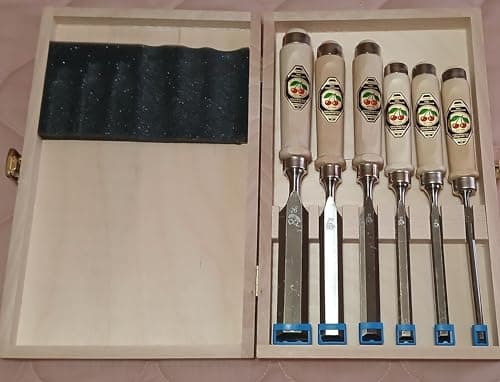
Solingen-forged carbon steel, hardened hard, in a set that people genuinely do hand down. The unpolished version costs less and cuts identically.
Cost per decade
$90.00
Horizon · tier C
20 years — No lifetime warranty; parts purchasable and resharpenable
No lifetime warranty published by the manufacturer at the date checked. Monolithic edge tool: no separately consumable part, and the edge is renewable by sharpening for as long as there is steel left.
Rebuy risk
Medium
parts listed, resharpenable
Steel & edge
9.0
Back flatness
8.5
Handle
9.0
Sizes covered
8.5
Value
6.5
What it gets right
+Carbon steel sharpens faster than A2 and takes a keener edge
+Hornbeam handles are the most durable wooden option in this list
+Set of six in a box is a coherent one-time purchase
What it costs you
−Carbon steel rusts if you leave it damp; this is a maintenance obligation
−No published warranty terms
−Priced well above the point where more money buys more cutting
Skip this if…
…your workshop is a damp garage. Carbon steel and humidity is a fight you will lose.
Price as of October 16, 2026. Prices move; Amazon's is the one that counts.
#ad · we may earn a commission from this link to Two Cherries Bevel Edge Chisels, 6 Piece in Wooden Box
05Best Japanese chisels for the money
Set
3 pieces
Construction
Laminated hagane over jigane
Back
Hollow ground (ura)
Origin
Listing states Made in Japan
KAKURI Japanese Wood Chisel Set, 3 Piece (Oire Nomi)
KAKURI
8.2/10
Laminated hard steel over soft iron, hollow-ground backs, hooped handles, made in Japan, at a price where the western equivalents are still using chrome-vanadium.
Cost per decade
$27.90
Horizon · tier C
20 years — No lifetime warranty; parts purchasable and resharpenable
No warranty terms published for the US market at the date checked. A laminated hagane-over-jigane edge is renewable by sharpening until the hard layer runs out, which on a full-size chisel or plane iron is a working lifetime.
Rebuy risk
Medium
parts listed, resharpenable
Steel & edge
9.0
Back flatness
9.0
Handle
8.0
Sizes covered
6.5
Value
8.5
What it gets right
+Hollow-ground back means lapping touches only a narrow land, so setup is fast
+Laminated edge takes a keener edge than a homogeneous western chisel
+Hooped handles are made to be struck
What it costs you
−The hoop must be seated properly before first use, and the instructions assume you know
−Hard laminate chips if you twist it in the cut
−Three sizes only
Skip this if…
…you lever waste out of mortises. A Japanese bench chisel is a paring and chopping tool, not a prybar, and the hard laminate will tell you so.
Price as of October 16, 2026. Prices move; Amazon's is the one that counts.
#ad · we may earn a commission from this link to KAKURI Japanese Wood Chisel Set, 3 Piece (Oire Nomi)
06The corners a straight paring chisel cannot reach
Width
12 mm
Supplied as
Matched left-hand and right-hand pair
Maker
Two Cherries (Hirsch), Germany
Grind
Skewed bevel edge
Warranty
None published
Two Cherries Skew Bevel Chisels, Pair of 12mm
Two Cherries
7.1/10
A left and right pair of 12 mm skew chisels from Hirsch's Two Cherries works in Remscheid. They exist for one problem a straight chisel genuinely cannot solve: the acute inside corner of a dovetail socket, where a square edge either misses the corner or bruises the opposite wall getting to it.
Cost per decade
$43.50
Horizon · tier C
20 years — No lifetime warranty; parts purchasable and resharpenable
No lifetime warranty published by the manufacturer at the date checked. Monolithic edge tool: no separately consumable part, and the edge is renewable by sharpening for as long as there is steel left.
Rebuy risk
Medium
parts listed, resharpenable
Steel & edge
9.0
Back flatness
8.5
Handle
8.0
Sizes covered
4.0
Value
6.0
What it gets right
+A skewed edge reaches into an acute corner without the opposite bevel touching the far wall, which is the one cut a square chisel cannot make cleanly
+Sold as a matched pair, so both corners of a socket are covered
+Two Cherries' steel and back flatness are among the best in the Western chisel market and arrive genuinely usable
+Specialist geometry that stays useful for a lifetime because nothing else substitutes for it
What it costs you
−A specialist tool, not a first chisel — if you do not cut hand dovetails this will sit in the drawer
−No warranty of any length published
−Expensive for 12 mm of steel, because you are buying two chisels
−Skewed edges are fiddly to hone freehand and most honing guides will not hold the angle
Skip this if…
…you clean your dovetail corners with a knife and are happy with the result. That works, and it is free.
07Best chisels overall, and the end of the argument
Set
4 pieces
Steel
Cr-Mn / Cr-V, hardened
Handles
Beech, tanged
Warranty
Not published by the maker
Narex Bevel Edge Chisel Set, 4 Piece
Narex
8.4/10
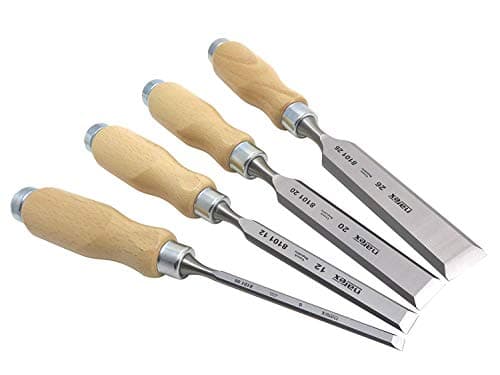
The set that makes the case for this whole site. Four sizes, Czech chrome-vanadium hardened properly, beech handles, and a price that leaves budget for the stone you will need anyway.
Cost per decade
$24.50
Horizon · tier C
20 years — No lifetime warranty; parts purchasable and resharpenable
A UK specialist retailer states a lifetime guarantee on Narex chisels; we could not find published warranty terms from Narex itself, so we do not rate it tier A. Unhandled blade blanks are sold separately, and the tool is resharpenable indefinitely.
Rebuy risk
Medium
parts listed, resharpenable
Steel & edge
8.5
Back flatness
8.0
Handle
7.5
Sizes covered
8.5
Value
9.5
What it gets right
+Edge retention indistinguishable from sets at four times the price in normal use
+Backs are flat enough that lapping is a job, not an ordeal
+Four sizes is genuinely the number most people use
+Nothing on the tool is consumable: sharpening renews it indefinitely
What it costs you
−Narex publishes no warranty terms we could find, so it cannot rate tier A
−Lacquer on the handles is functional rather than lovely
−Side lands are thicker than a dedicated dovetail chisel's
Skip this if…
…you cut a lot of tight dovetails. The side lands will bruise the pins; buy a dedicated dovetail chisel for those and keep these for everything else.
Best overall: the Narex Richter five-piece. Finer side lands than the Classic line, backs ground and polished, 6 mm at the small end, and cryo-treated steel published at about 62 HRc with ash handles and stainless ferrules. It is the set we would buy if dovetails were the main reason for buying chisels.
If you want a forged set rather than a factory one: the Ioroi four-piece oire nomi, hand forged in Miki. Hollow-ground backs mean the lapping is a narrow rim rather than a whole face, the laminated edge takes a keener edge than any western alloy here, and the trade is that the hard layer is less forgiving of levering.
Best value in the Narex range: the Premium four-piece with hornbeam handles — the same Czech steel as the Classic in handles worth keeping, at 6, 12, 20 and 26 mm. The lands are thicker than the Richter's; ten minutes each on a coarse stone fixes that.
If you want German steel and a handle for life: the Two Cherries six-piece in the wooden box. Solingen-forged high carbon in hornbeam, a thinner blade overall than the Czech chisels, and the widest useful spread of sizes here. More generous lands than the Richter, and no warranty is published.
Cheapest Japanese route: the Kakuri three-piece. Laminated construction, hollow-ground backs and a listing that states Made in Japan, for less than most western four-piece sets. Three sizes is thin for dovetails, so expect to add one.
The specialist worth buying third: the Two Cherries 12 mm skew pair. Matched left and right, and the only tool here that physically reaches the acute corner rather than approximating it. Buy it after a bench set, not instead of one.
If the budget is the constraint: the Narex Classic four-piece. The same family steel in beech, at the bottom of the range. The lands need grinding and the backs need lapping, and after an evening of both it will cut dovetails as well as anything above it in this list. The best budget chisel sets has the cheaper field in full.
Preparing a chisel for dovetails
Flatten the back first, and only near the edge. The first inch is all that registers on the work. Do not try to lap a whole blade flat — it is unnecessary and it takes hours. How to flatten a chisel back has the shortcut, and the ruler trick is the faster way still.
Thin the side lands. Take each flank back toward the back face on a coarse stone until the land is barely a line. Keep it square to the back, check with a fingernail, and stop before you reach the edge itself.
Hone at 25 to 30 degrees, not steeper. Dovetail work is paring, not chopping, so bias toward the lower end. Add a microbevel if you want the honing to be quick — sharpening angles explained has the ranges and microbevels explained the method.
Strop before every session. A paring edge goes off long before it goes blunt, and twenty seconds on a strop brings it back — stropping explained.
Keep the narrow ones for the corners only. A 6 mm chisel used as a lever is a 6 mm chisel with a chipped corner. Chop the waste out with the wide one and clean the corners with the narrow one. How to use a chisel covers the grip and the stroke.
Cost per decade on a tool you will own forever
A chisel is the most durable tool in a hand-tool shop. There is nothing to wear out but the steel in front of the handle, and a chisel sharpened weekly for thirty years loses perhaps an inch of blade. That makes the long-run arithmetic almost entirely about the handle and the tang — the parts that actually fail — and about whether the steel is hard enough to be worth resharpening.
Which is why the cheap end of this page is a better buy than the cheap end of a plane page. A Narex Classic set prepared properly will still be cutting dovetails in 2060; its handles may not be, and a replacement handle is a shop-made part rather than a purchase. Restoring wooden tool handles covers that work, and cost per decade has the arithmetic. The real reason to buy up here is time rather than lifespan: the dearer sets arrive closer to ready, and an evening of lapping is the price of the difference.
Questions
Frequently asked
What chisels do I need to cut dovetails?+
Three widths covers it: something around 1/4 in for the corners, something around 1/2 in for general paring and something wide for clearing waste. A four or five-piece bevel-edge set starting at 6 mm gives you all three. The specialist addition, once you cut them regularly, is a matched pair of skew chisels for the acute corners at the baseline.
What is the difference between a bench chisel and a dovetail chisel?+
The side lands and the blade taper. A dovetail chisel has its flanks ground almost to the back face, so the cutting edge can enter a corner sharper than 90 degrees; a bench chisel leaves a flat land of a sixteenth of an inch or so, which fouls on the sloping wall of a socket. The steel is usually the same. A bench chisel can be converted in about ten minutes on a coarse stone — bench chisels vs mortise chisels puts the three patterns side by side.
Are Japanese chisels good for dovetails?+
Very. Oire nomi have fine lands by tradition, the hollow-ground back means lapping is a narrow rim rather than a whole face, and the laminated edge takes a keener edge than most western alloys. The caution is that the hard cutting layer chips if you lever with it, so they reward a clean technique. Japanese vs western chisels is the full comparison, and how to sharpen Japanese chisels covers the different routine.
What angle should a dovetail chisel be sharpened at?+
Twenty-five degrees for pure paring, thirty if the same chisel also chops waste. Lower angles slice end grain more cleanly and are more fragile; a 25 degree primary bevel with a 30 degree microbevel gets you both and keeps the honing quick. Do not go above 30 for dovetail work — a steep edge crushes the fibers in the corner instead of severing them.
Do I need a skew chisel for dovetails?+
Not to cut them, but it is the only tool that properly solves the corner where the socket wall meets the baseline. If you have been getting a bruised shadow along the baseline that will not pare out, a matched left-and-right skew pair is the fix. Most people buy one after their first dozen joints, which is the right order.
Can I use my regular bench chisels for dovetails?+
Yes, and most people do. Grind the side lands thinner, flatten the first inch of the back properly, hone at 25 to 30 degrees and the chisels you already own will cut good dovetails. The sets on this page save you that evening and start you from a better back; they do not do anything your prepared chisels cannot.
We have not handled these tools. Nobody here has tested one, owned one, or taken one apart. Specifications come from the manufacturer or the retailer listing; warranty terms come from the maker's own warranty page; the cost-per-decade arithmetic is ours and reproducible. Where we could not verify a figure we say so on the page rather than quietly leaving it out. Read the full method.