Hand Saws
Rip vs Crosscut Teeth
The most common reason a saw feels bad, and it has nothing to do with how much it cost.
We earn a commission when you buy through our Amazon links, at no extra cost to you. It never decides a ranking, and where the best tool in a class is one we earn nothing on, we say so and link it anyway. How this works.
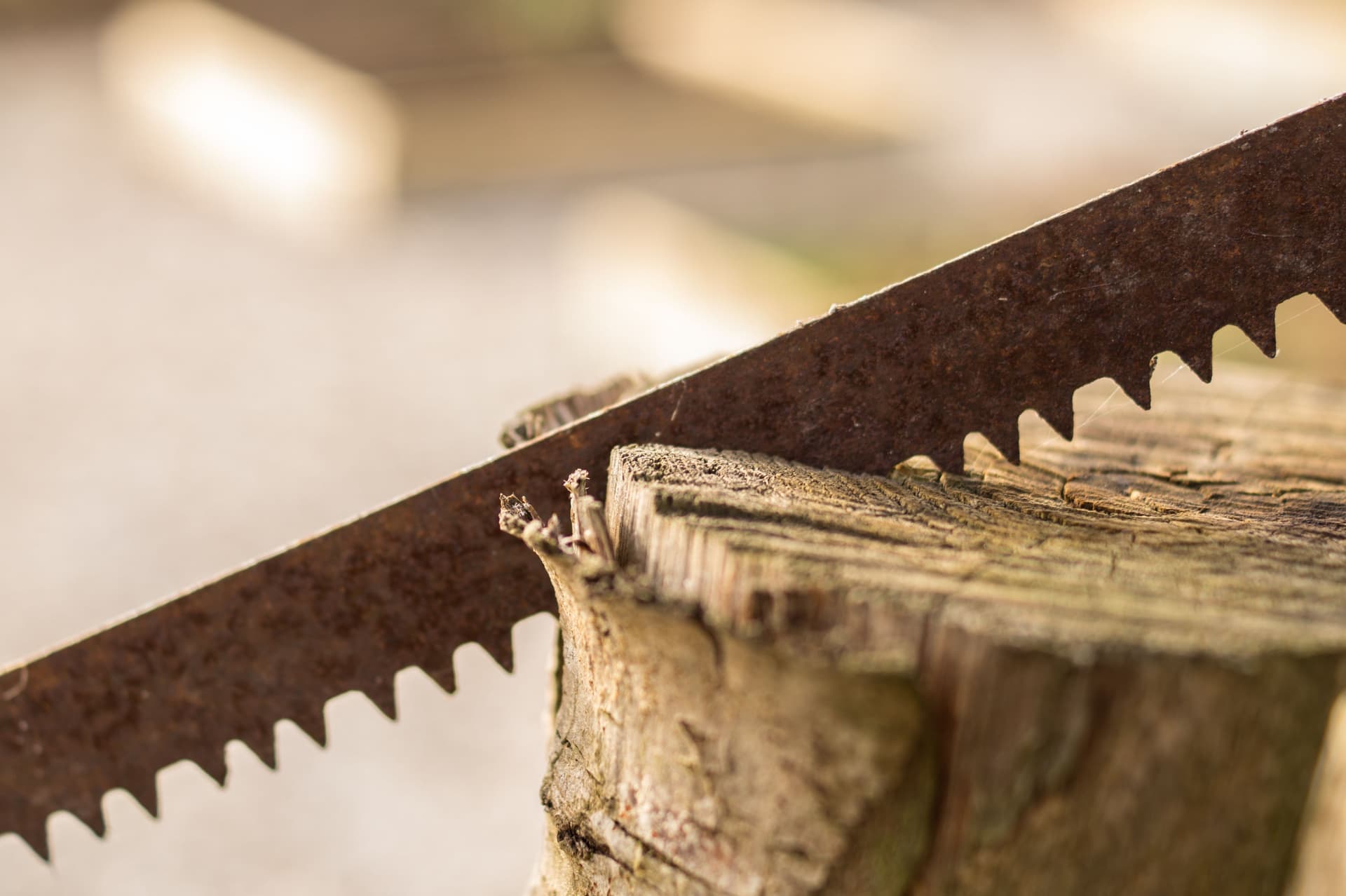
If a saw feels like hard work, or leaves a torn edge, or seems to fight you, the most likely explanation is not that it is dull or cheap. It is that the teeth are filed for the other kind of cut.
The two kinds of cutting
Wood is a bundle of long fibers running the length of the board. Cutting along those fibers and cutting across them are physically different problems, and they want differently shaped teeth.
Ripping— cutting along the grain — means separating fibers from each other lengthwise. You are not severing anything; you are splitting between fibers and chiselling out the waste. So rip teeth are filed straight across, like a row of tiny chisels, and they cut on their leading edge.
Crosscutting— cutting across the grain — means severing every fiber. If you tried it with a chisel-shaped tooth the fibers would tear and lift rather than part cleanly. So crosscut teeth are filed at an angle, producing knife-like points that score the fibers on either side of the kerf before the waste between them is removed.
What happens when you use the wrong one
A crosscut saw ripping. Slow and hard work. The knife points are not shaped to lift waste along the grain, so you saw and saw and remove very little. People conclude the saw is dull.
A rip saw crosscutting. Fast, and it leaves a torn, ragged edge with fibers lifted on the exit side. The chisel-shaped teeth are tearing fibers rather than severing them. People conclude the saw is coarse or badly made.
Neither is a quality problem. Both are the wrong tool, and both are extremely common because almost nothing at the hardware store tells you which filing you are buying.
How to tell which you have
Look along the teeth from the end of the saw. Rip teeth are square across the plate; each tooth face is perpendicular to the blade and you see a flat chisel edge. Crosscut teeth are filed at an angle, and you can see alternating bevels leaning left and right along the row.
If you cannot see it clearly, run a fingertip carefully along the side of the teeth: crosscut teeth feel like a row of tiny points, rip teeth feel like a row of tiny flats.
Set, while we are here
Teeth are also bent slightly alternately left and right — the set. This makes the kerf slightly wider than the plate, so the plate does not bind in its own cut. More set means an easier but wider cut; less set means a narrower, cleaner cut and more risk of binding.
Fine joinery saws have very little set. Flush-cut saws have none at all, which is what lets the plate lie flat on a surface without scratching it.
The two useful answers
A ryoba. Rip teeth on one edge, crosscut on the other. The problem stops existing, which is why it tops the main saw roundup.
A universal or hardpoint saw.Modern western saws are frequently filed with a compromise geometry that does both adequately. It is genuinely a compromise — worse than a dedicated rip saw at ripping and worse than a dedicated crosscut at crosscutting — and for a saw that lives in a toolbox it is the right compromise.
The one place to be deliberate is joinery. A tenon shoulder is a crosscut and a tenon cheek is a rip, and having the right filing for each is a genuine improvement in the finished joint.
Questions
Frequently asked
What is the difference between rip and crosscut saw teeth?
Rip teeth are filed straight across like tiny chisels, for cutting along the grain. Crosscut teeth are filed at an angle into knife points, to sever fibers cleanly when cutting across the grain.
Can I use a crosscut saw to rip?
You can, and it will be slow and frustrating. The knife-shaped teeth are not shaped to lift waste along the grain, so you remove very little wood per stroke.
How do I tell if a saw is rip or crosscut?
Look along the teeth from the end. Rip teeth are square across the plate with flat chisel faces; crosscut teeth show alternating bevels leaning left and right.
What is saw set?
The slight alternate left-right bend of the teeth, which makes the kerf wider than the plate so it does not bind. More set cuts easier and wider; less set cuts narrower and cleaner.
Are universal saw teeth any good?
They are a real compromise: worse than a dedicated rip saw at ripping and worse than a crosscut at crosscutting, and perfectly reasonable for a general toolbox saw. For joinery, use the right filing.
Receipts
Sources
- SUIZAN Japan — Replacement Blade collection (replacement blades sold directly for ryoba, dozuki and kataba). Retrieved 2026-07-24.
- Amazon listing for SUIZAN Ryoba Double Edge Pull Saw, 9.5 in — specifications and price basis, retrieved via the Amazon Product API on 2026-07-24 and refreshed on the daily price check.
- Amazon listing for Irwin Universal Handsaw, 20 in — specifications and price basis, retrieved via the Amazon Product API on 2026-07-24 and refreshed on the daily price check.
We have not handled these tools. Nobody here has tested one, owned one, or taken one apart. Specifications come from the manufacturer or the retailer listing; warranty terms come from the maker's own warranty page; the cost-per-decade arithmetic is ours and reproducible. Where we could not verify a figure we say so on the page rather than quietly leaving it out. Read the full method.
Keep reading
Related
- Saw TPI explainedThe other number on the blade, and what it changes.
- How to sharpen a hand sawWhere you actually file these two shapes yourself.
- The best hand sawsIncluding the ryoba that solves this problem outright.
- Saw types comparedHow filing combines with length and back into named saws.
- What is a panel sawA full-size handsaw scaled down to fit a tool chest and the crosscuts you actually make.
Back to Hand Saws · how we pick · editorial policy