The chisel you push with your shoulder instead of hitting with a mallet. Seven ranked on what the makers publish, and on the one specification nobody prints: how flat the back arrives.
We earn a commission when you buy through our Amazon links, at no extra cost to you. It never decides a ranking, and where the best tool in a class is one we earn nothing on, we say so and link it anyway. How this works.
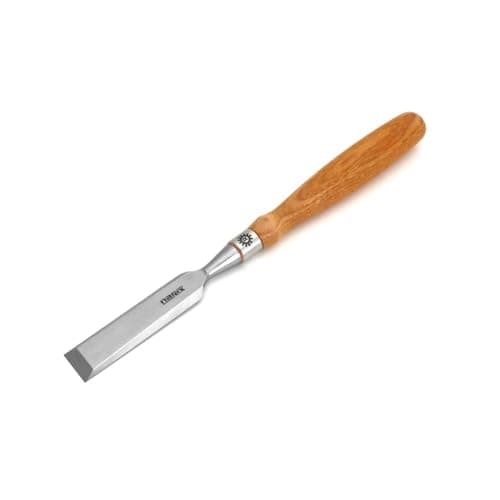
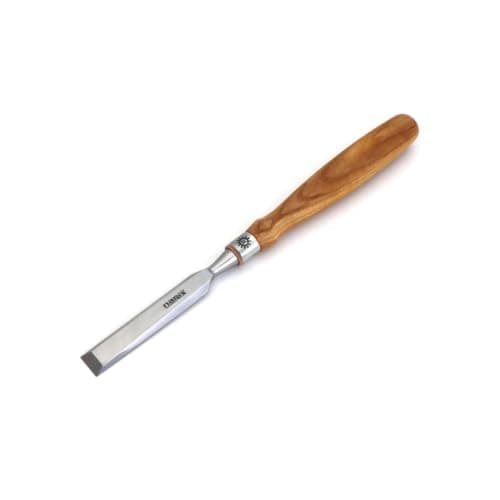
Narex's Richter grind on a long paring handle. Richter is the line where Narex publishes a cryogenically treated chrome-vanadium steel and a hardness above its standard chisels, and on a paring chisel edge retention is the entire argument: you are pushing by hand, with no mallet behind you, so a dull edge does not cut slower, it stops cutting and starts crushing.
The same Richter steel and long handle in a 1 in width, which is the one to own if you only own one. A wide paring chisel references itself across the cut: the extra width bridges the hollows a narrow blade follows, which is why a 1 in chisel leaves a flatter tenon cheek than a 1/2 in does in the same hands.
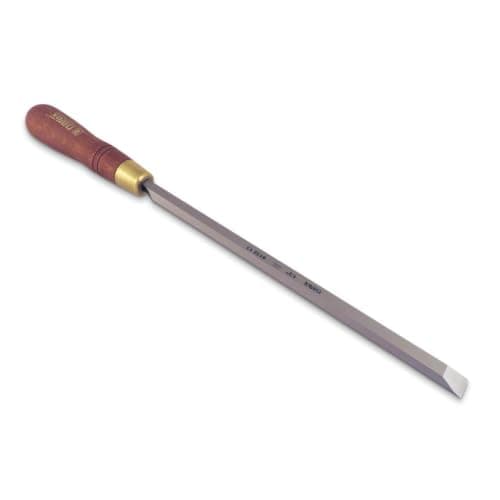
The same Cr-Mn steel at the same published 59 HRc as the Narex bench chisels, in a blade nearly two and a half times as long. Everything you are paying for here is geometry: a 245 mm blade in a 390 mm tool, ground at 25 degrees, on a hornbeam handle with a brass ferrule and a heavy seated tang.
The first paring chisel, once a bench chisel is no longer enough
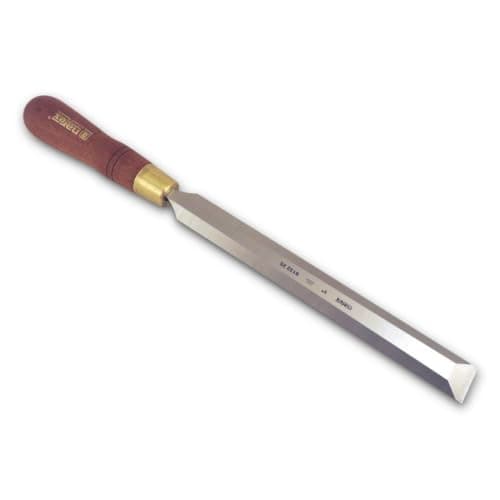
The same chisel one size up, and the width that actually earns a paring chisel its keep. A wide blade held flat on a surface is a straightedge with an edge on it, and that is the job a bench chisel is too short to do reliably.
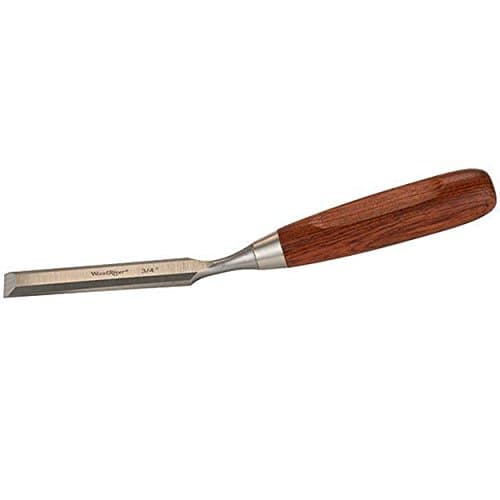
The cranked-neck variant, and the one geometry a straight chisel genuinely cannot copy: an 18 degree bent tang lifts your hand clear of the work so the blade can lie flat well inside a panel. Woodcraft publishes the bend angle and the length and nothing whatever about the steel.
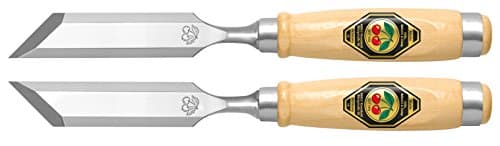
A left and right pair of 12 mm skew chisels from Hirsch's Two Cherries works in Remscheid. They exist for one problem a straight chisel genuinely cannot solve: the acute inside corner of a dovetail socket, where a square edge either misses the corner or bruises the opposite wall getting to it.
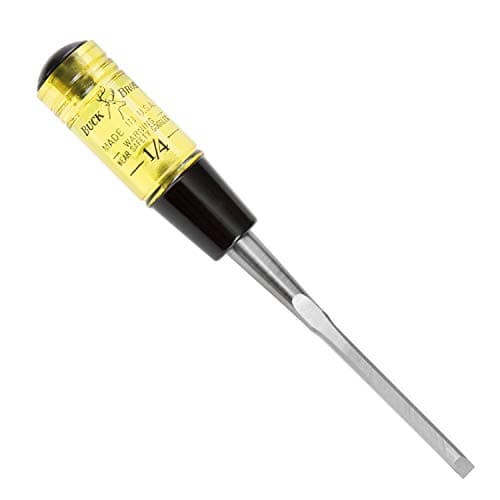
A tempered tool steel bench chisel, made in the USA, that Buck Brothers sells for paring and finishing cuts. Call it what it is: this is not a paring chisel — the blade is short and the handle is a mallet-safe bench handle — but it is honest steel at a price that makes the question of whether you need a dedicated paring chisel answerable for the cost of lunch.
Finding out whether you want a paring chisel at all
#ad· Live prices from the Amazon Product API, as of October 16, 2026. Where we have no verified live price we show none, and the cost-per-decade figure is suppressed with it — we would rather leave a gap than print a number that has rotted.
Buy the Narex Richter paring chisel in 1/2 in if you want the best paring edge available on Amazon, and the 1 in if you only intend to own one. Richter is Narex's premium line, where the steel is cryogenically treated chrome- vanadium published at a higher hardness than its standard chisels, and on a paring chisel that is not a nicety. If the Richter price is more than the job warrants, the Narex Premium paring chisel in 1/2 in is the same geometry in Narex's standard steel for meaningfully less, and it is the value pick on this page.
A paring chisel is defined by what you are forbidden from doing with it. You do not hit it. There is no mallet, no hoop, no shock. You put the heel of your hand or your shoulder behind a long handle and push, steering with the other hand on the blade, and you take a shaving off end grain or a tenon cheek or a dovetail baseline. Everything about the tool follows from that: the blade is long and thin so it can lie flat on a reference surface, the handle is long so your body can get behind it, and the bevel is ground shallower than a bench chisel's because nothing is going to drive it through anything.
It also means a dull paring chisel does not behave like a dull bench chisel. A blunt bench chisel cuts slower and you hit it harder. A blunt paring chisel stops cutting altogether and starts crushing fibers ahead of itself, leaving a surface that looks burnished and glues badly. Edge retention on a hand-pushed tool is therefore not about how often you sharpen — it is about whether the tool works at all for the last third of its sharpening interval.
What decides it, in the order that matters
We have not used any of these. We opened each maker's or retailer's own listing, wrote down only what is published, cited it below, and ranked on that — the method is on the methodology page.
1. Published steel and hardness. This is first because of the crushing problem above. Narex publishes its Premium paring chisels as fine-grained chrome-manganese steel hardened to 59 HRc, and its Richter line as cryogenically treated chrome-vanadium at a higher figure again. Those are real numbers you can compare. Against them, “tempered tool steel” and “durable hardened steel blade” — which is genuinely all two listings here publish — tell you nothing. Chisel steel explained covers what the grades mean and what the hardness numbers buy.
2. Blade length and handle length, which are the product. A paring chisel is a long blade on a long handle, and length is not cosmetic. The blade length determines how far into a cut you can reach while the blade still lies flat on the surface behind it, which is the only thing keeping the cut parallel. Narex publishes 245 mm of blade and 390 mm overall on its Premium paring chisels, which is the full traditional proportion. A bench chisel with a short blade and a mallet handle cannot be pushed the same way however sharp it is, and one entry on this page is exactly that, ranked last and labeled honestly.
3. How flat the back arrives. Nobody publishes this and it decides your first evening with the tool. A paring chisel registers on its back — flat on the wood, bevel up, sliding along the surface it is copying — so a back that is hollow or twisted means the edge is not where the blade says it is. Premium lines are ground closer to flat before shipping, which is a substantial part of what the money buys. How to flatten a chisel back is the job in question, and it is worth reading before you choose a price bracket.
4. Width, and how many you actually need. A wide paring chisel bridges hollows and leaves a flatter surface; a narrow one reaches into sockets a wide one cannot enter. Most people are well served by two — something around 1/2 in and something around 1 in — which is why both widths of both Narex lines appear here rather than a token single entry. How many chisels do you need makes the general case and it applies doubly to a specialist tool.
5. Geometry, for the cuts a straight chisel cannot make. Two entries here are not straight chisels and are on the page because of it. A bent or cranked-neck paring chisel lifts the handle clear of the work so the blade can lie flat in the middle of a wide panel, where a straight chisel's handle fouls the surface. A skewed pair reaches into the acute inside corner of a dovetail socket, where a square edge either misses the corner or marks the opposite wall getting there.
What the makers publish
Chisel
Steel as published
Geometry
Warranty
Narex Richter paring, 1/2 and 1 in
Cryogenically treated Cr-V, published hardness
Straight, long handle
None published by Narex
Narex Premium paring, 1/2 and 1 in
Chrome-manganese, 59 HRc
Straight, 245 mm blade, 390 mm overall
None published by Narex
KAKURI long-handle set, 3 piece
Laminated Japanese steel; grade not named
Oire nomi, long handle
None; returns only for wrong or damaged goods
WoodRiver bent paring, 3/4 in
“Durable hardened steel”; no grade, no hardness
18 degree bent tang, approx 10 in overall
None published
Two Cherries skew pair, 12 mm
Not published on this listing
Matched left and right skew
None published
Buck Brothers 1/4 in
“Tempered tool steel”; no grade, no hardness
Bench chisel, mallet-safe handle
None published
The warranty column is the honest headline of this page: not one maker here publishes a defect warranty of any length on a paring chisel. The lifetime guarantee often quoted for Narex chisels comes from a UK specialist retailer rather than from Narex, which is why we do not rate Narex at the top tier however good the tools are. On a monolithic edge tool that absence matters less than it would on a plane — there is no mechanism to fail and no part to consume, and the edge is renewable for as long as there is steel left. Warranties and repairability sets out when a missing warranty is a real risk and when it is noise.
Sharpening angle, and the one number that is a trap
Paring chisels are ground shallower than bench chisels — commonly 20 degrees against 25 or 30 — because a lower included angle slices end grain with less force, and no mallet blow is coming to damage the thin edge. That is the correct advice and it is also where people ruin good chisels.
The trap is grinding a bench chisel down to a paring angle and then using it as a bench chisel. A 20 degree edge in hard maple under a mallet chips, and once chipped it has to come all the way back. If you own one set and use it for everything, leave it at 25 and accept slightly more effort on end grain. A dedicated paring chisel can go to 20 precisely because it is never doing anything else. Sharpening angles explained has the full range, and microbevels explained covers the compromise that lets you have both.
What is not on this page
Lie-Nielsen and Veritas paring chisels. Both makers sell direct rather than through Amazon, so we earn nothing on either and cannot route a tracked link to them. Veritas publishes PM-V11 at Rc61-63 on its bench chisels and Lie-Nielsen publishes A2 at Rockwell 60-62 with a guarantee covering materials and workmanship for the life of the tool, which is better documentation than anything on this page has. Chisel brands compared covers how the makers line up.
Japanese usunomi, properly speaking. A true Japanese paring chisel is a long thin laminated blade with no hoop, and the ones worth owning come from named smiths and sell through specialist dealers rather than Amazon. The KAKURI long-handle set on this page is the closest honest substitute available with a tracked link: oire nomi blades on long handles, which is paring-adjacent rather than the real thing. The best Japanese chisels covers that side of the market, and Japanese vs western chisels explains why the hoop matters.
Chisel sets sold as “paring and finishing.” A good deal of what is marketed for paring is a bench chisel with the word printed on the box. We have included exactly one, the Buck Brothers, and ranked it last with its geometry named plainly in its cons, because at its price it is a legitimate way to find out whether you want the real tool.
Every pick, in full
The write-ups
01The best paring edge you can buy on Amazon today
Width
1/2 in
Line
Richter — cryogenically treated Cr-V
Handle
Long paring handle
Blade length
Not published on this listing
Warranty
None published by Narex
Narex Richter Paring Chisel, 1/2 in
Narex
8.1/10
Narex's Richter grind on a long paring handle. Richter is the line where Narex publishes a cryogenically treated chrome-vanadium steel and a hardness above its standard chisels, and on a paring chisel edge retention is the entire argument: you are pushing by hand, with no mallet behind you, so a dull edge does not cut slower, it stops cutting and starts crushing.
Cost per decade
$29.84
Horizon · tier C
20 years — No lifetime warranty; parts purchasable and resharpenable
A UK specialist retailer states a lifetime guarantee on Narex chisels; we could not find published warranty terms from Narex itself, so we do not rate it tier A. Unhandled blade blanks are sold separately, and the tool is resharpenable indefinitely.
Rebuy risk
Medium
parts listed, resharpenable
Steel & edge
9.0
Back flatness
8.5
Handle
9.0
Sizes covered
6.5
Value
7.5
What it gets right
+Richter steel is cryogenically treated and published at a higher hardness than Narex's standard chisels, which on a hand-pushed edge is the figure that matters
+A long handle is not a styling choice: it puts your shoulder behind the cut and lets you steer with two hands
+Narex grinds the Richter line's backs closer to flat than its cheaper chisels, so the lapping session before first use is shorter
+Narex sells unhandled Richter blade blanks, so the blade and the handle are independently replaceable
What it costs you
−Narex publishes no warranty of any length; the lifetime guarantee quoted for these chisels comes from a UK specialist retailer, not the maker
−Sold individually at a price where some makers sell sets, so a working range of widths is a real outlay
−No blade length or overall length published on this listing
−Stock was in single digits at the date checked
Skip this if…
…you intend to hit it. A paring chisel is pushed, never struck, and a mallet blow on a long thin blade bedded in a long handle is how the tang levers out.
The same Richter steel and long handle in a 1 in width, which is the one to own if you only own one. A wide paring chisel references itself across the cut: the extra width bridges the hollows a narrow blade follows, which is why a 1 in chisel leaves a flatter tenon cheek than a 1/2 in does in the same hands.
Cost per decade
$33.45
Horizon · tier C
20 years — No lifetime warranty; parts purchasable and resharpenable
A UK specialist retailer states a lifetime guarantee on Narex chisels; we could not find published warranty terms from Narex itself, so we do not rate it tier A. Unhandled blade blanks are sold separately, and the tool is resharpenable indefinitely.
Rebuy risk
Medium
parts listed, resharpenable
Steel & edge
9.0
Back flatness
8.0
Handle
9.0
Sizes covered
6.5
Value
7.0
What it gets right
+A 1 in edge spans and flattens where a narrow one follows the surface it finds
+Same cryogenically treated Richter steel as the 1/2 in, so the edge retention argument holds
+Unhandled Richter blanks are sold separately, which makes the handle a repairable part
+The single most useful paring width for tenons, housings and glue squeeze-out
What it costs you
−A wide blade is harder to register in a narrow space; it cannot get into a 3/8 in dovetail socket
−No published warranty from Narex
−More expensive than the 1/2 in for the same steel, which is simply what wide blades cost
−Needs a wide, flat stone to lap and hone, and a narrow pocket stone will dub the corners
Skip this if…
…your work is small-scale joinery and dovetails. Buy the 1/2 in, or narrower, and do not fight the width.
03The first paring chisel, once a bench chisel is no longer enough
Steel
Chrome-manganese, 59 HRc (maker)
Blade
245 mm (9-1/2 in) long, 1/2 in wide
Overall
390 mm (15-1/4 in)
Handle
Stained European hornbeam, brass ferrule, heavy steel tang
Bevel
Ground at 25 degrees
Narex Premium Paring Chisel, 1/2 in
Narex
7.8/10
The same Cr-Mn steel at the same published 59 HRc as the Narex bench chisels, in a blade nearly two and a half times as long. Everything you are paying for here is geometry: a 245 mm blade in a 390 mm tool, ground at 25 degrees, on a hornbeam handle with a brass ferrule and a heavy seated tang.
Cost per decade
$25.84
Horizon · tier C
20 years — No lifetime warranty; parts purchasable and resharpenable
A UK specialist retailer states a lifetime guarantee on Narex chisels; we could not find published warranty terms from Narex itself, so we do not rate it tier A. Unhandled blade blanks are sold separately, and the tool is resharpenable indefinitely.
Rebuy risk
Medium
parts listed, resharpenable
Steel & edge
8.0
Back flatness
8.0
Handle
8.5
Sizes covered
6.5
Value
8.0
What it gets right
+Published steel, published hardness and published dimensions, which is more than most of this category discloses
+1/2 in is the width that does most fitting work, so it is the right single chisel to start with
+The 245 mm blade is what registration is actually for — length is the feature, not a styling choice
+Brass ferrule and a heavy seated tang, the two places a long-handled chisel fails first
What it costs you
−Narex publishes no warranty terms we could find, so it cannot rate tier A
−It must never be struck, and a hornbeam handle with no hoop makes that obvious in the worst way
−The long blade is more steel to keep dead flat on the stone than a bench chisel back
−At 59 HRc it holds an edge respectably rather than exceptionally, and a low bevel dulls faster
Skip this if…
…you do not already own sharp bench chisels. A paring chisel is a third or fourth purchase, and a dull bench chisel is the problem it will not solve.
04Paring, where the extra handle length does the work
Set
3 pieces
Handle
Long pattern
Construction
Laminated
Origin
Listing states Made in Japan
KAKURI Japanese Chisel Set, 3 Piece Long Handle
KAKURI
8.1/10
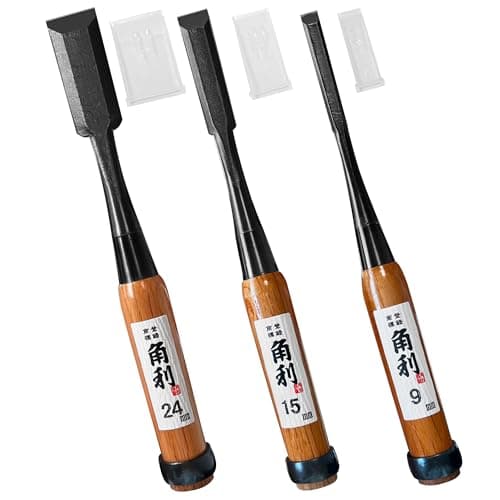
The same laminated construction with a longer handle, which changes what the tool is for: controlled two-handed paring rather than mallet work.
Cost per decade
$33.90
Horizon · tier C
20 years — No lifetime warranty; parts purchasable and resharpenable
No warranty terms published for the US market at the date checked. A laminated hagane-over-jigane edge is renewable by sharpening until the hard layer runs out, which on a full-size chisel or plane iron is a working lifetime.
Rebuy risk
Medium
parts listed, resharpenable
Steel & edge
9.0
Back flatness
9.0
Handle
8.5
Sizes covered
6.5
Value
7.5
What it gets right
+Length gives genuine two-handed control for paring
+Same laminated edge quality as the standard set
+Reaches into joints a short chisel cannot
What it costs you
−Longer handle is worse for accurate mallet chopping
−Costs more than the standard set for a narrower use case
−Three sizes
Skip this if…
…this is your only Japanese set. Buy the standard-length one first; it is the more general tool.
Stained European hornbeam, brass ferrule, heavy steel tang
Bevel
Ground at 25 degrees
Narex Premium Paring Chisel, 1 in
Narex
7.6/10
The same chisel one size up, and the width that actually earns a paring chisel its keep. A wide blade held flat on a surface is a straightedge with an edge on it, and that is the job a bench chisel is too short to do reliably.
Cost per decade
$27.34
Horizon · tier C
20 years — No lifetime warranty; parts purchasable and resharpenable
A UK specialist retailer states a lifetime guarantee on Narex chisels; we could not find published warranty terms from Narex itself, so we do not rate it tier A. Unhandled blade blanks are sold separately, and the tool is resharpenable indefinitely.
Rebuy risk
Medium
parts listed, resharpenable
Steel & edge
8.0
Back flatness
7.5
Handle
8.5
Sizes covered
6.5
Value
7.5
What it gets right
+Width plus length is what lets the blade reference off the surface instead of digging into it
+The right chisel for tenon cheeks, half-lap floors and trimming plugs flush
+Same published steel and hardness as the Narex bench chisels, so the comparison is geometry alone
+Sold as a single, so you can own the two widths that matter without buying a five-piece set
What it costs you
−A 1 in back is a genuinely long lapping session before the first use
−Too wide for most dovetail and small frame work, so it does not replace a bench chisel
−No published warranty terms from Narex
−Never struck means never — the temptation with a wide blade in hardwood is real
Skip this if…
…your fitting work is small-scale joinery. At this width the chisel is a surfacing tool, and a 1/2 in paring chisel will feel more useful more often.
'Durable hardened steel'; grade and hardness not published
Handle
Hardwood
WoodRiver Bent Paring Chisel, 3/4 in
WoodRiver
6.6/10
The cranked-neck variant, and the one geometry a straight chisel genuinely cannot copy: an 18 degree bent tang lifts your hand clear of the work so the blade can lie flat well inside a panel. Woodcraft publishes the bend angle and the length and nothing whatever about the steel.
Cost per decade
$24.99
Horizon · tier C
20 years — No lifetime warranty; parts purchasable and resharpenable
No lifetime warranty published by the manufacturer at the date checked. Monolithic edge tool: no separately consumable part, and the edge is renewable by sharpening for as long as there is steel left.
Rebuy risk
Medium
parts listed, resharpenable
Steel & edge
6.0
Back flatness
6.5
Handle
7.0
Sizes covered
6.0
Value
7.5
What it gets right
+The bent tang does something no straight chisel can: keeps knuckles off the board while the blade stays flat
+3/4 in is a sensible single width for trimming plugs, dogs and proud tenons flush
+Shorter and cheaper than a full-length paring chisel, so it is a smaller commitment to the idea
+Nothing on it is consumable — resharpenable until the steel runs out
What it costs you
−Neither the steel grade nor the hardness is published, so edge life is unknowable in advance
−At about 10 in it is far shorter than a true paring chisel, which costs you registration
−Blade length and bevel angle are not published either
−No warranty terms published
Skip this if…
…what you actually need is length. A cranked neck solves clearance, not registration, and for truing a long tenon cheek a straight 15 in chisel is the better tool.
07The corners a straight paring chisel cannot reach
Width
12 mm
Supplied as
Matched left-hand and right-hand pair
Maker
Two Cherries (Hirsch), Germany
Grind
Skewed bevel edge
Warranty
None published
Two Cherries Skew Bevel Chisels, Pair of 12mm
Two Cherries
7.1/10
A left and right pair of 12 mm skew chisels from Hirsch's Two Cherries works in Remscheid. They exist for one problem a straight chisel genuinely cannot solve: the acute inside corner of a dovetail socket, where a square edge either misses the corner or bruises the opposite wall getting to it.
Cost per decade
$43.50
Horizon · tier C
20 years — No lifetime warranty; parts purchasable and resharpenable
No lifetime warranty published by the manufacturer at the date checked. Monolithic edge tool: no separately consumable part, and the edge is renewable by sharpening for as long as there is steel left.
Rebuy risk
Medium
parts listed, resharpenable
Steel & edge
9.0
Back flatness
8.5
Handle
8.0
Sizes covered
4.0
Value
6.0
What it gets right
+A skewed edge reaches into an acute corner without the opposite bevel touching the far wall, which is the one cut a square chisel cannot make cleanly
+Sold as a matched pair, so both corners of a socket are covered
+Two Cherries' steel and back flatness are among the best in the Western chisel market and arrive genuinely usable
+Specialist geometry that stays useful for a lifetime because nothing else substitutes for it
What it costs you
−A specialist tool, not a first chisel — if you do not cut hand dovetails this will sit in the drawer
−No warranty of any length published
−Expensive for 12 mm of steel, because you are buying two chisels
−Skewed edges are fiddly to hone freehand and most honing guides will not hold the angle
Skip this if…
…you clean your dovetail corners with a knife and are happy with the result. That works, and it is free.
08Finding out whether you want a paring chisel at all
Width
1/4 in
Blade
Tempered tool steel
Handle
Mallet-safe
Made in
USA
Warranty
None published
Buck Brothers 1/4 in Wood Chisel, Made in USA
Buck Brothers
6.2/10
A tempered tool steel bench chisel, made in the USA, that Buck Brothers sells for paring and finishing cuts. Call it what it is: this is not a paring chisel — the blade is short and the handle is a mallet-safe bench handle — but it is honest steel at a price that makes the question of whether you need a dedicated paring chisel answerable for the cost of lunch.
Cost per decade
$5.18
Horizon · tier C
20 years — No lifetime warranty; parts purchasable and resharpenable
No lifetime warranty published by the manufacturer at the date checked. Monolithic edge tool: no separately consumable part, and the edge is renewable by sharpening for as long as there is steel left.
Rebuy risk
Medium
parts listed, resharpenable
Steel & edge
6.0
Back flatness
5.5
Handle
6.0
Sizes covered
4.5
Value
9.0
What it gets right
+Made in the USA at a price where nothing else on this page is made anywhere in particular
+Mallet-safe handle means it will survive being used as a bench chisel when the paring job turns into a chopping job
+1/4 in reaches into dovetail sockets and small housings that the wide chisels above cannot
+Cheap enough to regrind into a skew or a fishtail without feeling bad about it
What it costs you
−Short blade and a bench handle: you cannot get your shoulder behind the cut the way a long paring chisel allows
−No steel grade or hardness published, only 'tempered tool steel'
−Expect to lap the back and hone the edge before it will pare end grain
−No warranty published
Skip this if…
…you already know you want to pare. Buy the long-handled chisel; the geometry is the product and this does not have it.
One paring chisel, and you want the best edge: the Narex Richter in 1 in. Cryogenically treated steel at a published hardness above Narex's standard line, a long handle you can get your shoulder behind, and a width that bridges and flattens rather than following the surface it finds.
Dovetails and small joinery: the Narex Richter in 1/2 in. The 1 in blade cannot enter a narrow socket; this one can, with the same steel behind it. If you cut a lot of dovetails, the Two Cherries skew pair is the specialist addition that solves the corners neither straight width reaches.
The value pick: the Narex Premium in 1/2 in. Same 245 mm blade and 390 mm overall proportion, same hornbeam handle and brass ferrule, in chrome-manganese at a published 59 HRc instead of the Richter steel. You will sharpen it a little more often and you will not notice anything else.
Wide panels and housings in the middle of a board: the WoodRiver bent paring chisel. The 18 degree bent tang is the only thing on this page that lifts your knuckles clear of the work, which is the difference between paring the middle of a panel and not. Its steel is undocumented, which is why it is not higher.
You want the Japanese route: the KAKURI three-piece long-handle set. A laminated hard-steel edge on soft iron takes and holds a keener edge than any Western chisel here, and KAKURI publishes nothing about the grade and no warranty at all. Both halves of that are true at once.
You are not sure you need one: the Buck Brothers 1/4 in, made in the USA. It is a bench chisel and we have said so. For the price of lunch it answers the question, and it is cheap enough to regrind into a skew later.
Using one, which is a different skill from chopping
Two hands, always, and neither of them hitting anything. Dominant hand on the handle driving from the shoulder, other hand pinching the blade near the edge to steer and to brake. The steering hand is what makes the cut accurate; the pushing hand just supplies force.
Register the back on the surface you are copying. The whole point of a long flat blade is that it cannot cut deeper than the plane of its own back. Lay the back on the reference surface and the tool guides itself — lift it and you are freehand carving.
Pare across or at a skew, not straight into end grain. A slicing cut at an angle to the fibers takes far less force than a square push and leaves a cleaner surface. On a tenon cheek, work from the edges toward the middle.
Never, ever hit it. A long thin blade in a long handle is a lever, and the tang is the fulcrum. A mallet blow is how paring chisel handles split and tangs work loose. If the cut needs a mallet, you want a bench chisel — paring chisel vs bench chisel is the full version of that line.
Stop before the edge dulls, not after. The moment a paring chisel starts needing force is the moment to hone it. Thirty seconds on a fine stone restores it; pushing on through gets you a burnished surface and a longer job at the stone later. How to sharpen a chisel has the routine.
Cost per decade on a tool with nothing to consume
A paring chisel is the easiest tool on this site to own for a lifetime, and the arithmetic is boring in the best way. There is no mechanism, no fastener, no replaceable part and no consumable — there is a piece of steel and a stick. Sharpening removes a few thousandths of an inch per session, which on a 245 mm blade is decades of regular work before length becomes an issue, and the handle is a shaped piece of hardwood that anybody can replace with a scrap and a lathe.
That is why the missing warranties on this page do not move the ratings much. A warranty protects you against a defect in a mechanism; these tools have no mechanism. The real risks are a soft or badly hardened blade that will not hold an edge — which is exactly what the published hardness figures let you screen for — and rust, which is on you. Cost per decade has the full method, and on this category it comes out favoring the dearer chisels: the price difference between the Richter and the undocumented blades is recovered within a decade on sharpening time alone.
Questions
Frequently asked
What is a paring chisel used for?+
Shaving small, controlled amounts off a surface by hand, with no mallet involved. The standard jobs are leveling a tenon cheek so the shoulders seat, cleaning a dovetail baseline, trimming a hinge mortise to depth and taking glue squeeze-out off an inside corner. The long flat blade lies on the surface you already have and copies it, which is what makes the cut parallel rather than merely close.
Can I hit a paring chisel with a mallet?+
No, and this is the one hard rule in the category. The blade is long and thin, the handle is long, and the tang is the fulcrum between them — a mallet blow levers the tang against the handle and splits it or works it loose. Paring chisel handles are not hooped or fitted for impact. If the cut needs force, it needs a bench or mortise chisel instead.
What angle should I sharpen a paring chisel to?+
Around 20 degrees is the traditional figure, against 25 to 30 for a bench chisel. The lower included angle slices end grain with less force, and because the tool is never struck, the thinner edge survives. The caution is that a 20 degree edge will chip if the chisel is ever used with a mallet, so only grind that shallow on a chisel dedicated to paring.
Do I need a bent or cranked-neck paring chisel?+
Only if you pare in the middle of wide surfaces. On a straight chisel the handle sits in line with the blade, so when the blade lies flat on a panel your knuckles are on the panel too and the blade lifts. A bent neck raises the handle clear and lets the blade stay flat anywhere on the work. For tenons, dovetails and anything near an edge, a straight chisel is fine and more versatile.
How many paring chisels do I need?+
Two covers nearly everything: something around 1/2 in for joinery and sockets, and something around 1 in for cheeks and wide surfaces. A wide blade bridges hollows and leaves a flatter result, a narrow one goes where the wide one cannot, and the sizes between them are convenience rather than capability. Add a skew pair only if you cut hand dovetails often enough to be annoyed by the corners.
Are expensive paring chisels worth it?+
On this tool, more than on most. You are buying two things that are hard to fix yourself: a blade hard enough to keep slicing at the end of its sharpening interval, and a back ground close enough to flat that your first evening is not spent lapping. Both are genuinely better on the premium lines, and both save time every single session. What you are not buying is a warranty — nobody on this page publishes one.
We have not handled these tools. Nobody here has tested one, owned one, or taken one apart. Specifications come from the manufacturer or the retailer listing; warranty terms come from the maker's own warranty page; the cost-per-decade arithmetic is ours and reproducible. Where we could not verify a figure we say so on the page rather than quietly leaving it out. Read the full method.