Sharpening
Stropping Explained
The thirty-second step that takes an edge from sharp to keen, removes the last burr, and roughly doubles how long you go between stones.
We earn a commission when you buy through our Amazon links, at no extra cost to you. It never decides a ranking, and where the best tool in a class is one we earn nothing on, we say so and link it anyway. How this works.
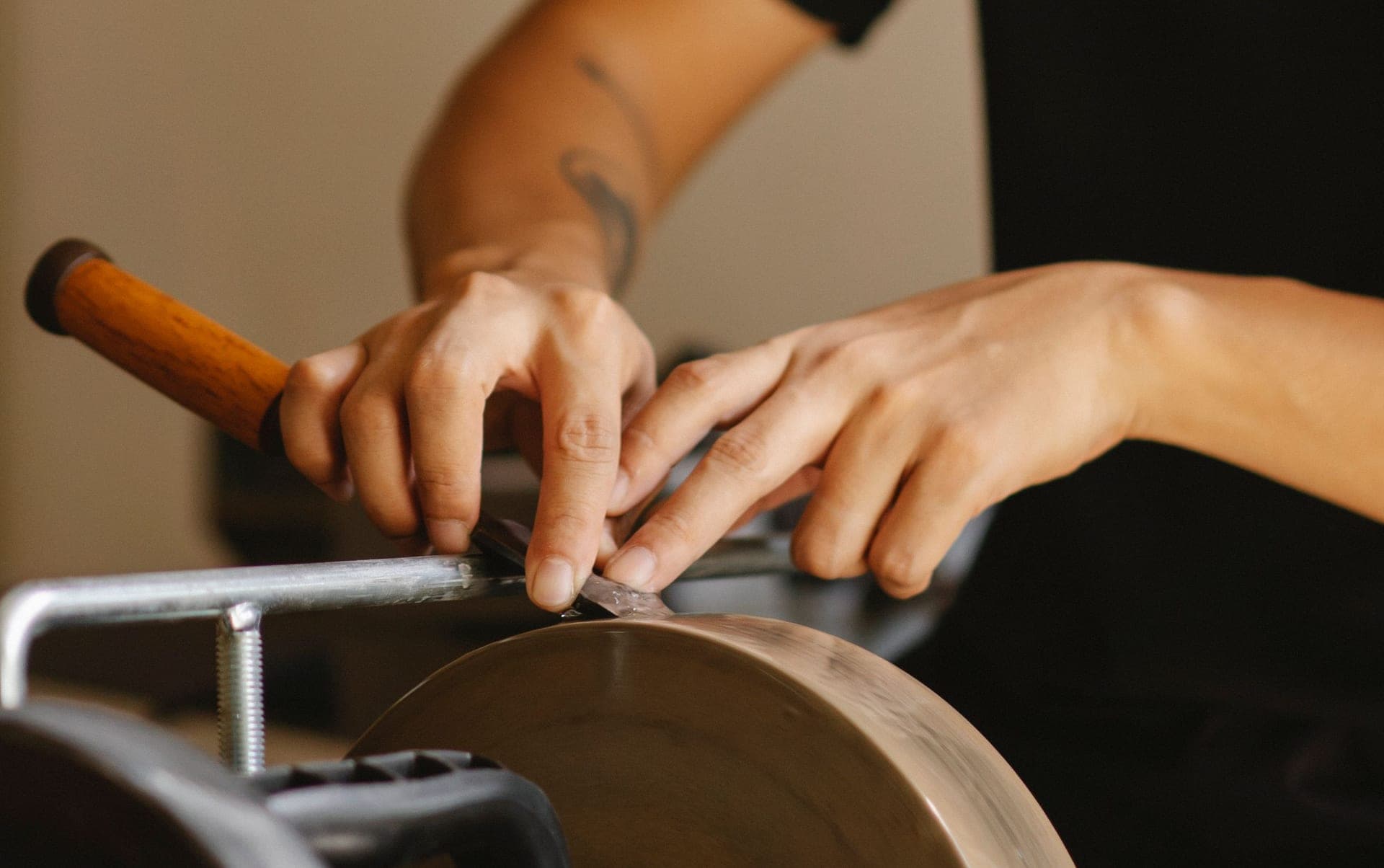
A strop is the highest-value item in the whole sharpening kit per dollar spent, and it is the one most beginners leave out. It does two distinct jobs, it takes thirty seconds, and once you add it to your routine you will reach for the stones far less often.
What stropping actually does
Stropping does two things, and it helps to keep them separate in your head.
It removes the burr.When you sharpen on a stone, the metal at the very edge folds over into a fine wire — the burr, or wire edge — that hangs off the back of the bevel. A tool with a burr feels sharp and dulls almost immediately, because the wire breaks off in use and takes the edge with it. A few strokes on a strop tear that burr away cleanly and leave the actual edge behind.
It refines the edge. Charged with a fine compound, a strop is simply a very fine sharpening surface. It polishes the last few microns of the bevel to a keenness beyond what most finishing stones reach, and it does so quickly because it is only touching the very apex. This is why a diamond plate plus a strop closes most of the polish gap with a fine waterstone.
Leather, MDF or bare
The strop is just a carrier for compound, and the material changes how the edge behaves.
Leather.The traditional and most common choice. It has a slight give, which conforms to the bevel and makes it forgiving to use, and it holds compound well. That same give is also the source of the main risk — more on that below. Use the smooth (grain) side for the finest finish, or the rough (flesh) side, which holds more compound and cuts a little faster.
MDF or hardwood. A hard, flat board charged with compound. Because it does not compress, it cannot round the edge over the way leather can, so it maintains a crisper, flatter bevel. Many people who chase precision prefer a hard strop for exactly this reason. It is less forgiving of a sloppy angle but truer when you get the angle right.
Bare leather.With no compound at all, a strop still does useful work — it aligns and deburrs the edge by friction alone, the way a barber's strop maintains a razor. It will not refine like a charged strop, but for a quick touch-up between cuts it keeps an edge honest.
Honing compound grades
Compound is abrasive suspended in a wax or grease stick that you rub onto the strop. The color is a rough guide to the abrasive and its fineness, though brands vary, so treat this as orientation rather than a standard.
| Compound | Typical color | Character |
|---|---|---|
| Chromium oxide | Green | Very fine, the default for a final polish on woodworking edges |
| Aluminum oxide | White | Fine, a touch more cutting than green |
| Emery / coarse | Black or gray | Faster cutting, for removing more metal before a fine stage |
| Diamond paste | Various | Available very fine; cuts hard modern steels a green stick struggles with |
For almost everyone, a green chromium-oxide stick on leather is all the strop compound they will ever need. It is a few dollars, it lasts years, and the strop does effectively nothing without it. If you work harder modern steels, a fine diamond paste is worth the upgrade.
The trailing stroke
There is one rule that must not be broken: you always strop with a trailing stroke, dragging the edge backwards, spine-first, away from the direction it would cut.
The reason is simple and unforgiving. A strop — leather especially — has some give. If you pushed the edge forward into a compressible surface, the edge would dig in, and at best it would round the apex over and at worst it would slice the strop and ruin the edge. Dragging the edge backwards means the trailing bevel rides along the surface and only the compound acts on the apex. Lay the whole bevel flat on the strop, keep the angle steady, and pull. Lift, return, repeat. A handful of light strokes per side is plenty; stropping is a refinement, not a grinding operation.
The rounding-over risk
This is the one real hazard, and it is worth understanding so you can avoid it. Because leather compresses under the blade, the surface bulges up slightly around the bevel. If you lift the handle even a little, or press too hard, that compressed leather wraps around the very edge and polishes it into a tiny convex curve. Do it session after session and you have quietly rounded the edge over — it feels dull, and no amount of further stropping fixes it, because stropping is what caused it.
Three defenses. Keep the bevel flat on the strop and resist the urge to lift the handle. Use light pressure — the compound does the work, not force. And if precision matters to you, use a hard strop (MDF or wood), which cannot compress and therefore cannot round the edge. Whichever you use, go back to the stone when the strop stops restoring the edge; stropping maintains an edge, it does not create one from a dull tool. The angle you established on the stone is the one the strop should preserve, which is why sharpening angles explained and the strop go hand in hand.
Keeping an edge between sharpenings
This is the payoff and the reason a strop earns its keep. An edge does not go from sharp to dull in one step. It first loses its keenest apex — the wire-thin final edge folds and wears — long before the bevel itself needs regrinding. A few strop strokes realign and refresh that apex in seconds, and if you strop little and often you can go far longer before the tool needs a stone at all. In practice, regular stropping roughly doubles the interval between full sharpenings.
The habit that works: keep a charged strop on the bench, right next to where you work, and give the tool a few strokes whenever the cut starts to feel less crisp. It is faster than walking to the stones and it keeps the tool at its best continuously. It pays off most on plane irons, which dull steadily in continuous contact with the wood — how to sharpen a plane iron covers where a strop fits into that cycle. And because a strop mainly refreshes a small secondary bevel, it pairs naturally with microbevels, where that small polished facet is the only part you ever touch up.
Questions
Frequently asked
What does stropping do?
Two things: it tears away the burr, or wire edge, left by sharpening, and, when charged with compound, it polishes the very apex of the edge to a keenness beyond most finishing stones. It refines a sharp edge and helps maintain it between sharpenings.
Which way do you strop a blade?
Always with a trailing stroke — drag the edge backwards, spine-first, away from the cutting direction. Pushing the edge forward into the strop digs it in and can round or slice the edge. Keep the bevel flat, use light pressure, and pull.
Do I need honing compound on a strop?
For refining, yes — a bare strop only aligns and deburrs; the compound does the polishing. A green chromium-oxide stick on leather suits almost every woodworking edge, lasts years and costs a few dollars. Harder modern steels benefit from a fine diamond paste.
Can stropping make a blade duller?
Yes, if you round the edge over. Leather compresses, so lifting the handle or pressing hard wraps it around the apex and polishes a convex curve onto it. Keep the bevel flat, press lightly, or use a hard MDF strop that cannot compress.
How often should I strop?
Little and often. A few strokes whenever the cut starts feeling less crisp keeps the tool at its best and roughly doubles how long you go before needing a stone. Return to the stone once stropping no longer restores the edge.
Keep reading
Related
Back to Sharpening · how we pick · editorial policy