Sharpening
Sharpening Angles Explained
One number, one trade: keenness against durability. Here are the values that matter and the one case where the angle changes what the tool does.
We earn a commission when you buy through our Amazon links, at no extra cost to you. It never decides a ranking, and where the best tool in a class is one we earn nothing on, we say so and link it anyway. How this works.
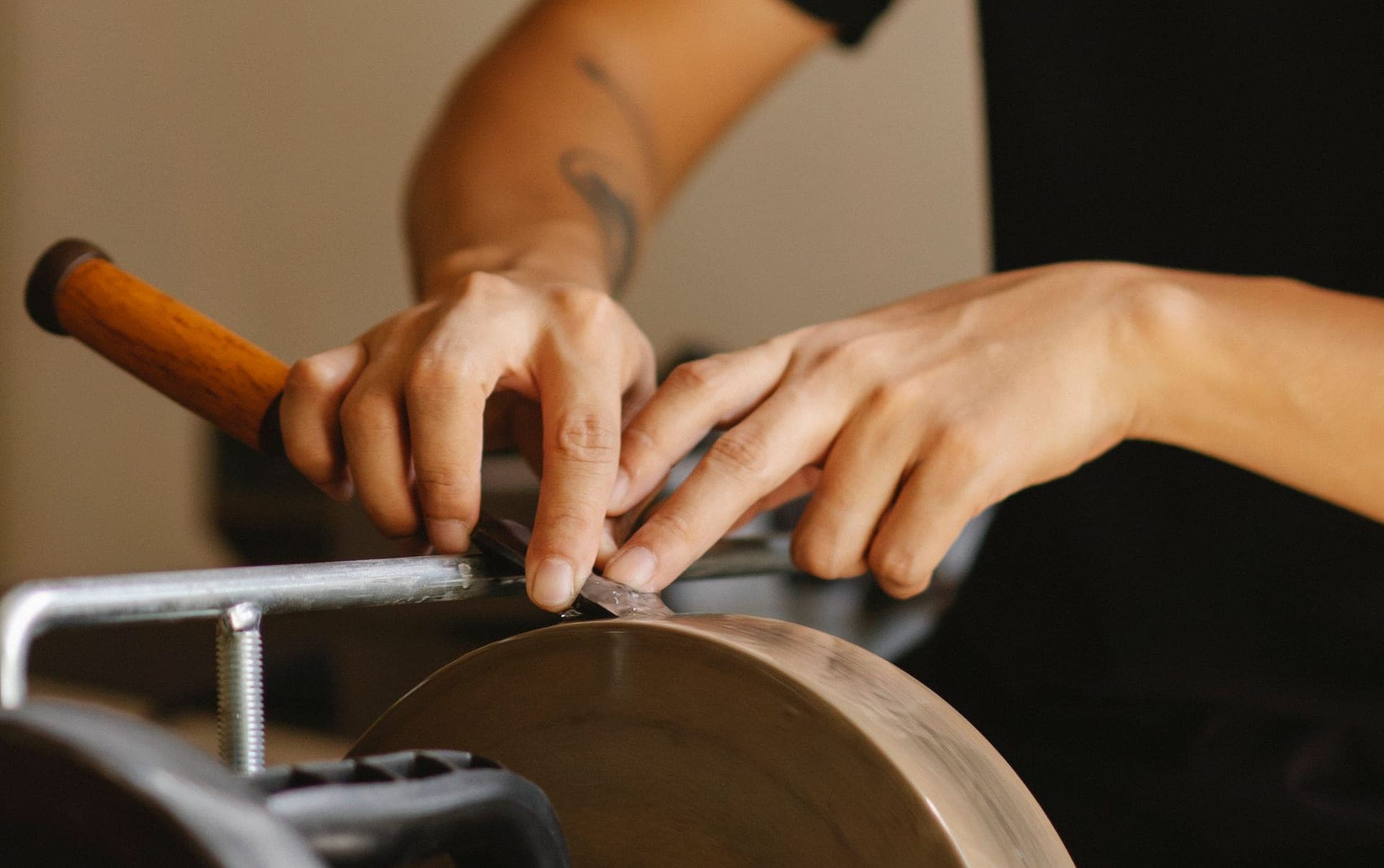
Bevel angle is one number with one trade behind it, and once you understand the trade all the recommended values make sense rather than needing to be memorized.
The trade
A shallower angle is keener and weaker. Less steel behind the cutting edge means it slices with less resistance, and it also means less material supporting the edge, so it dulls or chips sooner.
A steeper angle is more durable and less keen. More steel behind the edge supports it under load, at the cost of requiring more force to cut.
That is the whole thing. Every recommended angle below is a point chosen on that line for a particular job.
The numbers
| Tool and use | Bevel | Why |
|---|---|---|
| Paring chisel, softwood only | 20° | Maximum keenness, never struck, so durability matters less |
| Bench chisel, general | 25° | The sensible default for almost everything |
| Bench chisel, hardwood chopping | 30° | Enough support that the edge does not chip under a mallet |
| Mortise chisel | 30–35° | Heavy levering loads need a strong edge more than a keen one |
| Bevel-down plane iron | 25° | Bed angle sets the cut; bevel only affects durability |
| Bevel-up plane, end grain | 25° | 12° bed + 25° = 37° cut. Low attack slices end grain |
| Bevel-up plane, general | 33° | 12 + 33 = 45°, identical to a standard bench plane |
| Bevel-up plane, figured grain | 38–50° | Raises the cutting angle to resist tearout |
The chisel angle chart
The table above mixes chisels and plane irons because the underlying trade is the same. If you came here for chisels specifically, this is the same information sorted by chisel type, with the grind the makers themselves publish in the last column so you can see how much of this is convention and how much is documented.
| Chisel type and work | Primary grind | Honed / secondary | What the makers publish |
|---|---|---|---|
| Paring chisel, hand-pushed only | 25° | 20–25°, no steeper | Narex grinds its Premium paring chisels at 25° |
| Bench chisel, general joinery | 25° | 25–30° | Narex and Jorgensen both publish a 25° factory grind |
| Bench chisel, chopping hardwood | 25° | 30° microbevel | Not published; this is the standard remedy for a chipping edge |
| Dovetail chisel, softwood | 25° | 25° | Not published; keenness beats durability on thin lands |
| Mortise chisel, general | 25° | 30° | Not published as a figure by most makers |
| Mortise chisel, hardwood or 62 HRc steel | 25° | 30–35° | Narex recommends a 30–35° secondary on its Richter line in hard wood |
| Firmer chisel, carpentry and rough work | 25° | 30° | Not published; square lands already favor strength over access |
Two things are worth noticing in that last column. The first is that the primary grind is 25 degrees on essentially everything, which is why almost no maker bothers to vary it: the factory grind is a starting point and the working angle is the one you hone. The second is that the only maker-published deviation on the whole chart is upward, for hard steel doing violent work — nobody publishes a recommendation to go shallower, because a shallower edge is a choice you make about your own wood and your own tolerance for resharpening.
If you are choosing between the chisel families rather than sharpening one you already own, chisel types compared covers what each is for, and paring chisel versus bench chisel covers why the paring row in that table is the only one that goes below 25 degrees.
Why the chisel numbers cluster where they do
A chisel edge fails in one of two ways and the angle decides which. Below roughly 25 degrees the edge is thin enough that a mallet blow into hardwood can fracture the very apex, taking a crescent out of an otherwise sharp edge. Above roughly 35 degrees the edge is strong enough for anything but needs enough force to push that it stops tracking a knife line accurately — it starts to wedge rather than slice, and the cut wanders.
Everything usable therefore lives in a ten-degree band, and the whole craft argument is about where inside that band a particular tool should sit. That is also why the tolerances are wide: 27 degrees and 25 degrees are the same edge in practice, and the difference between a chisel that works and one that does not is almost never two degrees. It is whether the back is flat and whether you actually finished the honing.
Hardness interacts with this. A harder chisel holds an edge longer and is more brittle at the apex, which is precisely why the one published recommendation to go steeper attaches to a 62 HRc chisel rather than a 59 HRc one. What the hardness numbers mean is on chisel steel explained.
The one case where the angle changes what the tool does
On a bevel-downbench plane, the iron beds bevel-down and the flat back faces the wood. The cutting angle is the bed angle — usually 45 degrees — regardless of what you grind. The bevel angle affects only edge durability.
On a bevel-up plane, the bevel faces the wood, so the cutting angle is the bed angle plus the bevel angle. Grinding at 25 rather than 33 does not make the edge more fragile in a minor way; it makes the plane behave like a fundamentally different plane.
This is why a honing guide matters far more on bevel-up planes, and it is the mechanism behind the three-irons-one-plane system on bevel up versus bevel down.
Micro-bevels
Grind a primary bevel at 25 degrees, then add a tiny secondary bevel at 30 by tipping the guide a couple of degrees for the last few strokes on your finest stone.
The benefit is time. Subsequent sharpenings only touch that small secondary bevel, so a resharpen takes under a minute instead of several. You get the durability of a 30-degree edge and the sharpening speed of a much smaller surface. Regrind the full primary only when the micro-bevel has grown large enough to slow you down.
What if you get it slightly wrong
Not much, mostly. A chisel ground at 27 degrees instead of 25 works fine and you will not notice. The tolerances are far wider than the confident numbers suggest, and consistency between sharpenings matters more than hitting an exact value — because a repeatable angle means you only ever hone the existing bevel rather than grinding a new one.
The two exceptions where it genuinely matters: bevel-up plane irons, where the angle sets the cut, and edges that keep chipping, which is almost always telling you the bevel is too shallow for the work.
Reading an edge that keeps failing
Chipping— bevel too shallow for the load, or the steel is too hard. Go steeper.
Rolling or denting— the steel is too soft, and no angle fixes that. That is a heat treatment problem; see chisel steel explained.
Dulling quickly but cleanly— normal wear. Strop more often.
Where the angle is not the whole answer
Two tools need more than a number. On a bevel-up block plane the bevel you grind adds to the bed angle to produce the cutting angle, so 25 degrees on a 12 degree bed is a 37 degree cut — how to sharpen a block plane blade works through it. And a roughing plane iron needs a shape as well as an angle, which is how to camber a plane iron.
Questions
Frequently asked
What angle should I sharpen my chisels at?
25 degrees for general use, 30 if you chop hardwood and the edge chips, 20 for a paring chisel used only on softwood and never struck.
What is a micro-bevel?
A tiny secondary bevel a few degrees steeper than the primary, added with the last few strokes on the finest stone. Subsequent sharpenings only touch it, so a resharpen takes under a minute.
Does bevel angle change how a plane cuts?
On a bevel-down bench plane, no — the bed sets the cutting angle. On a bevel-up plane, yes: the cutting angle is bed plus bevel, so the angle you grind changes the plane's behavior.
Why does my chisel edge keep chipping?
Usually the bevel is too shallow for the load. Go from 25 to 30 degrees. If the edge is rolling or denting rather than chipping, the steel is too soft and no angle will fix it.
How precise does the bevel angle need to be?
Not very. A degree or two either way makes no practical difference. Consistency between sharpenings matters more, because a repeatable angle means you only hone the existing bevel instead of grinding a new one.
Receipts
Sources
- Lie-Nielsen Toolworks — Replacement Blades (A2, cryogenically treated, HRc 60-62). Retrieved 2026-07-24.
- Amazon listing for Veritas Mk.II Honing System — specifications and price basis, retrieved via the Amazon Product API on 2026-07-24 and refreshed on the daily price check.
- Amazon listing for Atlin Honing Guide — specifications and price basis, retrieved via the Amazon Product API on 2026-07-24 and refreshed on the daily price check.
We have not handled these tools. Nobody here has tested one, owned one, or taken one apart. Specifications come from the manufacturer or the retailer listing; warranty terms come from the maker's own warranty page; the cost-per-decade arithmetic is ours and reproducible. Where we could not verify a figure we say so on the page rather than quietly leaving it out. Read the full method.
Keep reading
Related
- Bevel up vs bevel downThe one case where the angle changes what the tool does.
- The best honing guidesHow to hit these angles repeatably.
- How to sharpen a chiselThe procedure these numbers plug into.
- How to sharpen a plane ironSame numbers, plus camber.
- Stropping explainedThe thirty-second step that takes an edge from sharp to keen, removes the last burr, and roughly doubles how long you go between stones.
Back to Sharpening · how we pick · editorial policy