Chisels
Chisel Steel Explained
Steel names are marketing. The number that tells you something is hardness, and most makers do not publish it.
We earn a commission when you buy through our Amazon links, at no extra cost to you. It never decides a ranking, and where the best tool in a class is one we earn nothing on, we say so and link it anyway. How this works.
The short answer
Quick picks
| # | Tool | Best for | Per decade | Score | Price |
|---|---|---|---|---|---|
| 01 | 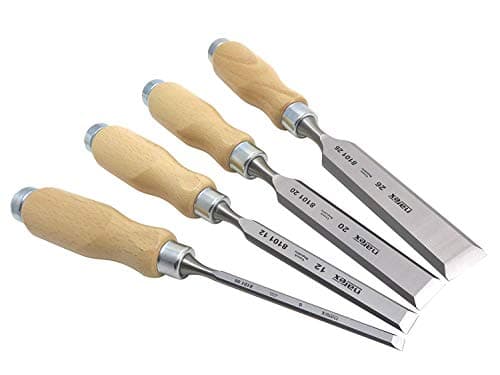 Narex Bevel Edge Chisel Set, 4 Piece The set that makes the case for this whole site. Four sizes, Czech chrome-vanadium hardened properly, beech handles, and a price that leaves budget for the stone you will need anyway. | Best chisels overall, and the end of the argument | $24.45tier C | 8.4/10 | $48.90Amazon |
#ad· Live prices from the Amazon Product API, as of October 21, 2026. Where we have no verified live price we show none, and the cost-per-decade figure is suppressed with it — we would rather leave a gap than print a number that has rotted.
Chisel listings advertise steel as though it settles the argument. It does not. Every steel in common use makes a working chisel, and they differ along one axis with a fixed trade at both ends.
The one trade that explains everything
Edge retention and ease of sharpening move in opposite directions, always. A steel that holds its edge longer is harder, more wear-resistant, and correspondingly slower to grind back when it does dull. A steel that sharpens quickly gets dull quickly.
There is no steel that holds forever and sharpens instantly, and any marketing that implies one is describing a small movement along this line as though it were an escape from it. Which end you want is a genuine preference: would you rather sharpen less often, or sharpen more easily?
The steels you will actually encounter
Chrome-vanadium (Cr-V) and chrome-manganese (Cr-Mn).The workhorses. Tough, forgiving, sharpen quickly, dull sooner than the premium alloys. Almost every budget and mid-price chisel. Narex's standard line is Cr-Mn and it is entirely sufficient for furniture work.
O1 tool steel. A simple oil-hardening high-carbon steel. Takes a very keen edge, sharpens fast, dulls moderately fast, and rusts if you leave it damp. Traditionalists often prefer it precisely because it comes back so quickly on a stone.
A2 tool steel.Air-hardening, with added chromium for wear resistance. Holds an edge noticeably longer than O1 and is meaningfully slower to sharpen — and the carbides that give it wear resistance mean it will not take quite as fine an edge as O1 at the limit. It is the default on premium western tools. That trade is worth its own page: A2 vs O1 steel, with the published compositions and hardness figures side by side.
PM-V11 and other powder-metallurgy steels.Modern alloys made by a different process that produces a finer, more even carbide structure. They genuinely improve on the O1-versus-A2 trade rather than just moving along it. Expensive, and the reason to mention them here rather than only on the plane pages is that Veritas publishes a full bench-chisel line in PM-V11 at Rc61–63, in seven widths. It is the top of this market and priced accordingly.
Japanese laminated (hagane over jigane). Not one steel but two, forge welded: a very hard high-carbon cutting layer on a soft tough body. Because the hard layer does not have to survive the shock, it can be harder than any monolithic chisel steel. See Japanese versus western chisels.
The number that matters more than the name
Rockwell hardness, HRc.The same alloy heat-treated well and heat-treated badly produces two entirely different tools, and heat treatment is where cheap chisels actually fail — not in the alloy selection.
- Under 56 HRc— too soft. The edge rolls under load rather than staying put. This is what a genuinely bad chisel feels like.
- 58–62 HRc— the working range for western bench chisels. A good compromise between edge life and toughness.
- 62–65 HRc— premium western and Japanese laminated edges. Superb edge retention; chips rather than rolls if abused.
A maker who publishes an HRc figure has measured it. A maker who does not may still have hardened well, but you are trusting rather than checking — and on this site, the difference between trusting and checking is the whole point. Narex publishes a figure on both its lines — around HRc 62 on Richter, 59 HRc on the standard bevel-edge sets — which most of their competitors at either price do not.
Cryogenic treatment
A real process, not a marketing word. After hardening, the steel is taken to very low temperature to convert retained austenite into martensite — in plain terms, to finish a transformation the quench left incomplete. The result is more uniform hardness and somewhat better wear resistance.
It is a genuine improvement and a modest one. It does not turn a mediocre steel into a good one; it makes a well-treated steel slightly more consistent.
What this means for buying
Very little, honestly, and that is the useful conclusion. Any of these steels, hardened into the working range, makes a chisel that will cut every joint you will ever cut. Steel selection is somewhere below back flatness, handle comfort and your sharpening setup in order of what will actually affect your work.
If you want a rule: buy a maker who publishes a hardness figure where you can, do not pay a premium for an alloy name alone, and put the money you save into a stone. The stone improves every steel you own.
Questions
Frequently asked
What is the best steel for wood chisels?
There is no best. A2 holds an edge longer and sharpens slower; O1 and Cr-V sharpen fast and dull sooner; laminated Japanese steel takes the keenest edge and chips if twisted. Pick the end of the trade you prefer.
Is A2 better than O1 for chisels?
A2 holds its edge longer; O1 sharpens faster and takes a marginally finer edge. Neither is better in general. If you dislike sharpening, A2. If you sharpen often and want the keenest possible edge, O1.
What hardness should a chisel be?
Between about 58 and 62 HRc for a western bench chisel. Below 56 the edge rolls under load. Japanese laminated edges run higher, 62 to 65, and chip rather than roll if abused.
Does cryogenic treatment actually do anything?
Yes, modestly. It converts retained austenite left over from the quench, giving more uniform hardness and somewhat better wear resistance. It improves a well-treated steel; it does not rescue a badly treated one.
Why do cheap chisels go dull so fast?
Usually heat treatment rather than alloy choice. A steel hardened below about 56 HRc has an edge that rolls under load, and no amount of sharpening fixes the underlying softness.
Receipts
Sources
- Taylor Toolworks — Narex Richter unhandled bevel-edge chisel blanks (cryogenically treated Cr-V, published hardness). Retrieved 2026-07-24.
- Taylor Tools — Narex Profi standard bevel-edge chisel sets, item 863010 ('fine-grained, nicely tempered chrome-manganese steel and hardened to 59 HRc'; 'bevels are ground at a 25 degree angle'; lacquered European beech handles with 'two (2) steel ferrules to withstand vigorous mallet work'; 'blades have well seated steel tangs'; 4, 8 and 12 piece sets from 3 mm to 50 mm; made in the Czech Republic). Retrieved 2026-09-03.
- Veritas — PM-V11 Bench Chisels ('PM-V11 tool steel blade' at 'Rc61-63'; torrefied maple handle; 'Made in Canada'; 1/8, 3/16, 1/4, 3/8, 1/2, 3/4 and 1 in widths, sold individually and as sets of five and seven). Retrieved 2026-09-10.
- Lie-Nielsen Toolworks — Replacement Blades (A2, cryogenically treated, HRc 60-62). Retrieved 2026-07-24.
- Amazon listing for Narex Richter Bevel Edge Chisel Set of 5 — specifications and price basis, retrieved via the Amazon Product API on 2026-07-24 and refreshed on the daily price check.
- Amazon listing for Two Cherries Bevel Edge Chisels, 6 Piece — specifications and price basis, retrieved via the Amazon Product API on 2026-07-24 and refreshed on the daily price check.
We have not handled these tools. Nobody here has tested one, owned one, or taken one apart. Specifications come from the manufacturer or the retailer listing; warranty terms come from the maker's own warranty page; the cost-per-decade arithmetic is ours and reproducible. Where we could not verify a figure we say so on the page rather than quietly leaving it out. Read the full method.
Keep reading
Related
- The best wood chiselsWhich sets publish a hardness figure, and which do not.
- The best sharpening stonesHarder steels want a stone that can cut them.
- Japanese vs western chiselsWhy laminating escapes the compromise a single steel has to make.
- Narex chisels reviewedWhat HRc 62 and cryogenic treatment buy in practice.
- A2 vs O1 steelThe two premium tool steels head to head, on published composition and hardness rather than folklore.
Back to Chisels · how we pick · editorial policy