Every set here cuts wood and none of them arrives sharp. What separates them is what the maker will tell you, and whether you can afford a stone afterwards.
We earn a commission when you buy through our Amazon links, at no extra cost to you. It never decides a ranking, and where the best tool in a class is one we earn nothing on, we say so and link it anyway. How this works.
The only set at this money whose maker publishes a hardness figure: chromium alloy steel at HRC 60-64, beveled at 25 degrees, with impact-resistant metal ferrules at both ends of the handle. In a tier where almost every listing says 'hardened steel' and stops, a stated Rockwell range is the entire reason this ranks first.
Built for a tool belt rather than a bench. Bi-material handles and a strike cap that tolerates a framing hammer, which is a legitimate design target even if it is not a furniture one.
Site work where the chisel gets hit with whatever is nearby
Full-tang construction at a price where most competitors use a stub. That is a structural difference, not a marketing one, and it is why this beats most of what sits beside it on the shelf.
Six chisel widths plus a sharpening stone, a honing guide and a case. The chisels are Cr-V bevel edge with no published hardness, and that matters less than it sounds here, because the thing that stops most budget chisels working is not the steel but the absence of any way to sharpen it.
Owning no stones yet and needing the whole problem solved at once
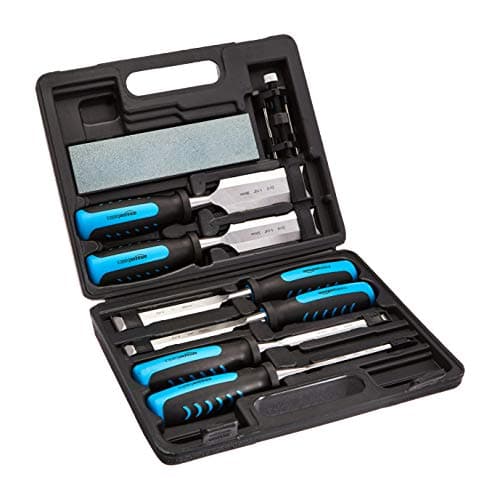
The other kit-in-a-box at this price: chisels from 1/4 to 1-1/2 in with a honing guide, a sharpening stone and a case. Amazon publishes no steel grade and no hardness for it, which is the deciding fact against it and the reason it sits below the WORKPRO on coverage rather than above it on trust.
The cheapest set here by a wide margin: four Cr-V bevel-edge chisels with PVC handles and blade guards. We include it because pretending the bottom of the market does not exist helps nobody, and because there is one narrow case where it is the right purchase.
The genuine floor of the market, and what it actually buys
#ad· Live prices from the Amazon Product API, as of October 21, 2026. Where we have no verified live price we show none, and the cost-per-decade figure is suppressed with it — we would rather leave a gap than print a number that has rotted.
The best budget chisel set is the one that leaves you money for a stone. That is the finding this page kept arriving at, and it is worth putting first on a page that earns a commission when you buy something. Every set below will cut wood. Not one of them arrives sharp. The gap between a set at the bottom of this page and a set at the top is real but small; the gap between any of them sharpened and any of them unsharpened is enormous.
This page covers the genuinely cheap tier — the sets you find by searching on price rather than on brand. If what you actually want is the first set for someone who has never used a chisel, ranked on how much setup work each one demands, that is a different question and it is answered on the best chisels for beginners. If you want the field including the tools we think are worth paying up for, that is the best wood chisels. This page is specifically about what happens at the bottom of the market and what it costs you.
How we ranked these
Five things decide the order, and they are the same five for every set on the page. None of them is a feeling about the edge in the hand, because we have not used these — the notice above this page says so, and our methodology explains what we do instead.
1. Published hardness.This is the single most discriminating fact in the budget tier, because almost nobody publishes it. One set on this page carries a stated Rockwell range from its maker: Jorgensen publishes HRC 60–64. Everything else says “hardened steel”, “Cr-V”, or nothing whatever. That is not proof the others are soft. It is proof you are trusting rather than checking, and on a site that ranks tools on documented evidence it decides the order.
2. Handle construction.On a struck tool the handle is what fails first. What you want is a ferrule at the bolster so the tang cannot split the wood from below, and either a second ferrule or a steel strike cap at the top so the striking end cannot mushroom. Jorgensen publishes both ends. Stanley's FatMax uses a strike cap. The bottom of the page uses molded plastic and publishes nothing.
3. Factory grind.A set ground at 25 degrees means your first session is honing. A set ground at some unstated angle, or ground badly out of square, means your first session is regrinding — which on a budget stone is an evening rather than a coffee break. Only two makers on this page state their grind angle at all.
4. Whether it includes the means to sharpen it.Two sets here bundle a stone and a honing guide. On a page about buying cheaply this matters more than it would anywhere else on the site, because the commonest budget-chisel failure is not bad steel — it is a drawer of chisels and no way to put an edge on them.
5. Cost per decade. Every card below carries the arithmetic, and in this category it is unusually kind, because a chisel has no consumable part. It is steel, and steel renews on the stone until it runs out. That cuts both ways: spread over twenty years, the difference between the cheapest set here and the dearest is small enough that buying cheap twice is worse than buying properly once. The tier table is on cost per decade.
The honest shape of this market
Almost everything on the cheap shelf is chrome-vanadium or chrome-manganese steel from the same handful of factories, sold under a dozen names, and the listings describe it in language chosen precisely because it commits to nothing. “Cr-V” names an alloy family, not a grade and not a heat treatment. Two chisels can both be honestly labeled Cr-V and behave completely differently, because what decides edge behavior is how they were hardened and tempered — which is the number nobody prints.
That is why a published Rockwell range is worth so much more here than it would be at the premium end, where every maker publishes one. It is the only variable in the tier that can be checked rather than assumed. What the designations mean is on chisel steel explained.
What you actually give up against the tier above
Being specific about this is more useful than a verdict. Against a set like the Narex — published chrome-manganese at 59 HRc, ground at 25 degrees, on beech with two steel ferrules — a budget set costs you four things, in descending order of how much they matter.
Back flatness is the big one. A chisel back is a reference surface, and the cheaper the set the more of it you have to lap yourself before the tool is accurate. That is an evening of work you are doing instead of the factory, and it is the single biggest hidden cost of buying cheap. How to flatten a chisel back is the procedure.
Edge retention is second, and it is smaller than people expect. A softer chisel does not cut worse; it needs the stone more often. If you sharpen willingly that is an inconvenience rather than a defect.
Side land thickness is third. Budget bevel-edge chisels have thicker lands than premium ones, which means they bruise the pins when you clean out a tight dovetail. It matters if you cut dovetails and is invisible if you do not.
Handle longevity is fourth and only bites over decades. A molded plastic handle cannot be replaced on a lathe when it fails; a turned wooden one can.
Every pick, in full
The write-ups
01Best budget chisel set overall
Set
4 pieces (1/4, 1/2, 3/4, 1 in)
Steel
Chromium alloy, HRC 60-64 (maker)
Bevel
Ground at 25 degrees
Handle
Oval hardwood, metal ferrule top and bottom
Warranty
Not published on the product page
Jorgensen Wood Chisel Set, 4 Piece
Jorgensen
7.6/10
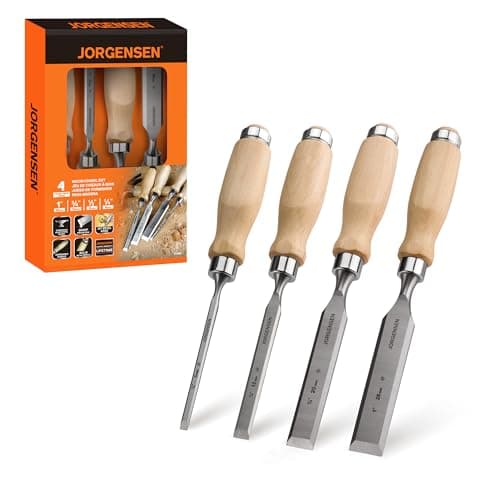
The only set at this money whose maker publishes a hardness figure: chromium alloy steel at HRC 60-64, beveled at 25 degrees, with impact-resistant metal ferrules at both ends of the handle. In a tier where almost every listing says 'hardened steel' and stops, a stated Rockwell range is the entire reason this ranks first.
Cost per decade
$18.00
Horizon · tier C
20 years — No lifetime warranty; parts purchasable and resharpenable
No lifetime warranty published by the manufacturer at the date checked. Monolithic edge tool: no separately consumable part, and the edge is renewable by sharpening for as long as there is steel left.
Rebuy risk
Medium
parts listed, resharpenable
Steel & edge
8.0
Back flatness
7.0
Handle
8.0
Sizes covered
7.0
Value
8.0
What it gets right
+HRC 60-64 published by the maker, which nothing else in this price band discloses
+Ferrules at both ends: one stops the tang splitting the handle, the other takes the mallet
+25 degree factory grind is the right primary bevel, so your first sharpening is honing rather than regrinding
+Four widths is genuinely the number most people use, so nothing in the roll is decoration
What it costs you
−Jorgensen names the alloy family rather than a grade, so 'chromium alloy steel' is not the same disclosure as a designation like O1
−No warranty terms published on the product page
−The dearest set on this page, which undercuts the case for buying budget at all
−Backs still need lapping; a published hardness is not a published flatness
Skip this if…
…you can stretch to the Narex. At that point you are close enough to the tier above that the extra money buys documented flatness and a better handle, and this set stops being the value argument.
02A first set that will not be precious about abuse
Set
5 pieces
Handles
Struck-capped polypropylene
Steel
Carbon steel
Warranty
Limited lifetime; excludes normal wear and tear
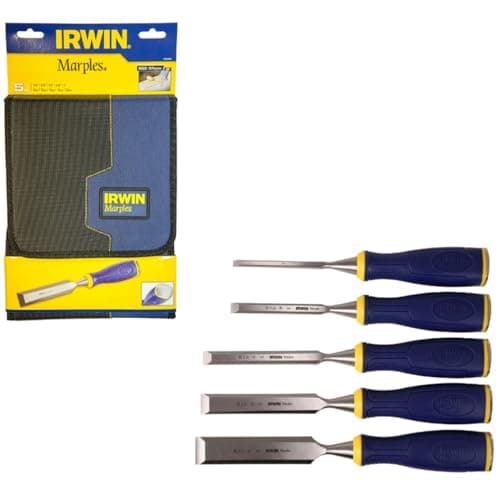
Irwin Marples All-Purpose Chisel Set, 5 Piece
Irwin
6.9/10
The cheaper Marples line. Fine as a first set, fine as a site set, and fine as the chisels you let other people borrow.
Cost per decade
$38.09
Horizon · tier C
20 years — No lifetime warranty; parts purchasable and resharpenable
IRWIN publishes a limited lifetime warranty on select products against deficiencies in material and workmanship, for as long as the original purchaser owns the tool. It does not cover a product that 'fails to operate due to normal wear and tear', which on a chisel is the edge. Rated on the tool itself: monolithic, no separately consumable part, resharpenable for as long as there is steel left.
Rebuy risk
Medium
parts listed, resharpenable
Steel & edge
5.5
Back flatness
5.5
Handle
7.0
Sizes covered
8.0
Value
8.5
What it gets right
+Cheap enough that a chipped edge is not a crisis
+Strike caps mean a hammer will not destroy the handle
+Five sizes covers general carpentry comfortably
What it costs you
−Edge retention is the weakest in this roundup
−Grinding quality varies noticeably between individual chisels
−Nothing about the steel is a lifetime proposition, whatever the warranty says
Skip this if…
…this is your only set and you intend to keep it. Spend a little more once.
03Site work where the chisel gets hit with whatever is nearby
Set
5 pieces
Handles
Bi-material with strike cap
Steel
Chrome carbon
Warranty
Excludes blades as consumables
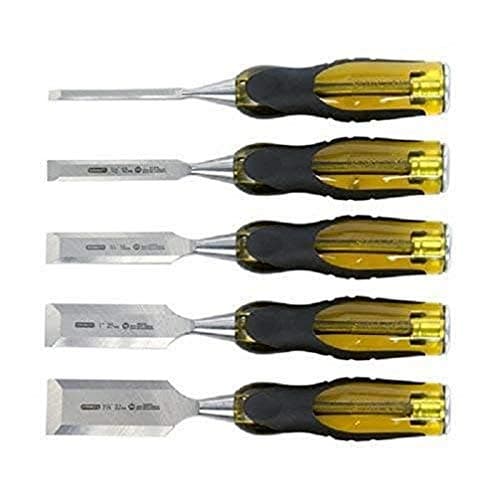
Stanley FatMax Bevel Edge Chisel Set, 5 Piece
Stanley
6.9/10
Built for a tool belt rather than a bench. Bi-material handles and a strike cap that tolerates a framing hammer, which is a legitimate design target even if it is not a furniture one.
Cost per decade
$56.96
Horizon · tier C
20 years — No lifetime warranty; parts purchasable and resharpenable
Stanley's limited lifetime warranty excludes consumables including 'any blade', which on a chisel is the entire tool. Rated on the tool itself: monolithic, no separately consumable part, resharpenable indefinitely.
Rebuy risk
Medium
parts listed, resharpenable
Steel & edge
6.5
Back flatness
6.0
Handle
6.5
Sizes covered
8.0
Value
7.5
What it gets right
+Survives site conditions that would destroy a wooden-handled set
+Strike cap is genuinely rated for a steel hammer
+Widely stocked, easily replaced
What it costs you
−The Stanley lifetime warranty excludes blades, which on a chisel means the tool
−Handles are too fat for controlled paring
−Edge retention is ordinary
Skip this if…
…the work is furniture. These are carpentry chisels wearing woodworking packaging.
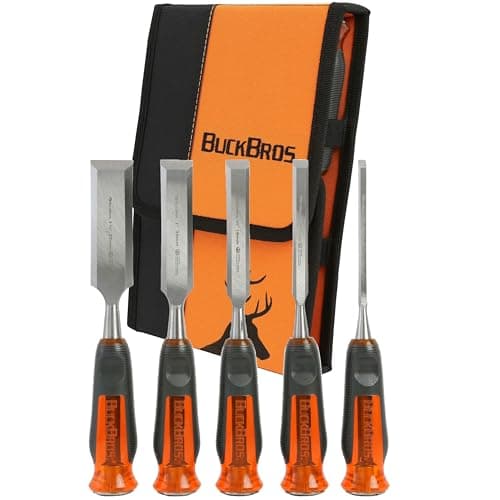
Full-tang construction at a price where most competitors use a stub. That is a structural difference, not a marketing one, and it is why this beats most of what sits beside it on the shelf.
Cost per decade
Suppressed — no live price
Horizon · tier C
20 years — No lifetime warranty; parts purchasable and resharpenable
No lifetime warranty published by the manufacturer at the date checked. Monolithic edge tool: no separately consumable part, and the edge is renewable by sharpening for as long as there is steel left.
Rebuy risk
Medium
parts listed, resharpenable
Steel & edge
5.5
Back flatness
5.0
Handle
7.0
Sizes covered
8.0
Value
8.5
What it gets right
+Full tang genuinely resists handle separation under mallet work
+Cheap enough to be a first set without regret
+Five sizes at a budget price
What it costs you
−Grinding is rough and first sharpening is real work
−Edge retention is entry-level
−No published warranty or steel specification
Skip this if…
…you have not bought a sharpening stone yet. Out of the box these need one more than anything else here.
05Owning no stones yet and needing the whole problem solved at once
Set
10 pieces; six chisels, 1/4 to 1-1/2 in
Includes
Sharpening stone, honing guide, pencils, case
Steel
Cr-V bevel edge; hardness not published
Warranty
Not published
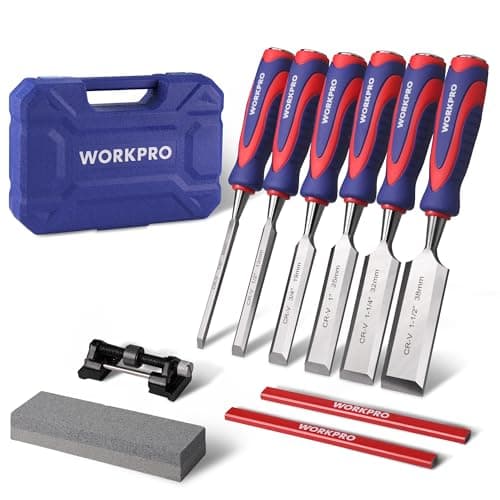
WORKPRO Wood Chisel Set, 10 Piece with Stone and Guide
WORKPRO
6.5/10
Six chisel widths plus a sharpening stone, a honing guide and a case. The chisels are Cr-V bevel edge with no published hardness, and that matters less than it sounds here, because the thing that stops most budget chisels working is not the steel but the absence of any way to sharpen it.
Cost per decade
$13.38
Horizon · tier C
20 years — No lifetime warranty; parts purchasable and resharpenable
No lifetime warranty published by the manufacturer at the date checked. Monolithic edge tool: no separately consumable part, and the edge is renewable by sharpening for as long as there is steel left.
Rebuy risk
Medium
parts listed, resharpenable
Steel & edge
5.5
Back flatness
5.5
Handle
6.0
Sizes covered
8.0
Value
7.5
What it gets right
+Bundles the stone and the guide, which is the actual barrier between a cheap chisel and a sharp one
+Six widths up to 1-1/2 in covers wider work than the usual four-piece budget roll
+A honing guide in the box means the first bevel is repeatable rather than guessed
+Nothing on a chisel is consumable, so the tool renews on the stone for as long as it lasts
What it costs you
−No hardness figure published anywhere, so edge life is unknowable before you own it
−A bundled budget stone is a starter stone, not a finishing stone, and you will want a finer grit
−'Cr-V' names an alloy family, not a grade or a heat treatment
−Ten-piece counts flatter the listing; six of the pieces are the tools
Skip this if…
…you already own sharpening stones. You are then paying for a kit whose best component you do not need, and the chisels alone are not the best chisels here.
Price as of October 21, 2026. Prices move; Amazon's is the one that counts.
#ad · we may earn a commission from this link to WORKPRO Wood Chisel Set, 10 Piece with Stone and Guide
06The same bundle argument, one width narrower
Set
8 pieces, chisels 1/4 to 1-1/2 in
Includes
Honing guide, sharpening stone, storage case
Steel
Not published
Warranty
Not published
Amazon Basics Wood Chisel Set, 8 Piece with Stone and Guide
Amazon Basics
6.3/10
The other kit-in-a-box at this price: chisels from 1/4 to 1-1/2 in with a honing guide, a sharpening stone and a case. Amazon publishes no steel grade and no hardness for it, which is the deciding fact against it and the reason it sits below the WORKPRO on coverage rather than above it on trust.
Cost per decade
$14.59
Horizon · tier C
20 years — No lifetime warranty; parts purchasable and resharpenable
No lifetime warranty published by the manufacturer at the date checked. Monolithic edge tool: no separately consumable part, and the edge is renewable by sharpening for as long as there is steel left.
Rebuy risk
Medium
parts listed, resharpenable
Steel & edge
5.0
Back flatness
5.5
Handle
5.5
Sizes covered
8.0
Value
7.5
What it gets right
+Stone and honing guide included, so there is no second purchase before the first sharp edge
+Storage case keeps edges off each other, which is most of what damages a cheap chisel
+Widths run to 1-1/2 in, wide enough for paring a tenon cheek or a half-lap
+The cheapest legitimate route to a sharpenable chisel plus the means to sharpen it
What it costs you
−Neither steel grade nor hardness is published — this is the least documented set on the page after the Hurricane
−House-brand tools have no maker to hold to a specification
−The bundled stone is coarse-tier; a finishing grit is still a separate purchase
−No published warranty
Skip this if…
…you want to know what you are buying. Nothing about the metal is disclosed, and on a site that ranks tools on published evidence that is the whole objection.
Price as of October 21, 2026. Prices move; Amazon's is the one that counts.
#ad · we may earn a commission from this link to Amazon Basics Wood Chisel Set, 8 Piece with Stone and Guide
07The genuine floor of the market, and what it actually buys
Set
4 pieces (1/4, 1/2, 3/4, 1 in)
Steel
Cr-V bevel edge; hardness not published
Handle
High-impact PVC, with safety caps
Warranty
Not published
Hurricane Wood Chisel Set, 4 Piece
Hurricane
5.0/10
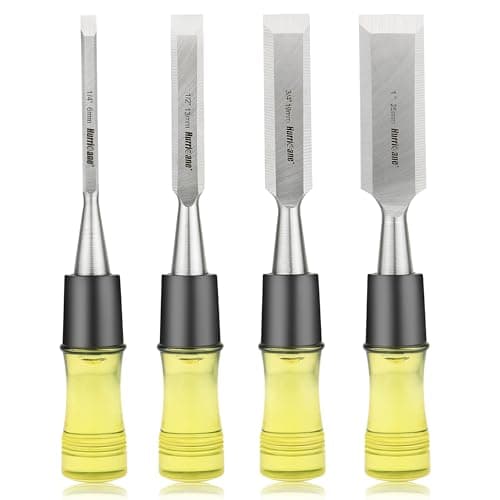
The cheapest set here by a wide margin: four Cr-V bevel-edge chisels with PVC handles and blade guards. We include it because pretending the bottom of the market does not exist helps nobody, and because there is one narrow case where it is the right purchase.
Cost per decade
$6.95
Horizon · tier C
20 years — No lifetime warranty; parts purchasable and resharpenable
No lifetime warranty published by the manufacturer at the date checked. Monolithic edge tool: no separately consumable part, and the edge is renewable by sharpening for as long as there is steel left.
Rebuy risk
Medium
parts listed, resharpenable
Steel & edge
4.0
Back flatness
4.0
Handle
4.0
Sizes covered
6.0
Value
7.0
What it gets right
+Cheap enough to keep in a toolbox for work you would not risk a good chisel on
+Bevel-edge grinding rather than square lands, so it can at least reach into a dovetail socket
+Blade guards included, which is more than several dearer sets manage
+Sharpenable like any other carbon-alloy chisel, for as long as the steel holds an edge
What it costs you
−No hardness, no grade, no maker documentation of any kind
−PVC handles are not a mallet-struck material and will not age like wood
−Expect the longest first-sharpening session on this page: budget sets arrive with the roughest backs
−No published warranty
Skip this if…
…this is your only set. Buying it and then buying a real set costs more than buying the real set, which is the exact rebuy trap this site exists to talk you out of.
This is the practical version of the argument at the top of the page. A cheap set plus a usable sharpening setup outperforms an expensive set with nothing to sharpen it on, every time, and it is not close. A chisel that will not take an edge is not a cheap chisel; it is not a chisel.
If you own nothing, the two bundled kits on this page are a legitimate answer — they put a stone and a honing guide in the same box, which removes the second purchase and the second decision. What they do not do is give you a finishing grit, so plan for one. Our honest starting recommendation for stones is the sharpening starter kit, and sharpening grits explained covers why one stone is rarely enough.
The first hour with any set on this page
Budget every one of these as a tool that needs commissioning rather than one that needs unwrapping. The sequence does not change with price; only its length does.
Lap the backs first, and only the first inch or so behind the edge. A chisel back does not need to be flat along its whole length and chasing that on a budget chisel is a way to lose an afternoon. Flat where it references is the whole requirement.
Then hone the bevel,at or near the 25 degrees the better sets are already ground to. If the factory grind is visibly out of square, fix that on your coarsest stone before you touch a finer one — honing a skewed edge just polishes the skew. The angles are charted on sharpening angles explained and the full procedure is on how to sharpen a chisel.
Then stop and use them. A budget chisel sharpened properly does clean, accurate work, and a great many people who conclude they need better chisels actually need a finer stone.
How many widths you need, and why sets oversell
Four is the honest number: something around 1/4 in, 1/2 in, 3/4 in and 1 in. That covers hand-cut joinery almost completely, and it is why the four-piece sets on this page are not a compromise. The eight and ten-piece counts further down include the stone, the guide, the case and in one instance a pair of pencils — six of the ten pieces are the tools.
Wider chisels earn their place if you pare tenon cheeks or half-lap floors, where width buys registration. Narrower ones earn theirs if you cut small dovetails. Neither is a first purchase. The general version of this question is on how many chisels do you need, and chisel sizes explained covers how the widths are designated.
Plastic handles, wooden handles, and struck tools
A bevel-edge bench chisel is a struck tool, so the handle is a wear item in a way the blade is not. Three constructions turn up in this tier.
A turned wooden handle with two ferrules is the traditional answer and the repairable one: when it eventually splits, a replacement is a piece of beech and an afternoon. A wooden handle with a steel strike cap is the same idea with the top ferrule replaced by a cap that takes the blow directly. A molded plastic handle survives mallet work fine when new and cannot be replaced when it does not. Over a decade that difference is the buy-it-for-life argument in miniature, and it is why handle construction is a ranking criterion here rather than a styling note. The full comparison is on chisel handle materials.
When buying budget is the wrong call
Three cases, stated plainly because the page earns nothing by being coy about them.
If you already know you are going to keep doing hand-tool woodworking, buying cheap now and properly later costs more than buying properly once, and the difference is roughly the price of the cheap set. That is the whole thesis of what makes a tool buy it for life.
If your work is fine joinery — dovetails in hardwood, small frames, anything where the side lands touch the finished surface — the thicker lands of a budget chisel will show up in the work. That is a geometry problem sharpening cannot solve.
And if you are buying chisels to chop mortises, none of these is the right tool at any price: a bevel-edge bench chisel levered against a mortise wall snaps at the neck. That job needs a mortise chisel, and the reason is on bench chisels versus mortise chisels.
Questions
Frequently asked
What is the best budget chisel set?+
The Jorgensen four-piece, because it is the only set at this money whose maker publishes a hardness figure — chromium alloy steel at HRC 60-64, ground at 25 degrees, with metal ferrules at both ends of the handle. Everything else in the tier says “hardened steel” and stops.
Are cheap wood chisels any good?+
Sharpened properly, yes, for most work. A budget chisel cuts cleanly and accurately; what you give up is factory back flatness, some edge retention, thicker side lands and a handle you cannot replace. The first of those costs you an evening of lapping, and it is the hidden price of buying cheap.
Do budget chisel sets come sharp?+
No. Not one set on this page arrives with a working edge. They arrive ground, and grinding is not honing. Expect to flatten the backs for the first inch behind the edge and hone the bevels before the first cut, and expect that session to be longest on the cheapest set.
Is a chisel set with a sharpening stone worth it?+
If you own no stones, yes — it removes the second purchase, and a chisel you cannot sharpen is worth nothing. If you already sharpen, no: you are paying for the best component in the box twice, and the chisels in those kits are the least documented on this page.
How much should I spend on my first chisels?+
Enough to leave money for a stone. That is the real constraint, not a number. If the choice is a dearer set with nothing to sharpen it or a cheaper set plus a stone and a guide, take the second every time — and if the budget stretches further, the tier above is covered on the best wood chisels.
What does Cr-V steel mean on a chisel?+
Chrome-vanadium: an alloy family, not a grade and not a heat treatment. Two chisels can both be honestly labeled Cr-V and hold an edge completely differently, because what decides that is the hardening and tempering, which almost nobody in this tier publishes. See chisel steel explained.
How many chisels do I actually need to start?+
Four: roughly 1/4, 1/2, 3/4 and 1 in. That covers hand-cut joinery almost completely. The eight and ten-piece counts on this page are counting the stone, the guide and the case, not eight and ten chisels.
Are plastic-handled chisels bad?+
Not for cutting — a molded handle takes mallet blows fine when new. The objection is repairability: when a wooden handle finally splits you turn a new one, and when a plastic one fails the chisel is finished. Over a twenty-year horizon that is the difference the cost-per-decade figure on each card is trying to capture.
We have not handled these tools. Nobody here has tested one, owned one, or taken one apart. Specifications come from the manufacturer or the retailer listing; warranty terms come from the maker's own warranty page; the cost-per-decade arithmetic is ours and reproducible. Where we could not verify a figure we say so on the page rather than quietly leaving it out. Read the full method.