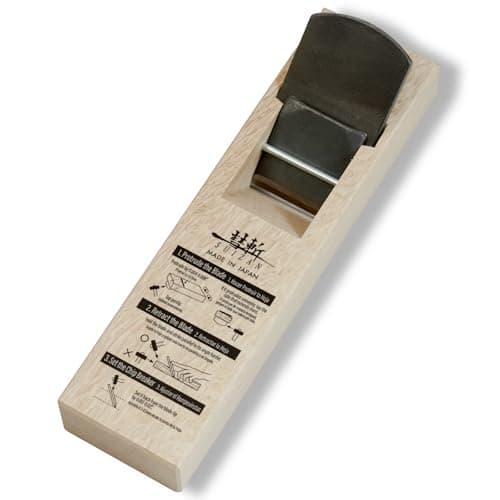
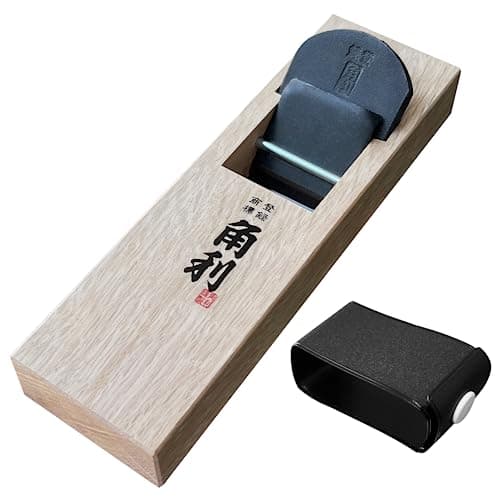
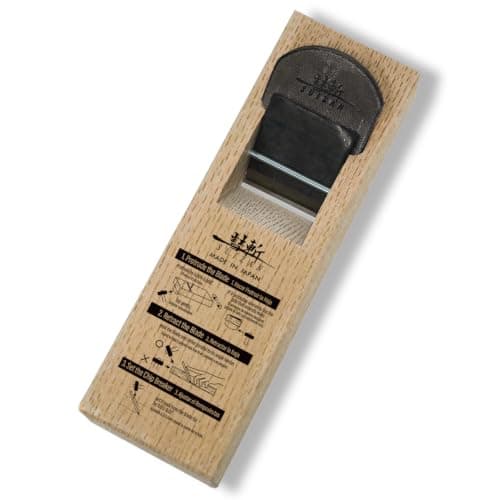
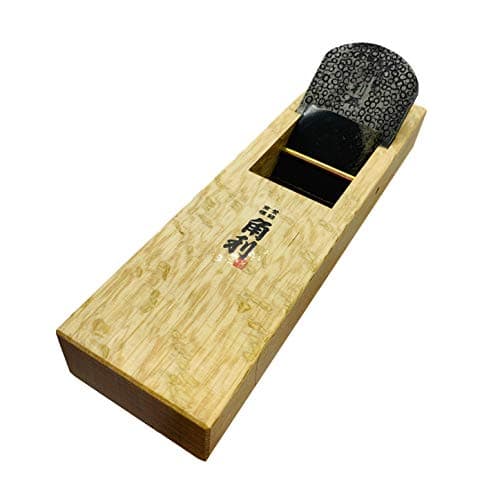
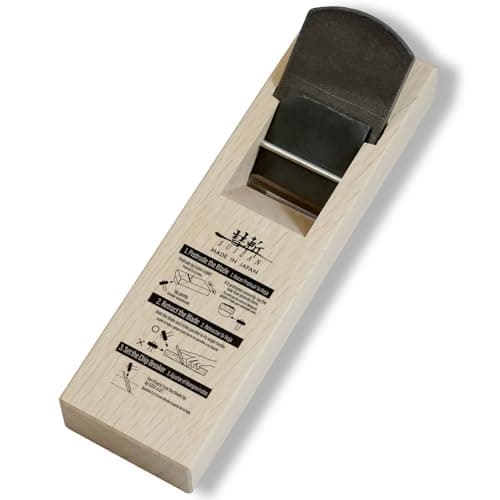
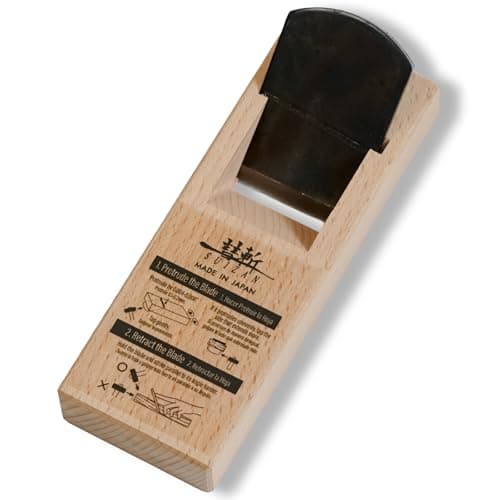
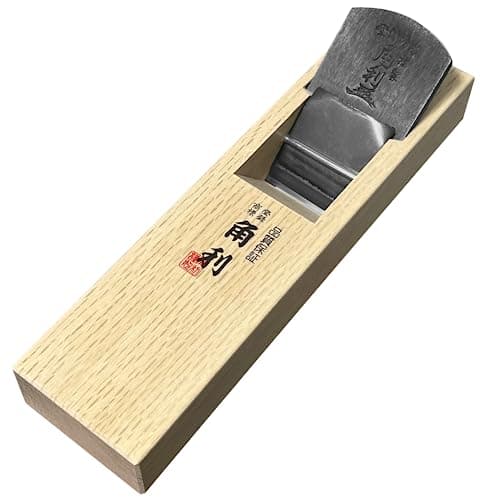
A kanna is a hand plane with almost everything taken away. There is no casting, no frog, no lever cap, no depth wheel and no lateral lever. There is a laminated iron, a wooden block called a dai, a chip breaker on most of them, and a hammer. You pull it toward you instead of pushing it away, you set the depth of cut by tapping the iron rather than turning a knob, and when the sole drifts out of true you correct it yourself rather than sending it anywhere. That is the whole tool.
For a buy-it-for-life buyer this is either the most attractive plane in the workshop or the most alarming one, and both reactions are correct. A tool with no mechanism has nothing to seize, strip or lose. A hard laminated edge can be sharpened until the hard layer is gone, which on a full-size plane iron is decades of shop use. But the same simplicity means the plane arrives as a kit of correct parts rather than a working tool, and both makers below say so on their own websites. Wooden vs metal hand planes covers why a wooden body behaves differently under the hand; this page is the shopping.
The site already ranks Japanese chisels and Japanese saws. The plane was the missing third — named in passing on two pages and ranked on none — which is why this one exists.
Decide this before you read the rankings
Double blade or single. A double-blade kanna has a chip breaker sitting behind the cutting iron, exactly as a western bench plane does, and it is what stops the shaving lifting ahead of the edge and tearing out. Six of the seven planes below are double-blade. The single-blade plane at the bottom is cheaper and lighter and will tear reversing grain that the others cut cleanly. If the reason you want a kanna is a finish, buy a double. What a cap iron does is the same mechanism described on a western plane.
Width, but not the number in the title.Every listing here is named for its blade width — 42 mm, 50 mm, 60 mm. The blade is wedged into a tapered mouth, so the part of it that actually cuts is narrower. KAKURI publishes both numbers: the 42 mm plane cuts 36 mm, the 50 mm cuts 42 mm, the 60 mm cuts 50 mm. SUIZAN publishes only the blade width. Buy on the cutting width where you can see it, and assume roughly the same 8 to 10 mm difference where you cannot.
How we ranked them
We have not handled any of these planes, and the page says so before it says anything else. What we did is open both makers' own product pages, their policy pages and their setup documentation, tabulate what each one is prepared to write down, and rank on that. Every source is linked at the bottom. Five things decided the order.
Whether the maker names the steel.This was the first and biggest split, and it went one way. KAKURI publishes a designation — SK85, in a double layer — for the white-oak planes ranked here, and a different one, AOGAMI (Blue Paper Steel) #2 over soft iron, for its more expensive range. SUIZAN publishes the words “Japanese steel” and nothing further: no grade, no hardness, no statement that the iron is laminated at all. Both are almost certainly laminated irons, because that is how kanna blades are made. Only one of the two is willing to be held to it, and on a site that ranks on published evidence that is worth two places.
Whether there is a chip breaker. Six yes, one no, and the one without it is priced accordingly and ranked last.
What the maker publishes about the body. White oak is the traditional dai wood and the one that takes decades of re-truing; KAKURI names it on every plane ranked here and specifies an oil finish on the 60 mm. SUIZAN names oak on three of its four and beech on the cheapest. Both publish body dimensions and weights; only KAKURI publishes a cutting width.
What the maker publishes about setup.This is where the order nearly flipped. KAKURI writes, on its own product pages, that you should budget “typically under one hour” to set the plane up, and suggests finding an English guide online. SUIZAN publishes the guide itself — how to advance the iron, how to retract it, how to correct a skewed blade, how to re-flatten the sole on sandpaper stuck to glass. For a first Japanese plane that documentation is worth real money, and it is why the SUIZAN 50 sits second rather than fourth.
What stands behind it.The usual finding on this site, in an unusually clean form. SUIZAN publishes, verbatim: “We offer a 30-day warranty from the date of delivery. In case of any initial defects, we will replace the item free of charge.” That is short, but it is a written promise. KAKURI publishes no warranty at all, and its refund policy says that once an order is complete the product “cannot be returned or exchanged for any reason attributable to the User”, with returns accepted only for goods that arrive wrong, damaged or non-conforming. Neither maker publishes a lifetime term, so every plane on this page sits in the same cost-per-decade tier and is compared on the same 20-year horizon — the reasoning is on cost per decade and the maker-by-maker table on warranties and repairability.
The setup hour is part of the price
No kanna on this page — and no kanna at ten times these prices — arrives ready to take a shaving. The iron needs sharpening, the back of the iron needs work, the iron needs fitting to the dai so it seats without rocking, and the sole needs conditioning so that it touches the wood only where a kanna sole is meant to touch it. Hida Tool, which sells hand-forged planes from named smiths at four to eight times this money, puts it plainly: the makers leave the plane in an “almost-ready to go” condition on purpose, so the craftsman can finish it to their own preference.
Price that hour honestly before you buy. If you enjoy it, it is the best-value hour in woodworking, because at the end of it you own a tool with no mechanism to fail. If the idea of it irritates you, buy a western smoother from the bench plane roundup instead and spend the difference on a stone. Neither answer is wrong; buying the kanna and resenting it is.
What is not on this page, and why
KAKURI's blue paper steel planes.KAKURI sells a second range whose blade is, in its words, “expertly crafted with two layers of AOGAMI (Blue Paper Steel) #2 and soft iron”, at roughly twice the price of the SK85 planes. On the published evidence that is the better iron, and it is genuinely the plane we wanted to rank first. The 48 mm listing was down to four units when we checked and the 30 mm block version to one. We do not feature stock that thin, and it is named here so you can go looking when it restocks.
KAKURI's replaceable-blade model.A traditional dai with a throwaway cutting edge: “by making the blade's cutting edge replaceable, there is no need to spend time sharpening”, with spare blades sold in threes. It solves the setup problem and creates a rebuy obligation in its place, which is the opposite of what this site is for — and the Amazon listing was down to two units anyway.
Senkichi and Daikichi.Both brands have kanna on Amazon, some cheaper than anything here. We found no maker's page publishing a steel grade, a cutting width or a weight for any of them, and most listings were at single-digit stock when we checked. Unmeasured and nearly sold out is not a recommendation.
Hand-forged planes from named smiths.These are the best Japanese planes made, they are sold direct by specialist importers rather than on Amazon, and we earn nothing on them. The Suika smoothing plane linked from the top pick — blue steel forge-welded to soft iron, forged by the third-generation Tsunesaburo in Miki City — starts at around four times the price of the planes ranked here and is the honest next step up.
KAKURI's ECO-oak 50 mm listing. Same laminated blade, cheaper body wood, a few dollars less than the white-oak version ranked first. It already has a card of its own on the block plane roundup, where it sits as the Japanese entry in a western field.
The order, briefly
The KAKURI 50 mm white oak is first because it is the only plane here that names its steel, publishes its cutting width and its weight, ships the chip breaker and sits in the middle of the price range. The SUIZAN 50 mm is second at the same width and near enough the same money, trading a published steel grade for a published warranty and the only real setup documentation any maker on this page offers. The KAKURI 42 is third as the cheapest route to a named steel, the SUIZAN 42 double fourth as the small plane that keeps its chip breaker, the KAKURI 60 fifth as the panel plane that costs the most maintenance, the SUIZAN 60 sixth as the same job with a warranty and no steel grade, and the SUIZAN 42 single last — the cheapest plane here, the only one without a chip breaker, and the honest way to find out whether you like the pull stroke at all.