We earn a commission when you buy through our Amazon links, at no extra cost to you. It never decides a ranking, and where the best tool in a class is one we earn nothing on, we say so and link it anyway. How this works.
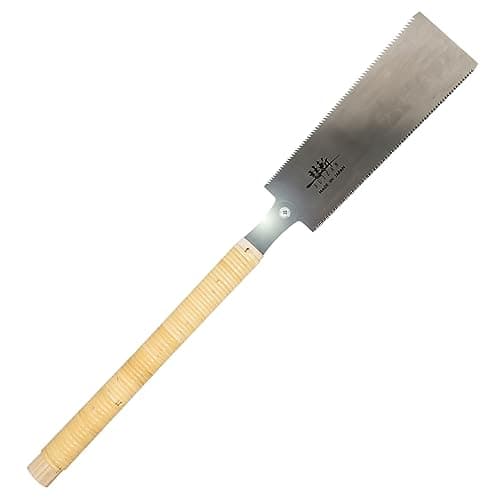
Rip teeth on one edge, crosscut on the other, a plate thin enough to cut with almost no force, and a maker who actually sells replacement blades. That last point is why it rates as well as it does.
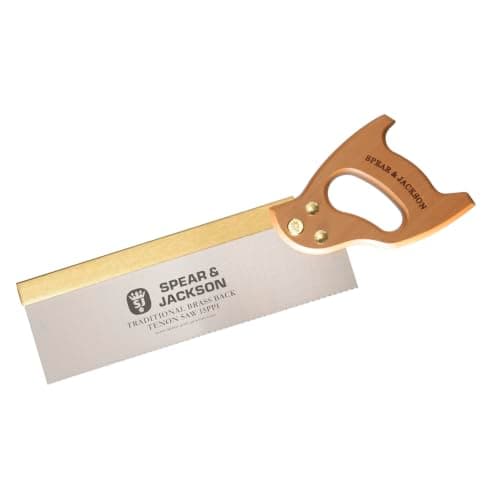
Sheffield-made, filed teeth, a proper back, and a price that does not assume you are a collector. This is the western answer to the dozuki for anyone who wants to sharpen rather than replace.
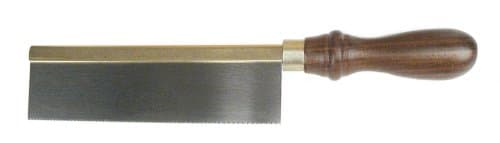
A traditional filed gents saw from Sheffield. It does not cut as cleanly out of the box as a dozuki, and unlike a dozuki you can put the teeth back for the rest of your life.
#ad· Live prices from the Amazon Product API, as of October 21, 2026. Where we have no verified live price we show none, and the cost-per-decade figure is suppressed with it — we would rather leave a gap than print a number that has rotted.
Unlike the equivalent chisel comparison, this one is not balanced. On cutting performance per dollar, the Japanese saw wins decisively. The interesting question is what you give up, and the answer is more interesting than the performance gap.
Why the pull stroke wins
A push saw puts its plate in compression, and compression buckles thin material. So a western saw plate has to be thick enough not to fold under the push — and thickness costs you directly: a wider kerf, more wood removed, more force required, a rougher surface.
A pull saw puts the plate in tension. Tension cannot buckle it, so the plate can be a fraction of the thickness. Every single advantage follows: narrower kerf, less effort, cleaner cut, better accuracy to a line. This is not a matter of craft tradition or steel quality. It is a consequence of which direction the force goes.
What western saws still do better
Four things, and they are real.
They can be sharpened forever. Filed teeth are cut and set by hand, and can be re-cut and re-set indefinitely. This is the entire buy-it-for-life case and it is why nineteenth-century saw plates are still working. Japanese impulse-hardened teeth cannot be filed at all.
They tolerate abuse. A thicker plate survives being forced, twisted, leaned on and stored badly. A Japanese plate kinks and a kinked plate is scrap.
They work with western jigs. Bench hooks, miter boxes and shooting setups are built around a saw that cuts on the push. A pull saw in a western miter box has the stop on the wrong side.
Familiarity. If you have used a saw before, you have used a push saw, and the pull stroke genuinely takes a few hours to stop feeling backwards.
The trade in one sentence
A Japanese saw is a handle plus a consumable blade that cuts beautifully. A western filed saw is a permanent object that cuts less well and can always be brought back. Which is “buy it for life” depends on whether you count a scheduled consumable as a failure.
Our view: it is not a failure if the maker actually sells the blade. A saw whose handle and spine last decades while the blade is periodically renewed is a coherent ownership model, and it is why SUIZAN and Gyokucho saws rate tier C on this site rather than tier D. A hardpoint saw with no replacement blade available is a different thing entirely, and it rates accordingly.
The dishonest version of this argument
Worth naming, because it is common. Sites that sell western saws describe Japanese saws as “disposable” without mentioning that replacement blades are sold. Sites that sell Japanese saws describe filed teeth as “requiring constant maintenance” without mentioning that maintenance is a fifteen-minute job every few months.
Both framings are true and neither is honest. The real trade is the one above.
What we would own
Both, and it costs under $80. A ryoba for general cutting because nothing western touches it for the money, and a filed western backsaw for joinery because it can be renewed forever and because learning to sharpen a saw is a genuinely useful skill.
If it has to be one: the ryoba. Better cuts today beats theoretical permanence, and the replacement blades are real. Ranked options are on best Japanese saws and best hand saws.
Every pick, in full
The write-ups
01Best hand saw overall
Length
9.5 in
Teeth
Rip one edge, crosscut the other
Blade
Impulse hardened, replaceable
Action
Pull stroke
SUIZAN Ryoba Double Edge Pull Saw, 9.5 in
SUIZAN
8.5/10
Rip teeth on one edge, crosscut on the other, a plate thin enough to cut with almost no force, and a maker who actually sells replacement blades. That last point is why it rates as well as it does.
Cost per decade
$24.90
Horizon · tier C
20 years — No lifetime warranty; parts purchasable and resharpenable
The teeth are impulse-hardened and cannot be filed, so the blade is a consumable — but the maker sells replacement blades directly for this model. The handle and spine are the durable part; the blade is a scheduled purchase, not a failure.
Rebuy risk
High
parts listed
Cut quality
9.5
Blade life
8.0
Control
8.0
Renewability
8.0
Value
9.0
What it gets right
+Two saws in one, and both edges are good rather than compromised
+SUIZAN sells replacement blades directly, so the handle is the lasting purchase
+Thin kerf means less wood removed and much less effort
What it costs you
−Impulse-hardened teeth cannot be filed; when they go, you buy a blade
−The blade warranty stated on the replacement blades is one month
−A thin plate kinks if you force or twist it
Skip this if…
…your definition of buy-it-for-life excludes consumables. A ryoba is a handle plus a scheduled blade purchase, and no amount of framing changes that.
Sheffield-made, filed teeth, a proper back, and a price that does not assume you are a collector. This is the western answer to the dozuki for anyone who wants to sharpen rather than replace.
Cost per decade
$15.62
Horizon · tier C
20 years — No lifetime warranty; parts purchasable and resharpenable
No lifetime warranty published at the date checked. The teeth are filed rather than impulse-hardened, so they can be resharpened and reset by hand indefinitely — the reason nineteenth-century saw plates are still in working use.
Rebuy risk
Medium
parts listed, resharpenable
Cut quality
8.0
Blade life
9.5
Control
8.0
Renewability
9.5
Value
8.5
What it gets right
+Filed teeth mean this saw can be renewed indefinitely
+15 PPI is fine enough for joinery, coarse enough to be efficient
+Substantial back keeps the plate genuinely rigid
What it costs you
−Needs its teeth dressed and set before it does its best work
−Wider kerf than any Japanese equivalent
−Handle finish is rough at the price
Skip this if…
…you will not sharpen it. Everything good about this saw is downstream of that.
A traditional filed gents saw from Sheffield. It does not cut as cleanly out of the box as a dozuki, and unlike a dozuki you can put the teeth back for the rest of your life.
Cost per decade
$20.18
Horizon · tier C
20 years — No lifetime warranty; parts purchasable and resharpenable
No lifetime warranty published at the date checked. The teeth are filed rather than impulse-hardened, so they can be resharpened and reset by hand indefinitely — the reason nineteenth-century saw plates are still in working use.
Rebuy risk
Medium
parts listed, resharpenable
Cut quality
7.5
Blade life
9.5
Control
8.0
Renewability
9.5
Value
8.0
What it gets right
+Filed teeth can be sharpened and set indefinitely by hand
+Genuinely a lifetime tool rather than a lifetime handle
+Straight turned handle suits a light, controlled grip
What it costs you
−Out of the box it needs the teeth dressed to cut at its best
−Cuts a wider kerf than any dozuki
−The straight handle is a preference; some people hate it
Skip this if…
…you have no intention of learning to sharpen a saw. Unsharpened, this is worse than a fifteen-dollar dozuki forever.
For cutting performance per dollar, clearly — the pull stroke allows a much thinner plate and therefore a narrower kerf and less effort. Western filed saws can be sharpened indefinitely, which Japanese impulse-hardened saws cannot.
Why are Japanese saw blades so thin?+
Because cutting on the pull stroke puts the plate in tension rather than compression, and a plate in tension cannot buckle. A push saw has to be thick enough to resist folding.
Is a Japanese saw buy it for life?+
The handle and spine are; the blade is a consumable. That is a coherent model if the maker sells replacement blades, which SUIZAN and Gyokucho do. A pull saw with no available replacement blade is genuinely disposable.
Can I use a Japanese saw with a bench hook?+
Not a western one designed for push saws — the stop is on the wrong side. Japanese bench hooks exist, or you can make one; it is a minor annoyance rather than a dealbreaker.
We have not handled these tools. Nobody here has tested one, owned one, or taken one apart. Specifications come from the manufacturer or the retailer listing; warranty terms come from the maker's own warranty page; the cost-per-decade arithmetic is ours and reproducible. Where we could not verify a figure we say so on the page rather than quietly leaving it out. Read the full method.