Almost every search result for a plane set is a brass miniature in a box. Two real kits exist, and one of them is still the wrong way to buy three planes.
We earn a commission when you buy through our Amazon links, at no extra cost to you. It never decides a ranking, and where the best tool in a class is one we earn nothing on, we say so and link it anyway. How this works.
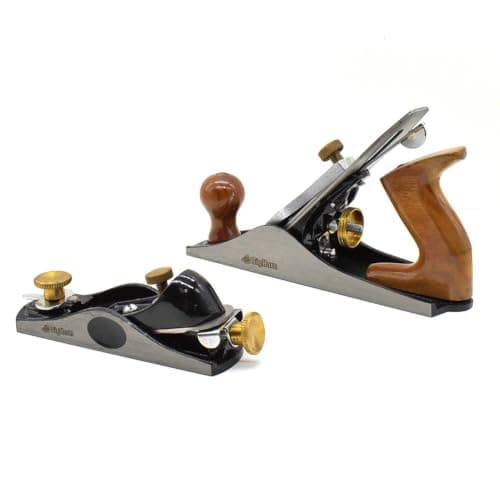
A No. 4 smoother and a low-angle No. 60-1/2 block plane in one box, which is the correct two-plane starting pair and not what most kits contain. Big Horn publishes no page for it, so everything beyond the two patterns is unverified.
The cheapest kit that pairs the two planes you actually need
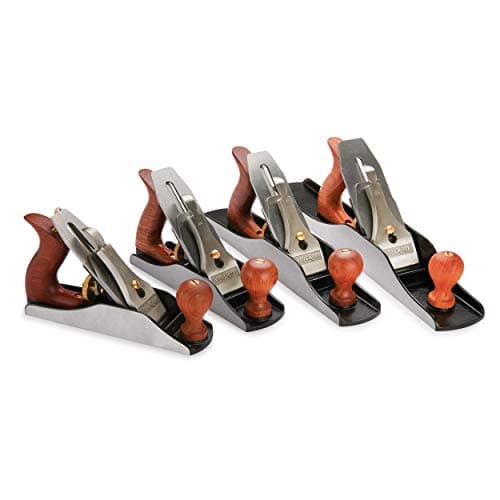
Four V3 bench planes — #3, #4, #5 and #6 — with a dimension, a blade width and a weight published for every one of them. It is a real kit from a real brand, and it is also four planes where almost everyone needs two.
The only full bench-plane kit from a brand that publishes specs
A Bedrock-pattern frog on a ductile cast body at roughly half the price of the premium options. The frog design is the meaningful part: it beds the iron along its full length, which is what kills chatter.
The same Bedrock-pattern frog and lapped ductile body as our best first plane, stretched to a 14 in jack, with a cryogenically treated O1 iron the maker actually publishes a thickness and hardness for. Nothing else on this page combines that frog, that iron and this price.
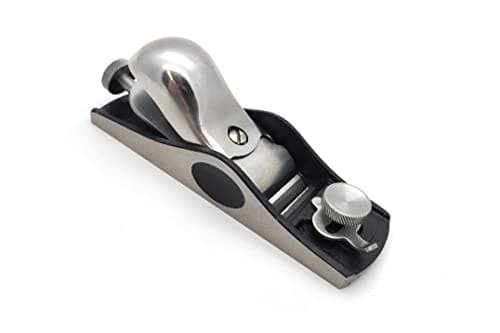
Adjustable mouth, stainless knuckle cap and adjustment screws, and a bed low enough to handle end grain properly. The stainless hardware is the detail that matters in a tool that lives in a pocket.
#ad· Live prices from the Amazon Product API, as of October 19, 2026. Where we have no verified live price we show none, and the cost-per-decade figure is suppressed with it — we would rather leave a gap than print a number that has rotted.
There are two hand plane sets worth discussing. The Big Horn 19877 kit pairs a No. 4 smoother with a low-angle No. 60-1/2 block plane, which is the correct two-plane start, and it costs less than most single planes on this site. The WoodRiver Ultimate Bench Plane Kit is four V3 planes — #3, #4, #5 and #6 — with a published dimension, blade width and weight for each one, and it is a four-figure purchase. For most people the answer is neither: buy a smoother, a jack and a low-angle block plane separately, which is the three-plane set at the bottom of this page.
That recommendation is not a dodge, and it is worth explaining before the picks, because the reason sets are rare here tells you something about the category. A plane is not a chisel. A four-chisel set makes sense because you need four widths of the same tool and buying them together is cheaper. A plane set has to justify every plane in the box individually, because each size is a different tool doing a different job, and the moment one of them is a size you will not use, the discount is gone.
What a “plane set” actually returns
We ran the search on the date on this page. Here is the honest shape of the market, because it is not what the phrase suggests.
Brass miniature sets. Three small brass planes — usually a block, a bullnose and a scraper — for twenty to sixty dollars, sold under a dozen names with no published steel, hardness, bed angle or dimension for any of them. These are modeling tools. They are the majority of the results and none of them is ranked here; the best mini hand planes covers them in detail and explains why.
Spokeshave and rasp kits. Legitimate tools, often good value, and not planes. If a spokeshave is what you want, what is a spokeshave is the primer.
Two real multi-plane kits. The Big Horn 19877 and the WoodRiver Ultimate Kit, both ranked below, both from brands this site already covers elsewhere.
Single planes with “set” in the title. A large share of the results are one plane whose listing mentions a blade set or a set screw. Worth knowing before you buy from a search page.
What every plane in a set has to earn
1. A job no other plane in the box does. This is where the four-plane kit struggles. A #3 and a #4 are 9-5/16 in and 9-7/8 in long with 1-3/4 in and 2 in irons: they are the same tool, half an inch apart, and almost nobody uses both. No. 4 vs No. 5 is the size comparison that matters, and the #5 and #6 in that kit are genuinely different tools.
2. An iron with an aftermarket. Everything in both kits takes a standard Bailey-pattern iron, which is the quiet advantage of buying full-size planes: the wear part is a commodity. Woodcraft catalogs V3 replacement blades for the #3, for the #4 and #5 together, and for the #6 and #7 together, so every plane in the big kit is renewable. The best replacement plane irons is the wider market.
3. A low-angle block plane somewhere in the set. This is the test the expensive kit fails and the cheap one passes. Four bench planes is four variations on pushing a 45 degree iron along a surface. A bevel-up block plane bedded at about 12 degrees does a different thing — it slices end grain instead of tearing it — and it is the plane you will reach for most often. Block plane vs bench plane is why those two are the starting pair.
4. Documentation. Woodcraft publishes a dimension, a blade width and a weight for all four planes in the Ultimate Kit. Big Horn publishes no page for the 19877 at all, so beyond the two patterns in the title nothing about it can be cited — no steel, no hardness, no sole tolerance, no weight, no warranty. It is ranked first anyway, on what it is: the right two planes at a price that makes the missing paperwork a reasonable trade. That is a judgment, and you should know it is one.
Sole tolerances, iron thickness and hardness published
Yes — adjustable-mouth low-angle block
The third row is the recommendation, and it is not a trick: those three planes are all ranked first or second in their own categories on this site, they publish their numbers, and bought together they cost a fraction of the four-plane kit. The only thing you give up is the box.
The order to buy them in
If you are assembling rather than buying a kit, the sequence matters more than the total, because each plane should earn its place before the next one arrives.
First: a No. 4 smoother. It is the plane that produces the finished surface, it is the one you will use on every project, and it is short enough to be forgiving. The best smoothing planes ranks them.
Second: a low-angle block plane. End grain, chamfers, trimming a proud plug, fitting a drawer. An adjustable mouth is the feature that separates the real ones from the ornaments, and the best block planes is ranked on exactly that.
Third: a No. 5 jack. The one that does the heavy work — flattening a board, taking a twist out, hogging stock off before the smoother touches it. The best jack planes covers it, and jack plane vs jointer plane is the honest version of whether you need a longer plane after it.
Fourth, and only if the work demands it: a jointer. A #6 or a #7 for long edges and glue joints. Most people who buy one early use it rarely; most people who buy one late wonder why they waited. The best jointer planes has the picks, and building a hand tool kit on a budget puts the whole sequence in order against everything else you need.
Every pick, in full
The write-ups
01The cheapest kit that pairs the two planes you actually need
Big Horn 19877 Bench & Block Plane Kit (No. 4 and 60-1/2)
Big Horn
6.8/10
A No. 4 smoother and a low-angle No. 60-1/2 block plane in one box, which is the correct two-plane starting pair and not what most kits contain. Big Horn publishes no page for it, so everything beyond the two patterns is unverified.
Cost per decade
$40.49
Horizon · tier C
20 years — No lifetime warranty; parts purchasable and resharpenable
No lifetime warranty published at the date checked. The iron is a standard Bailey-pattern size, so aftermarket replacements from third-party makers are purchasable, and the body is a casting with no consumable part.
Rebuy risk
Medium
parts listed, resharpenable
Sole & body
6.5
Iron & edge
6.0
Adjustment
6.5
Out of box
6.0
Parts & repair
7.0
Value
9.0
What it gets right
+The pairing is right: a smoother for surfaces and a low-angle block for end grain and chamfers covers most of a woodworking day
+A No. 4 iron is a standard 2 in Bailey size, so the wear part has a real aftermarket
+Costs less than either plane alone from most of the brands this site ranks
What it costs you
−Big Horn publishes no product page for this kit, so no steel, hardness, sole tolerance or weight can be cited
−No warranty terms of any length published
−Stock was thin at the date checked, and a kit that goes out of stock strands you mid-set
−Both planes will need their irons honed and their soles checked before they cut properly
Skip this if…
…you want documented specifications. Buy the two planes separately from makers that publish them and accept paying more.
Four V3 bench planes — #3, #4, #5 and #6 — with a dimension, a blade width and a weight published for every one of them. It is a real kit from a real brand, and it is also four planes where almost everyone needs two.
Cost per decade
$462.49
Horizon · tier C
20 years — No lifetime warranty; parts purchasable and resharpenable
No lifetime warranty published at the date checked. The iron is a standard Bailey-pattern size, so aftermarket replacements from third-party makers are purchasable, and the body is a casting with no consumable part.
Rebuy risk
Medium
parts listed, resharpenable
Sole & body
9.0
Iron & edge
8.5
Adjustment
8.5
Out of box
8.5
Parts & repair
8.0
Value
5.0
What it gets right
+Woodcraft publishes the contents list and a dimension, blade width and weight for each of the four planes
+V3 castings, and cataloged replacement blades for the #3, the #4/#5 and the #6/#7
+Covers smoothing, general bench work and edge jointing in one purchase, with no duplicate pattern
+A ductile-iron body in every size, so none of the four is the weak link
What it costs you
−Four figures of total spend, and the #3 overlaps the #4 so closely that most buyers will use one and shelve the other
−No warranty terms published for the kit or for the individual planes
−No jointer: a #6 is the longest plane in the box, so a long edge still wants a #7
−Buying the #4 and #5 alone from the same maker costs materially less and covers most of the same ground
Skip this if…
…this is your first set of planes. Buy a smoother and a jack, learn what you actually reach for, and fill the gaps you find.
Price as of October 19, 2026. Prices move; Amazon's is the one that counts.
#ad · we may earn a commission from this link to WoodRiver Ultimate Bench Plane Kit (#3, #4, #5, #6)
03Best plane per dollar if you sharpen your own
Size
No. 4, 9-3/8 in sole
Cutter width
2 in
Frog
Bedrock-style flat-top
Body
Ductile cast iron, lapped sides
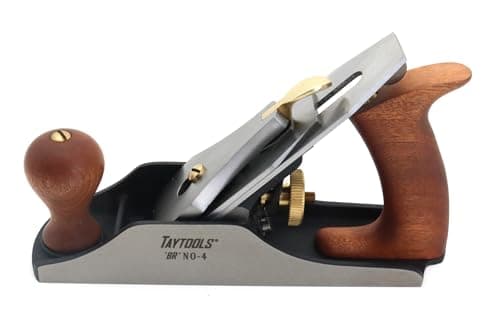
Taytools #4 Bedrock-Style Smoothing Plane
Taytools
8.0/10
A Bedrock-pattern frog on a ductile cast body at roughly half the price of the premium options. The frog design is the meaningful part: it beds the iron along its full length, which is what kills chatter.
Cost per decade
$59.99
Horizon · tier C
20 years — No lifetime warranty; parts purchasable and resharpenable
No lifetime warranty published at the date checked. The iron is a standard Bailey-pattern size, so aftermarket replacements from third-party makers are purchasable, and the body is a casting with no consumable part.
Rebuy risk
Medium
parts listed, resharpenable
Sole & body
8.5
Iron & edge
7.5
Adjustment
8.5
Out of box
7.5
Parts & repair
7.0
Value
9.0
What it gets right
+Bedrock frog geometry is the feature people pay a premium for elsewhere
+Sides lapped square, so it works on a shooting board out of the box
+Ductile iron body is less brittle than gray cast if it gets dropped
What it costs you
−No published warranty terms we could find, so it rates tier C not tier A
−Iron benefits from immediate honing; the factory grind is a shape, not an edge
−Brand has far less parts history behind it than Stanley
Skip this if…
…you want a documented lifetime warranty to point at. The tool is good; the paperwork behind it is not.
Bedrock-style, full-contact, mouth adjusts with iron in place
Body
Ductile cast iron, sole and sides lapped
Warranty
None published; 90-day return on unused items
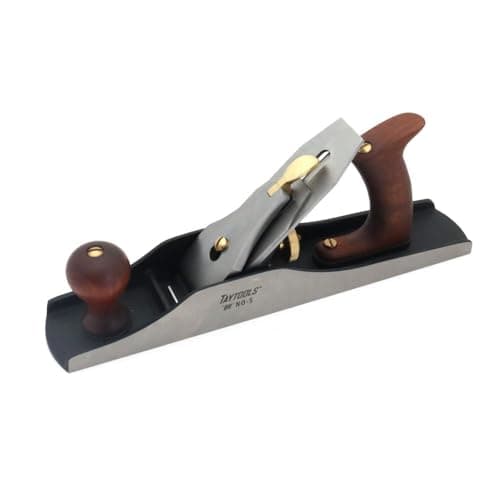
Taytools #5 Bedrock-Style Jack Plane
Taytools
8.2/10
The same Bedrock-pattern frog and lapped ductile body as our best first plane, stretched to a 14 in jack, with a cryogenically treated O1 iron the maker actually publishes a thickness and hardness for. Nothing else on this page combines that frog, that iron and this price.
Cost per decade
$70.00
Horizon · tier C
20 years — No lifetime warranty; parts purchasable and resharpenable
No lifetime warranty published at the date checked. The iron is a standard Bailey-pattern size, so aftermarket replacements from third-party makers are purchasable, and the body is a casting with no consumable part.
Rebuy risk
Medium
parts listed, resharpenable
Sole & body
8.5
Iron & edge
8.0
Adjustment
8.5
Out of box
8.0
Parts & repair
7.0
Value
9.0
What it gets right
+Bedrock frog with full-surface contact to the body, adjustable without pulling the iron — the feature the premium makers charge for
+Maker publishes the iron spec: 0.120 in O1, cryogenically treated, 54-58 HRc
+Sole and sides stated as lapped flat over the full length, so it can shoot as well as flatten
+Roughly half the money of the Woodcraft and Rockler jacks below it
What it costs you
−No warranty published and no flatness tolerance figure, unlike the Rockler and Big Horn planes
−54-58 HRc is softer than the A2 and O1 irons on the premium planes; expect to hone sooner
−Taytools states its own basic replacement irons do NOT fit its Bedrock planes, so a spare iron is not a catalog item
−Listed with a real but modest stock count at the time of check
Skip this if…
…you want a documented lifetime warranty. The Jorgensen one row down has one; this plane is here on the strength of its frog and iron, not its paperwork.
We earn nothing on this one
The best No. 5 you can buy in North America is a Lie-Nielsen, and it is not sold on Amazon, so we earn nothing on it. Ductile iron, a 0.125 in cryo-treated A2 iron at Rockwell 60-62, and — verbatim from the product page — materials and workmanship guaranteed for the life of the tool, with parts and repairs on request. Every figure there is quoted from the No. 5 product page at Lie-Nielsen Toolworks.
Adjustable mouth, stainless knuckle cap and adjustment screws, and a bed low enough to handle end grain properly. The stainless hardware is the detail that matters in a tool that lives in a pocket.
Cost per decade
$46.49
Horizon · tier C
20 years — No lifetime warranty; parts purchasable and resharpenable
No lifetime warranty published at the date checked. The iron is a standard Bailey-pattern size, so aftermarket replacements from third-party makers are purchasable, and the body is a casting with no consumable part.
Rebuy risk
Medium
parts listed, resharpenable
Sole & body
8.5
Iron & edge
7.5
Adjustment
8.5
Out of box
8.0
Parts & repair
7.0
Value
8.5
What it gets right
+Adjustable mouth is the single feature that separates a real block plane from a toy
+Stainless fittings resist the sweat and pocket grit that pit a block plane first
+Machining quality well above the price band
What it costs you
−No published warranty terms
−Iron wants honing before first use like everything else here
−Knuckle cap is a preference; some people want a plain lever cap
Skip this if…
…your hands are large. A block plane is a one-handed tool and this is a compact one.
We earn nothing on this one
The Veritas low-angle block plane is the better tool and we earn nothing on it — it sells direct only. Worth knowing before you buy: Lee Valley publishes a three-month satisfaction guarantee rather than a defect warranty, which is not the lifetime cover the tool's reputation implies. That guarantee wording is published by Lee Valley / Veritas.
Best kit: the Big Horn 19877. A No. 4 and a low-angle 60-1/2 is the pairing that covers surfaces and end grain, which is most of a woodworking day, and both planes take standard irons so the wear parts have an aftermarket. Big Horn publishes nothing about it, stock was thin at the date checked, and both planes will need honing and a sole check before they cut properly. At this price those are the trades, not surprises.
Best kit if money is not the constraint: the WoodRiver Ultimate Bench Plane Kit. Four V3 planes with published figures for each, ductile iron throughout, and cataloged replacement blades across the range. It is a real kit from a real brand. It is also four bevel-down bench planes with no block plane and no jointer, and the #3 duplicates the #4 closely enough that one of them will live in a cupboard.
Best way to buy three planes: separately. The Taytools #4 Bedrock-style smoother, the Taytools #5 Bedrock-style jack and the Taytools #9-1/2 low-angle block plane are each ranked at or near the top of their own category here, publish their sole tolerances and iron specifications, and together cover smoothing, stock removal and end grain. Nothing in the box is a size you will not use.
What to avoid: any set whose listing does not name the plane patterns it contains, and every brass miniature set sold as a “woodworking plane set”. If the listing cannot tell you which planes are in the box, it is not a set, it is a photograph.
Second-hand is the other real answer
A Stanley Bailey No. 4 and No. 5 from the first half of the twentieth century can usually be had for less than a new budget plane each, and the castings are better than anything at that price today. The trade is work: cleaning, flattening the sole, and sharpening an iron that has probably not been properly sharp in fifty years.
Buying used hand tools is what to look for and what to walk away from, how to restore a hand plane is the process end to end, and vintage vs new planesis the honest comparison of the two routes. If you enjoy the restoring, this is the cheapest good set of planes available to anyone. If you do not, buy new and skip it — a plane you are avoiding because it needs work is worse than a cheaper plane that cuts.
Cost per decade on a set versus three planes
A kit changes the arithmetic in one way only: it buys several castings at once, and the casting is the part that lasts. Everything that wears — the iron, in practice — is bought per plane either way, so a four-plane kit is four iron horizons, not one.
That is why the duplication matters financially and not just logically. A #3 you never use still has a cost: it is money that bought a casting doing nothing, and it displaced the block plane the kit does not include. Neither Woodcraft nor Big Horn publishes a defect warranty on these planes; Woodcraft publishes a 90-day satisfaction guarantee, which is a returns policy. Cost per decade is the arithmetic and warranties and repairability is why the parts catalog matters more than the promise.
Questions
Frequently asked
Is a hand plane set worth buying?+
Only if every plane in it is a size you will use. A two-plane kit pairing a No. 4 with a low-angle block plane is good value because both get used constantly. A four-plane bench kit usually contains at least one duplicate size and no block plane, which makes buying three planes separately the better purchase.
What three hand planes should a beginner own?+
A No. 4 smoother, a low-angle block plane with an adjustable mouth, and a No. 5 jack, in that order. The smoother makes the finished surface, the block plane does end grain and fitting, and the jack does the heavy stock removal. A jointer comes fourth and only if you are gluing up long edges.
Why are there so few real hand plane sets?+
Because each plane size is a different tool. A chisel set is four widths of one tool, so buying together is a straight saving; a plane set has to justify every size in the box, and the moment one is a size you will not use the discount evaporates. Most makers sell planes individually for that reason.
Are the cheap three-piece brass plane sets any good?+
As modeling tools, they are usable. As woodworking planes, no: no maker publishes a steel, a hardness or a bed angle for any of them, the irons are too thin to hold an edge under load, and there is nothing meaningful to adjust. They are the most common result for a plane set search and they are not what the phrase implies.
Should I buy a used set instead?+
It is the cheapest good answer if you are willing to do the work. A vintage Bailey No. 4 and No. 5 pair usually costs less than two new budget planes and the castings are better, but each needs cleaning, a sole check and a properly sharpened iron before it will cut.
We have not handled these tools. Nobody here has tested one, owned one, or taken one apart. Specifications come from the manufacturer or the retailer listing; warranty terms come from the maker's own warranty page; the cost-per-decade arithmetic is ours and reproducible. Where we could not verify a figure we say so on the page rather than quietly leaving it out. Read the full method.