A new iron is the cheapest upgrade in the workshop and the easiest one to buy wrong. Here is what each maker actually publishes, and which plane each blade will physically fit.
We earn a commission when you buy through our Amazon links, at no extra cost to you. It never decides a ranking, and where the best tool in a class is one we earn nothing on, we say so and link it anyway. How this works.
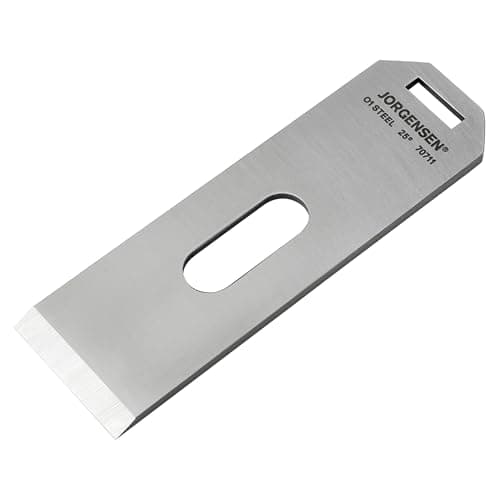
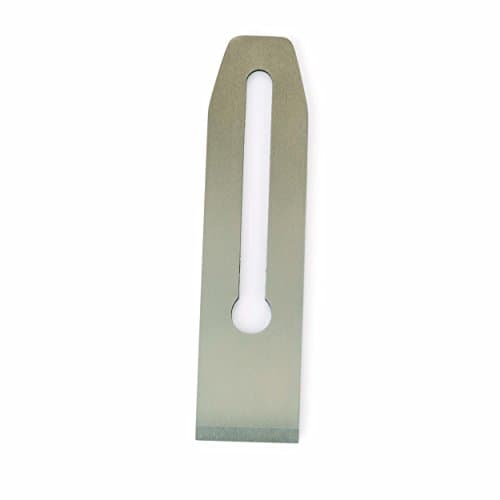
Almost the only blade at this price whose maker will name the steel: O1, published at Rockwell 60-64, 3 mm thick and 2 in wide. It is not a Hock, and it does not need to be — it is the cheapest honest way to find out whether you actually prefer an O1 edge.
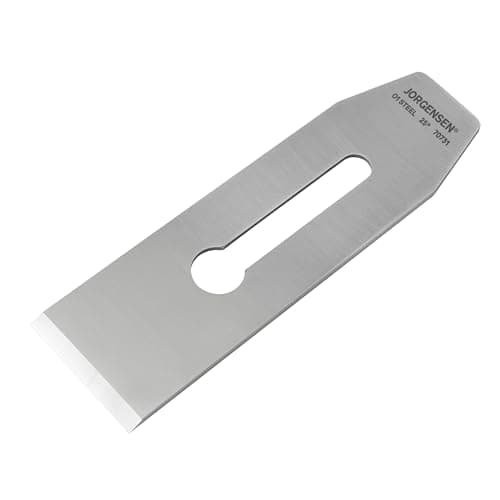
The same published specification as the bench blade above, in block plane width: O1 at Rockwell 60-64, 3 mm thick, 35 mm wide, ground at 25 degrees. A stock block plane iron is usually the thinnest, softest part of a cheap block plane, which makes this the highest-leverage few dollars in the category.
The only block plane iron here whose maker publishes a hardness
The widest blade here and the only one sold with an explicit multi-brand fitment claim: Taytools states its blades also fit WoodRiver planes and some non-vintage Stanley and Record planes. The dimensions are published, the hardness appears only in the retail listing, and the steel grade is published nowhere.
The correct spare for a WoodRiver V3 smoother or jack, and the reason that plane rates as a long-horizon tool at all: the wear part is purchasable. What Woodcraft will not tell you is what it is made of. The specification reads 'hardened, precision-ground steel' and a 25 degree bevel, and stops there.
Owners of a WoodRiver V3 who want the factory part
The same blade in 2-3/8 in, covering four planes in the WoodRiver line rather than two. Same virtue and same omission as the smaller one: the fitment is certain and the metallurgy is a phrase rather than a figure.
A WoodRiver jointer, or its wide-bodied No. 4-1/2 and No. 5-1/2
The narrow blade in the range, published at 1-3/4 in by 7-1/8 in, and the only WoodRiver blade whose listing names a plane from another maker: Woodcraft also lists it as fitting the Stanley #5-1/4. That one sentence is the most useful thing on any of these three listings.
A small smoother, and the one blade here cross-listed to a Stanley
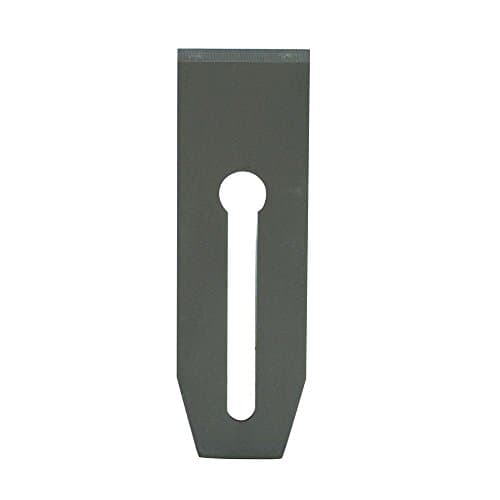
The floor of the category, and honest about being it. Nothing is published beyond the width: no grade, no hardness, no thickness. Its real use is diagnostic — if a fresh cheap iron transforms the plane, the old iron was the fault, and a documented blade is the actual upgrade.
The cheapest way to find out whether the iron is your problem
#ad· Live prices from the Amazon Product API, as of October 16, 2026. Where we have no verified live price we show none, and the cost-per-decade figure is suppressed with it — we would rather leave a gap than print a number that has rotted.
The iron is the only part of a hand plane that wears out. Everything else — the casting, the frog, the lever cap, the tote — is still doing its job in a century-old Bailey pulled out of a barn. The blade is not: you grind it back a little every time you sharpen it, and after enough decades there is not enough steel left above the adjuster slot to clamp. That single asymmetry is why a plane whose iron you can replace is a tool and a plane whose iron you cannot replace is a countdown, and it is why this page exists.
Most people shopping for a replacement iron do not have a blade problem. They have a setup problem. That is worth saying at the top of a page that earns a commission when you buy something. A plane that chatters, tears out or refuses to take a shaving is far more often a plane with a dull factory edge, a badly seated frog, a loose lever cap or a cap iron parked too far back than a plane with the wrong steel in it. Work through hand plane troubleshooting and how to set up a hand plane before you spend anything. If the symptom survives all of that, the iron is genuinely a candidate, and the rest of this page is for you.
How we ranked these
Five things decide the order, and they are the same five for every blade on the page. None of them is a feeling about the edge in use, because we have not used these — the notice above this page says so, and our methodology explains what we do instead.
1. Published steel grade.A maker who names the steel — O1, A2, anything with a designation behind it — has told you what edge behavior to expect, because those designations have published compositions. A maker who writes “hardened, precision-ground steel” has told you nothing, and it is remarkable how much of this category does exactly that. Two of the seven blades below name a grade. Four do not name one anywhere.
2. Published hardness.A hardness figure is the difference between a blade that holds an edge and a blade that folds on the first knot. Jorgensen publishes Rockwell 60–64 on both of its blades. The Taytools blade carries RC 55–60 in the retail listing and nowhere on the maker's own size table. The three WoodRiver blades and the GreatNeck blade publish no figure at all. One oddity that says something about this maker: Jorgensen publishes the hardness of the replacement block plane iron and not of the identical iron that ships in the plane, which we picked through in the Jorgensen block plane review.
3. Thickness. Chatter is a stiffness problem, and stiffness in a plane iron is thickness. This is the single most reliable improvement a replacement blade delivers, which is why a thick aftermarket iron transforms a light vintage plane and does very little for a plane that already came with a heavy one. Two blades here publish a thickness. One publishes two different thicknesses in two different places, which we have written into its spec table exactly as we found it.
4. Stated fitment.The most expensive mistake in this category is a blade that does not fit, and fitment is where the listings are vaguest. A blade has to match the width of your mouth, the length from the edge to the adjuster slot, and the clearance under your lever cap. Only two of these blades make any fitment claim beyond their own maker's planes, and both of those claims are hedged. We rank an explicit, written fitment statement well above a generous-sounding one.
5. Cost per decade.Every card below carries the arithmetic, and for a plane iron it is unusually flattering across the board, because a blade has no consumable part inside it. It is steel; it renews itself on the stone until it runs out. Spread over twenty years the gap between the cheapest and dearest blade here is small in absolute terms — which cuts both ways, and we say so on each card. The tier table is on cost per decade.
The honest shape of this market
This is a category with a hole in the middle of it. At the bottom sit unbranded blades that publish nothing. At the top sit the irons that woodworkers actually talk about — Hock, Veritas, Lie-Nielsen, IBC — and not one of them is sold through Amazon. They are sold direct by their makers or through specialist retailers, we earn nothing on any of them, and we would rather tell you that than pretend the ranked list below is the whole field.
Ron Hock's O1 iron is the reference blade in North America: high-carbon tool steel at a published 0.95% carbon, Rc62, ground in the USA, and sold through Woodcraft rather than Amazon. Hock's A2 blade is published at 62 HRC with cryogenic treatment that, in the retailer's words, “increases the toughness of the steel without affecting its hardness” and “significantly reduces edge chipping when working with challenging woods.” Lie-Nielsen publishes A2 at Rockwell 60–62, cryogenically treated, and maintains a full replacement-blade catalog. Those are the answers if budget is not the constraint, and the notes on our picks link them anyway, because a page that quietly omits the best tool in a class because it pays nothing is the exact failure this site exists to avoid.
Ranked on documentation, not on reputation
The order below will look strange if you expect price to track quality. It does not here. The two blades at the top are among the cheapest on the page, and they are at the top for one reason: their maker publishes the grade, the hardness, all three dimensions and the grind angle, and then states which plane the blade is for. The three WoodRiver blades sit lower not because they are bad — they are the correct factory spares for a well-regarded plane, and their existence is precisely what makes that plane a long-horizon purchase — but because almost nothing about the steel is disclosed. We are ranking what can be checked. That is the only thing we can honestly rank.
Almost the only blade at this price whose maker will name the steel: O1, published at Rockwell 60-64, 3 mm thick and 2 in wide. It is not a Hock, and it does not need to be — it is the cheapest honest way to find out whether you actually prefer an O1 edge.
Cost per decade
$10.49
Horizon · tier C
20 years — No lifetime warranty; parts purchasable and resharpenable
No lifetime warranty published by the manufacturer at the date checked. Monolithic edge tool: no separately consumable part, and the edge is renewable by sharpening for as long as there is steel left.
Rebuy risk
Medium
parts listed, resharpenable
Steel & edge
8.5
Thickness
8.5
Fitment
6.0
Published specs
9.0
Value
9.5
What it gets right
+Jorgensen publishes the grade, the hardness range and both dimensions — most blades at any price publish none of them
+3 mm is roughly half again the thickness of a stock Bailey-pattern iron, which is where chatter goes away
+O1 comes back to sharp in a fraction of the strokes A2 asks for
+Nothing on it is consumable: it is renewable by sharpening until the steel runs out
What it costs you
−Jorgensen states fitment only for its own No. 4 and No. 5 planes; 2 in is the common Bailey-pattern width but the maker does not publish Stanley or Record fitment
−O1 rusts. Half a percent of chromium is not corrosion resistance, and a damp shop will find that out
−Edge life is genuinely shorter than A2's — you are trading it for sharpening speed
−No warranty terms published for the blade
Skip this if…
…you resent sharpening. The whole argument for O1 is that resharpening is cheap in minutes, and that only pays if you are willing to do it more often.
We earn nothing on this one
The reference O1 iron in North America is Ron Hock's — 0.95% carbon, Rc62, ground in the USA, and roughly twice this price. It is not sold on Amazon, so we earn nothing on it, and we cite it here as the yardstick rather than as somewhere to send you. Those figures come from its listing at Woodcraft.
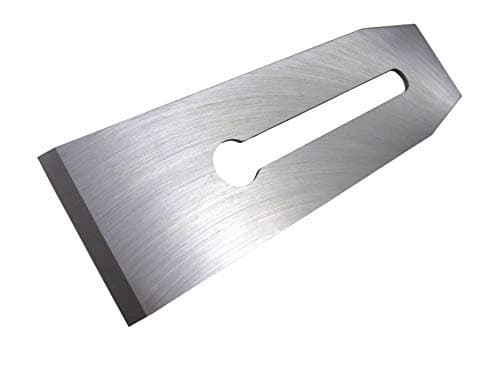
The same published specification as the bench blade above, in block plane width: O1 at Rockwell 60-64, 3 mm thick, 35 mm wide, ground at 25 degrees. A stock block plane iron is usually the thinnest, softest part of a cheap block plane, which makes this the highest-leverage few dollars in the category.
Cost per decade
$6.49
Horizon · tier C
20 years — No lifetime warranty; parts purchasable and resharpenable
No lifetime warranty published by the manufacturer at the date checked. Monolithic edge tool: no separately consumable part, and the edge is renewable by sharpening for as long as there is steel left.
Rebuy risk
Medium
parts listed, resharpenable
Steel & edge
8.5
Thickness
8.5
Fitment
6.0
Published specs
9.0
Value
9.0
What it gets right
+Grade, hardness, all three dimensions and the grind angle are published, which almost nothing else in this category manages
+3 mm is a genuinely heavy iron for a block plane, and mass is what stops chatter on end grain
+35 mm is the nominal width of the classic 60-1/2 pattern, so the odds of it fitting a 60-1/2-pattern plane from another maker are good
+Nothing on it is consumable — it is renewable by sharpening until the steel runs out
What it costs you
−Jorgensen publishes fitment for its own No. 60-1/2 only; any other plane is your measurement, not the maker's claim
−A 3 mm iron may not seat in a block plane with a tight, non-adjustable mouth without opening the mouth first
−O1 rusts, and a block plane lives in a pocket or an apron where it gets handled constantly
−No warranty terms published for the blade
Skip this if…
…your block plane has a fixed mouth you are unwilling to file. A thicker iron in a tight mouth simply will not seat, and finding that out afterwards is a wasted purchase.
Price as of October 16, 2026. Prices move; Amazon's is the one that counts.
#ad · we may earn a commission from this link to Jorgensen Replacement Block Plane Blade, O1, No. 60-1/2
03Putting a fresh edge in a jointer
Width
2-3/8 in
Length
7-5/8 in
Thickness
0.125 in on the maker's size table; 0.110 in in the retail listing
Hardness
RC 55-60, stated in the retail listing only
Fitment
Taytools #4-1/2, #5-1/2, #6, #7; not Taytools Bedrock
Taytools Replacement Blade for #6 and #7 Bench Planes
Taytools
7.9/10
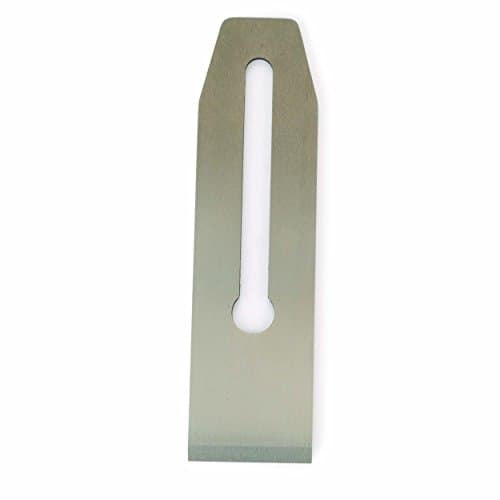
The widest blade here and the only one sold with an explicit multi-brand fitment claim: Taytools states its blades also fit WoodRiver planes and some non-vintage Stanley and Record planes. The dimensions are published, the hardness appears only in the retail listing, and the steel grade is published nowhere.
Cost per decade
$14.84
Horizon · tier C
20 years — No lifetime warranty; parts purchasable and resharpenable
No lifetime warranty published by the manufacturer at the date checked. Monolithic edge tool: no separately consumable part, and the edge is renewable by sharpening for as long as there is steel left.
Rebuy risk
Medium
parts listed, resharpenable
Steel & edge
7.0
Thickness
8.5
Fitment
8.5
Published specs
8.0
Value
7.5
What it gets right
+Width, length, thickness and bevel angle are all published, which puts it ahead of every unnamed-steel blade in this class
+Taytools states the blades also fit WoodRiver planes and some non-vintage Stanley and Record planes — a rare fitment claim in writing
+Explicitly rules out its own Bedrock planes, which is the kind of negative detail most listings omit
+A 2-3/8 in iron covers the No. 6 and No. 7 as well as the wide-bodied No. 4-1/2 and No. 5-1/2
What it costs you
−The steel grade is not published anywhere — you are buying 'hardened tool steel' and a hardness range
−RC 55-60 is softer than the Rockwell 60-64 the Jorgensen blades publish, and the bottom of that range is soft for a plane iron
−The maker's size table and the retail listing disagree on thickness, 0.125 in against 0.110 in, so check your lever cap clearance
−'Some non-vintage Stanley and Record' is a real hedge; pre-war planes are not covered by it
Skip this if…
…your jointer is a vintage Stanley or Record. Taytools limits its fitment claim to non-vintage examples, and a blade that will not sit under the lever cap is worth nothing.
We earn nothing on this one
If you want a jointer iron whose steel is documented rather than described, Lie-Nielsen publishes A2 at Rockwell 60-62, cryogenically treated, and runs a full replacement-blade catalog. It costs several times this, it is not on Amazon and we earn nothing on it. Those published figures are from the replacement-blade catalog at Lie-Nielsen Toolworks.
Price as of October 16, 2026. Prices move; Amazon's is the one that counts.
#ad · we may earn a commission from this link to Taytools Replacement Blade for #6 and #7 Bench Planes
04Owners of a WoodRiver V3 who want the factory part
Fitment
WoodRiver V3 No. 4 and No. 5 bench planes
Steel
'Hardened, precision-ground steel'; grade not published
Bevel
25 degrees
Hardness
Not published
Thickness
Not published
WoodRiver V3 Replacement Blade, No. 4 / No. 5
WoodRiver
6.2/10
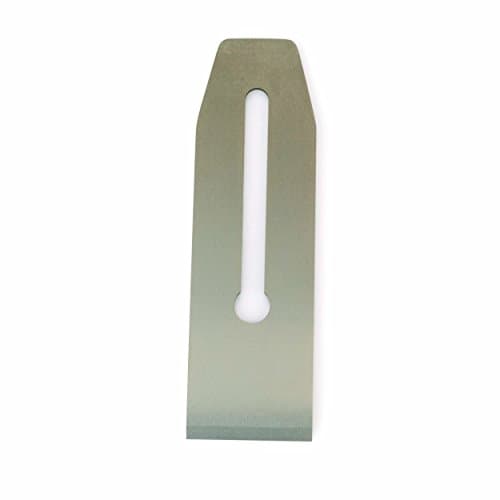
The correct spare for a WoodRiver V3 smoother or jack, and the reason that plane rates as a long-horizon tool at all: the wear part is purchasable. What Woodcraft will not tell you is what it is made of. The specification reads 'hardened, precision-ground steel' and a 25 degree bevel, and stops there.
Cost per decade
$15.99
Horizon · tier C
20 years — No lifetime warranty; parts purchasable and resharpenable
No lifetime warranty published by the manufacturer at the date checked. Monolithic edge tool: no separately consumable part, and the edge is renewable by sharpening for as long as there is steel left.
Rebuy risk
Medium
parts listed, resharpenable
Steel & edge
6.5
Thickness
6.0
Fitment
7.5
Published specs
4.5
Value
6.5
What it gets right
+It is the maker's own spare, so fitment in a WoodRiver V3 is not a gamble
+Its existence is what makes a WoodRiver a tool rather than a countdown — the consumable part can actually be bought
+Ships ground at 25 degrees, the right starting bevel for a bevel-down bench plane
+Sold by a national retailer with real stock rather than a single marketplace seller
What it costs you
−Woodcraft publishes neither the steel grade, the hardness nor the thickness — three of the five things that decide whether an iron is worth having
−Costs more than the Jorgensen blade, which publishes all three
−Fitment is stated for WoodRiver V3 planes only; nothing is claimed about Stanley or Record
−No warranty terms published for the blade
Skip this if…
…you are re-ironing a vintage Bailey and hoping this is the upgrade. It is a factory spare for a specific modern plane, priced accordingly, and the maker makes no claim that it fits anything else.
05A WoodRiver jointer, or its wide-bodied No. 4-1/2 and No. 5-1/2
Width
2-3/8 in
Fitment
WoodRiver V3 No. 4-1/2, No. 5-1/2, No. 6, No. 7
Bevel
25 degrees
Steel
'Hardened, precision-ground steel'; grade not published
Hardness
Not published
WoodRiver V3 Replacement Blade, No. 6 / No. 7
WoodRiver
6.0/10
The same blade in 2-3/8 in, covering four planes in the WoodRiver line rather than two. Same virtue and same omission as the smaller one: the fitment is certain and the metallurgy is a phrase rather than a figure.
Cost per decade
$21.49
Horizon · tier C
20 years — No lifetime warranty; parts purchasable and resharpenable
No lifetime warranty published by the manufacturer at the date checked. Monolithic edge tool: no separately consumable part, and the edge is renewable by sharpening for as long as there is steel left.
Rebuy risk
Medium
parts listed, resharpenable
Steel & edge
6.5
Thickness
6.0
Fitment
7.5
Published specs
4.5
Value
5.5
What it gets right
+One part number covers four planes in the range, the widest fitment span on this page
+Maker's own spare, so it seats under the lever cap without shimming or grinding
+The jointer is the plane you least want to stop mid-edge for, and a second iron is what prevents that
+Renewable by sharpening for as long as there is steel above the slot
What it costs you
−The most expensive blade on this page and the least documented per dollar
−Steel grade, hardness and thickness all unpublished
−No fitment claim for any plane outside the WoodRiver V3 line
−No warranty terms published for the blade
Skip this if…
…you only plane boards under about three feet. A jointer iron is a lot of steel to keep flat on a stone, and a No. 5 blade sharpened more often does the same work.
06A small smoother, and the one blade here cross-listed to a Stanley
Blade
1-3/4 in by 7-1/8 in
Fitment
WoodRiver V3 No. 3; also listed for the Stanley #5-1/4
Steel
'Hardened, precision-ground steel'; grade not published
Hardness
Not published
WoodRiver V3 Replacement Blade, No. 3
WoodRiver
5.9/10
The narrow blade in the range, published at 1-3/4 in by 7-1/8 in, and the only WoodRiver blade whose listing names a plane from another maker: Woodcraft also lists it as fitting the Stanley #5-1/4. That one sentence is the most useful thing on any of these three listings.
Cost per decade
$14.49
Horizon · tier C
20 years — No lifetime warranty; parts purchasable and resharpenable
No lifetime warranty published by the manufacturer at the date checked. Monolithic edge tool: no separately consumable part, and the edge is renewable by sharpening for as long as there is steel left.
Rebuy risk
Medium
parts listed, resharpenable
Steel & edge
6.5
Thickness
6.0
Fitment
6.5
Published specs
5.0
Value
5.5
What it gets right
+Dimensions are published, unlike the other two WoodRiver blades
+The listing names a non-WoodRiver plane it fits, which is genuinely rare cross-fitment information
+A No. 3 is often bought secondhand with a used-up iron, so a new blade is the whole repair
+Nothing on it is consumable beyond the steel itself
What it costs you
−Steel grade, hardness and thickness are all unpublished
−Narrower than most bench-plane blades, so it is useless as a general-purpose spare
−The Stanley #5-1/4 cross-listing is Woodcraft's claim, not Stanley's — check your own iron against it
−No warranty terms published for the blade
Skip this if…
…your smoother is a No. 4. The widths are not interchangeable, and 1-3/4 in will sit loose and skew in a 2 in mouth.
07The cheapest way to find out whether the iron is your problem
Width
2 in
Steel
Hardened steel; grade not published
Hardness
Not published
Warranty
GreatNeck's lifetime warranty excludes blades by name
GreatNeck PLS2 Replacement Plane Blade, 2 in
GreatNeck
5.4/10
The floor of the category, and honest about being it. Nothing is published beyond the width: no grade, no hardness, no thickness. Its real use is diagnostic — if a fresh cheap iron transforms the plane, the old iron was the fault, and a documented blade is the actual upgrade.
Cost per decade
$5.00
Horizon · tier C
20 years — No lifetime warranty; parts purchasable and resharpenable
The maker publishes a limited lifetime warranty on its tools and excludes blades from it by name, so this item is sold with no cover at all. Rated on the item itself: monolithic hardened steel, no separately consumable part, and the edge is renewable by sharpening for as long as there is steel left.
Rebuy risk
Medium
parts listed, resharpenable
Steel & edge
5.0
Thickness
4.5
Fitment
6.0
Published specs
3.5
Value
8.0
What it gets right
+The least expensive way to rule the iron in or out as the cause of a plane that will not cut cleanly
+2 in is the standard Bailey-pattern bench width, so it is at least the right size for the commonest planes
+A spare iron means you can keep planing while the other one is on the stone
+No consumable part and no mechanism — it is steel, and steel resharpens
What it costs you
−Neither grade nor hardness is published, so there is no way to know what edge life you are buying
−GreatNeck publishes a limited lifetime warranty on its tools and excludes blades from it by name, so this item carries nothing
−Listed as a block plane blade at a 2 in bench-plane width — measure your own iron before ordering
−Almost certainly no thicker than the stock iron in a budget plane, so it will not fix chatter
Skip this if…
…your plane already cuts and you want it to cut better. This is a like-for-like replacement at the bottom of the market, not an upgrade, and spending three times as much on a documented iron is the actual fix.
Fitment first, because nothing else matters if it does not seat
Three measurements decide whether a blade will work in your plane, and none of them is negotiable. Width must match the mouth: a 2 in iron in a 2 in bench plane, a 1-3/4 in iron in a No. 3. Too wide and it fouls the sides of the mouth; too narrow and it skews under load and leaves a step at the edge of the cut. Length and the position of the adjuster slot decide whether the depth adjuster can engage at all, which is why blades are sold per plane number rather than per width alone. Thickness decides whether the lever cap will close over it and whether the iron will pass through the mouth opening at your working depth.
Take the old iron out and measure it with a caliper before you buy anything. That takes two minutes and is more reliable than any listing on this page, including the ones with explicit fitment claims. If your plane is a vintage Stanley or Record, be especially careful: Taytools limits its fitment claim to “some non-vintage” examples of both, which is a candid way of saying the old ones vary. The plane numbering system tells you the sole length, not the iron width, and the two do not always track.
Thickness is the upgrade; steel grade is the preference
These two get conflated constantly and they do completely different jobs. A thicker iron adds stiffness, and stiffness is what stops the blade vibrating against the wood at the moment of cut. That vibration is chatter, and it prints as a fine washboard on the surface. If your plane chatters in hardwood and the frog is properly seated, a heavier iron is the fix, and it is a fix you will notice on the first pass.
Steel grade decides something else: how long the edge lasts and how long it takes to bring back. O1 is a plain oil-hardening carbon steel with roughly half a percent of chromium in it. A2 has five percent chromium plus molybdenum and vanadium, and published technical data puts it “intermediate in wear resistance between O1 oil-hardening tool steel and D2”. In practice that means A2 holds an edge longer and takes noticeably more work on the stones to renew, and O1 comes back to sharp in a fraction of the strokes and needs renewing sooner. One specialist retailer that sells both says outright that it prefers O1 “since it sharpens much quicker and holds a consistently sharp edge”. Neither is the right answer for everyone. The full breakdown is on A2 versus O1 steel.
There is a corrosion consequence to that choice worth knowing before you order. Half a percent of chromium is not corrosion resistance, so an O1 iron in a damp shop or a garage will find rust. That is manageable — a wipe of camellia oil or a film of wax after use ends the problem — but it is a habit you have to actually keep. Rust removal and prevention covers what works.
The cap iron is half the tearout story
Buying a new blade to cure tearout, without touching the cap iron, is the commonest wasted purchase in this category. The cap iron sitting on top of the blade is not a stiffener and it is not a chip deflector by accident — set close behind the edge, it breaks the shaving as it lifts and stops the split running ahead of the cut into the wood you wanted to keep. That mechanism does more for figured timber than a change of steel does.
It also has to mate perfectly. If there is any daylight between the leading edge of the cap iron and the back of the blade, shavings jam in the gap and the plane clogs every third pass. A new, thicker iron changes that fit, which means a replacement blade almost always means fettling the cap iron to match it. Budget for that before you order, and read what a cap iron does first.
None of these arrive sharp
Every blade on this page ships ground, not honed. A 25 degree grind is a starting bevel and a factory grinding finish, not a working edge, and a new iron straight from the box will cut worse than the tired one you took out. The first session is real work: flatten the back properly for the first half inch or so behind the edge, then hone the bevel through your grits. Full procedure is on how to sharpen a plane iron, and sharpening angles explained covers where to put the secondary bevel.
This has a direct bearing on what to buy. If you do not already own a stone that will flatten a back, buy that before you buy a blade — the new iron cannot outperform the old one until it has been sharpened, and an unsharpened premium blade is strictly worse than a sharp cheap one. The sharpening starter kit is the honest first purchase for most people reading this page.
When a new iron is the wrong purchase entirely
Three cases. First, if the plane's sole is genuinely out of flat, no blade will save it, and flattening the sole is the job in front of you. Second, if the plane is a very cheap casting with a soft, loose adjuster, a good iron in it is money attached to a body that will never hold a setting; the whole tool is the problem. Third, if the plane is a vintage Bailey with a serviceable iron, the honest arithmetic often says clean and tune what you have. That is the case vintage versus new planes makes at length, and it is the cheapest route into good planing that exists.
Where a new iron genuinely earns its money is the fourth case: a decent body, a sound mechanism, and an iron that is either worn short, pitted through at the edge, or so thin that the plane chatters no matter how well it is set. That is a real repair on a tool worth repairing, and it is the whole buy-it-for-life argument in miniature. If instead you are starting from nothing, buy the plane first — our main hand plane roundup covers that decision.
Questions
Frequently asked
Is a replacement plane iron worth it?+
On a plane with a sound body and a working adjuster, yes — a thicker, harder iron is the cheapest meaningful upgrade available, and it fixes chatter that no amount of tuning will. On a plane with an out-of-flat sole or a sloppy adjuster, no: you are attaching a good part to a bad tool. Check the troubleshooting page first, because most complaints about a plane turn out to be complaints about its setup.
How do I know which replacement blade fits my plane?+
Take the old iron out and measure three things: the width, the overall length, and the thickness. Width has to match your mouth, length and slot position have to let the depth adjuster engage, and thickness has to clear under the lever cap. Manufacturer fitment claims are useful but almost all of them are limited to that maker's own planes, and the one broad claim on this page explicitly excludes vintage Stanley and Record examples.
Are thicker plane irons better?+
For chatter, yes — stiffness scales with thickness, and chatter is a stiffness problem. For edge retention, no: that comes from the steel and its hardness, not its section. A thicker iron also has two costs. It may not pass the mouth of a plane with a fine fixed opening, and it is more steel to flatten on the first sharpening.
O1 or A2 for a plane iron?+
O1 sharpens faster and dulls sooner; A2 holds longer and takes appreciably more work on the stones. Published technical data puts A2's wear resistance between O1 and D2, which is the trade in one line. If you sharpen willingly and often, O1 is the pleasanter blade. If you resent stopping mid-project, A2 is worth the slower sharpening. The full comparison is on A2 versus O1 steel.
Do replacement plane irons come sharp?+
No. Every blade here ships ground to a bevel, usually 25 degrees, and a grinding finish is not a working edge. Expect to flatten the back for the first half inch behind the edge and hone through your grits before the first shaving. A new blade that has not been sharpened will cut worse than the worn one you removed.
Will a new blade fix tearout?+
Partly, and usually less than the cap iron will. Tearout is the shaving splitting ahead of the edge; a cap iron set close behind the edge breaks that split before it runs. A sharper, harder iron helps, and a tighter mouth helps, but if you change only one thing, change the cap iron setting. See what a cap iron does.
Can I put an aftermarket iron in a vintage Stanley?+
Often, but check rather than assume. Bailey-pattern widths are broadly standard — 2 in for a No. 4 and No. 5 — and that is why aftermarket irons exist at all. What varies is the slot position and the lever cap clearance across a century of production. The only blade on this page whose listing names a Stanley at all is the WoodRiver No. 3 blade, which Woodcraft also lists for the Stanley #5-1/4. Everything else is your measurement. Buying used hand tools covers what else to check on a vintage body.
Why do so many plane blades not say what steel they are?+
Because naming a grade is a commitment that can be checked, and a phrase like “hardened, precision-ground steel” cannot. Four of the seven blades on this page publish no grade anywhere, and three publish no hardness figure either. That is not proof the steel is bad — it is proof you are trusting rather than checking, and it is why the two blades whose maker publishes both sit at the top of this list.
We have not handled these tools. Nobody here has tested one, owned one, or taken one apart. Specifications come from the manufacturer or the retailer listing; warranty terms come from the maker's own warranty page; the cost-per-decade arithmetic is ours and reproducible. Where we could not verify a figure we say so on the page rather than quietly leaving it out. Read the full method.