We earn a commission when you buy through our Amazon links, at no extra cost to you. It never decides a ranking, and where the best tool in a class is one we earn nothing on, we say so and link it anyway. How this works.
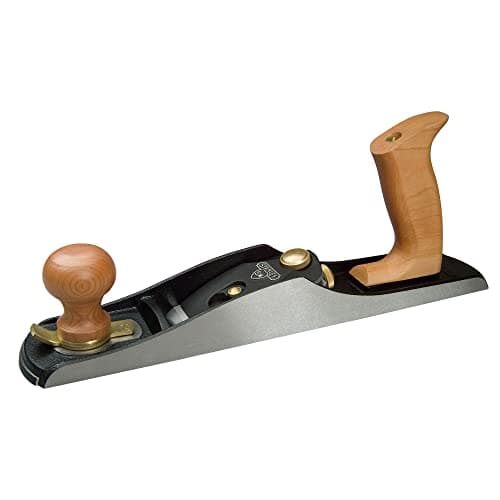
Bevel-up at a 12 degree bed, which means the bevel you grind sets the cutting angle. Grind three irons at three angles and one plane covers end grain, general work and figured hardwood.
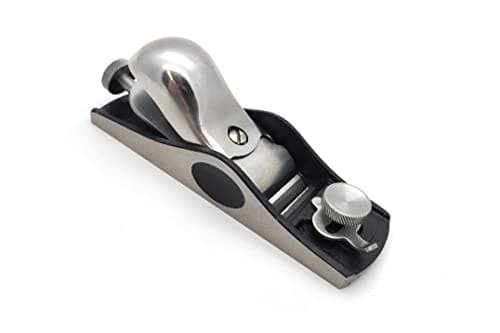
Adjustable mouth, stainless knuckle cap and adjustment screws, and a bed low enough to handle end grain properly. The stainless hardware is the detail that matters in a tool that lives in a pocket.
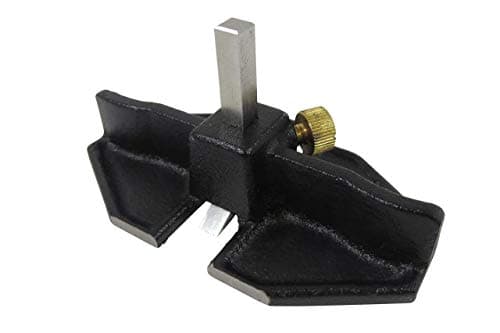
A 1/4 in cutter in a ductile cast iron body with a 4-1/8 by 1-1/4 in base, and the only router plane on this page whose listing states a blade hardness at all: 55-60 HRC. That is not a premium figure, but a published figure beats an implied one, and at this price nothing else here publishes anything.
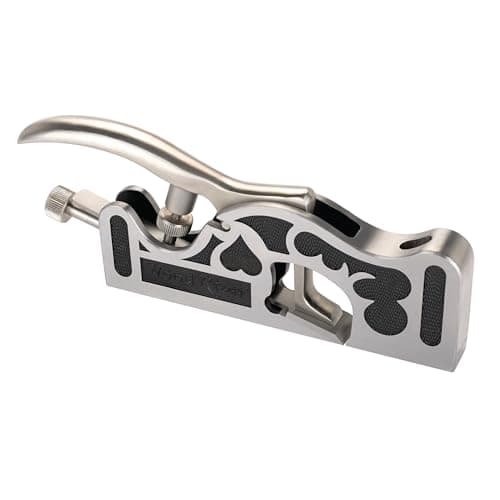
The same published recipe as the #92 scaled up to the 1 in class: Cr40 ductile body, Mn65 iron at HRC 60-64, bedded 15 degrees, with a spare iron whose steel and hardness Woodcraft prints on its own page. It is the only plane here you would choose for a door rail, and nearly four pounds of it.
The kanna reduced to a size where the setup burden is proportionate to the job. A good way to find out whether you get on with a pull plane before committing to a full-size one.
#ad· Live prices from the Amazon Product API, as of October 19, 2026. Where we have no verified live price we show none, and the cost-per-decade figure is suppressed with it — we would rather leave a gap than print a number that has rotted.
Buy the Stanley No. 62 Sweetheart low angle jack first. A 12 degree bevel-up bed means the bevel you grind sets the cutting angle, so one plane covers both ends of instrument wood: grind 25 and you cut at about 37 degrees for spruce and cedar, grind 38 and you cut at 50 for figured maple that would tear out under anything shallower. It also has an adjustable mouth, which is the other half of the tearout argument. After that, a low-angle block plane for braces and chamfers, a small router plane for rosette channels and anything that has to be a constant depth, a shoulder plane for joint cheeks, and a mini kanna if you want a pull plane for the smallest work.
This page is ranked by job, not by size, because a guitar build is five plane jobs that barely overlap. A roundup that ranks five planes against one criterion would be lying about the work.
The five jobs, in build order
1. Jointing the plate halves. A soundboard and a back are each two bookmatched halves glued down the centerline, and that joint has to be gap-free along its whole length with no glue filling anything. It is the most demanding edge joint in woodworking: the plates are 2 to 3 mm thick, so there is no mass to keep the edge square, and a lamp behind the closed joint shows every error. This is a long-plane job done on a shooting board or with the plate clamped on edge, and the low-angle jack is the tool — the best hand planes for shooting boards is the jig and the squareness question that comes with it.
2. Thicknessing and leveling plates. A spruce top finishes somewhere around 2.5 to 3 mm, and the last few tenths come off with a plane rather than a sander if you want the surface to stay crisp. The requirements are a very fine shaving, a tight mouth and an iron that is genuinely sharp, because spruce at this thickness tears rather than cuts under a dull edge. The same low-angle jack does it, set finer.
3. Carving braces and bridge plates. Braces are small quartersawn sticks shaped to a profile, and this is one-handed work on parts too small to clamp properly. A block plane does most of it; a mini plane does the last of it. Both are on this page, and the best mini hand planes ranks the smallest ones against each other on their own terms.
4. Cleaning joint cheeks and rebates. Neck tenons, headblock joints, binding ledges where they need truing — these are square shoulders that have to stay square, which is a shoulder plane job and nothing else. The iron runs the full width of the body, so it cuts right into the corner. Shoulder plane vs rabbet plane is why that matters.
5. Anything that has to be one constant depth. A rosette channel, a purfling ledge, the recess under a bridge plate. A router plane references off the surface and cuts to a set depth, which is the only reliable hand method for a flat-bottomed recess. The best router planes is the full category; the small pattern is the one a luthier wants.
What instrument wood demands that furniture wood does not
A low cutting angle, and sometimes a high one. Quartersawn spruce and cedar are soft, straight and easy to cut cleanly at a shallow angle. Figured maple, the other half of most builds, is the opposite: curl means the grain direction reverses every few millimeters, and a shallow angle lifts those reversals out as tearout. A bevel-up plane bedded at 12 degrees solves both with two irons ground differently — bevel up vs bevel down is the mechanism in full.
A mouth you can close. A tight mouth holds the fibers down right in front of the edge so they cannot lift ahead of it. On a 2.5 mm soundboard there is no margin for a tearout you can plane away afterwards: the tearout is the finished surface. Both bevel-up planes on this page have an adjustable mouth; the shoulder plane and the router plane have the equivalent in a sole that supports the cut.
Sharpness over mass. Most of this work is on parts a few millimeters thick, held in a jig or a hand. Weight does not help; it makes a thin plate flex. What does help is an edge that cuts spruce without crushing it, which means sharpening more often than furniture work demands and knowing when an edge has gone. How to sharpen a plane iron and stropping explained are the routine between sharpenings.
No marks, ever. A soundboard is the show face of the instrument and it is not getting thicker. A plane with a sharp corner on the iron will leave a line you cannot sand out of a 2.5 mm plate without going through it; the corners want relieving before the plane touches the wood. How to camber a plane iron covers how much and why.
What the makers publish
Plane
Job
Published geometry
Spare iron?
Stanley No. 62 Sweetheart
Jointing plates, thicknessing
12 deg bevel-up bed, adjustable mouth, A2 iron
Aftermarket, well supplied
Taytools #9-1/2 block plane
Braces, chamfers, small fitting
Low-angle pattern, adjustable mouth
Taytools lists plane blades as catalog items
Taytools 468334 small router plane
Rosette channels, constant-depth recesses
1/4 in blade, 4-1/8 x 1-1/4 in base, published hardness
Cutters sold separately
WoodRiver No. 93 shoulder plane
Joint cheeks, tenon shoulders
15 deg bed, 25 deg bevel, Mn65 at HRC 60-64
Yes — cataloged spare blade
KAKURI mini kanna
Smallest brace and bridge work
36 mm laminated iron, wooden dai, pull stroke
Iron is re-trued rather than replaced
Two things in that table are worth saying plainly. The first is that nothing here is a luthier-specific tool, and that is deliberate: dedicated instrument planes exist, mostly small brass thumb planes with curved soles, and almost none of them publishes a steel, a hardness or a bed angle. The second is that every plane here does ordinary woodworking too, which matters if the guitar is a project rather than a career.
The planes a luthier is sold and should think twice about
Brass thumb and finger plane sets. Three to five small curved-sole brass planes in a box, sold for instrument work. For carving a violin arch, a curved sole is genuinely the right geometry and there is no real substitute. For a guitar there is: braces are shaped with a block plane, a chisel and a scraper, and the flat-sole planes on this page do the work. We are not ranking the brass sets because no maker publishes a specification for any of them — the same reason they are excluded from the mini plane roundup.
Dedicated binding and purfling cutters. These are not planes and are outside this site's scope, but it is worth knowing they exist before you try to do a binding channel with a shoulder plane. The shoulder plane trues a channel; it does not cut one from nothing.
A No. 7 jointer. Tempting for plate joints, and heavier than the job wants. A 22 in plane on a 2.5 mm plate is mostly a liability; the No. 62's 14 in sole is long enough to true a 20 in joint and light enough to control. Jack plane vs jointer plane is the general version of that argument.
Every pick, in full
The write-ups
01The one plane to own if you only own one
Size
No. 62 low angle jack, 14 in
Bed angle
12 deg, bevel up
Iron
A2, thick section
Mouth
Adjustable
Stanley No. 62 Sweetheart Low Angle Jack Plane
Stanley
8.2/10
Bevel-up at a 12 degree bed, which means the bevel you grind sets the cutting angle. Grind three irons at three angles and one plane covers end grain, general work and figured hardwood.
Cost per decade
Suppressed — no live price
Horizon · tier A
30 years — Lifetime warranty, cited
Stanley publishes a limited lifetime warranty on hand tools against material and workmanship defects. Note it excludes consumables including 'any blade' — the casting is covered, the iron is not. Bailey-pattern irons are a standard size and replacements are widely sold.
Rebuy risk
Low
lifetime warranty, parts listed, resharpenable
Sole & body
8.5
Iron & edge
8.5
Adjustment
8.0
Out of box
8.0
Parts & repair
9.0
Value
7.0
What it gets right
+One body, three effective cutting angles, if you buy spare irons
+Low bed angle plus adjustable mouth is the best end-grain setup at this price
+Simple architecture: no frog to fettle, fewer things to get wrong
What it costs you
−Spare irons are the whole point and they are an extra purchase
−Bevel-up geometry means a chipped edge changes your cutting angle, not just your sharpness
−Heavier and longer than a smoother if that is the only job
Skip this if…
…you have already committed to a bevel-down set. Mixing the two systems means two sharpening setups for no benefit.
Adjustable mouth, stainless knuckle cap and adjustment screws, and a bed low enough to handle end grain properly. The stainless hardware is the detail that matters in a tool that lives in a pocket.
Cost per decade
$46.49
Horizon · tier C
20 years — No lifetime warranty; parts purchasable and resharpenable
No lifetime warranty published at the date checked. The iron is a standard Bailey-pattern size, so aftermarket replacements from third-party makers are purchasable, and the body is a casting with no consumable part.
Rebuy risk
Medium
parts listed, resharpenable
Sole & body
8.5
Iron & edge
7.5
Adjustment
8.5
Out of box
8.0
Parts & repair
7.0
Value
8.5
What it gets right
+Adjustable mouth is the single feature that separates a real block plane from a toy
+Stainless fittings resist the sweat and pocket grit that pit a block plane first
+Machining quality well above the price band
What it costs you
−No published warranty terms
−Iron wants honing before first use like everything else here
−Knuckle cap is a preference; some people want a plain lever cap
Skip this if…
…your hands are large. A block plane is a one-handed tool and this is a compact one.
We earn nothing on this one
The Veritas low-angle block plane is the better tool and we earn nothing on it — it sells direct only. Worth knowing before you buy: Lee Valley publishes a three-month satisfaction guarantee rather than a defect warranty, which is not the lifetime cover the tool's reputation implies. That guarantee wording is published by Lee Valley / Veritas.
A 1/4 in cutter in a ductile cast iron body with a 4-1/8 by 1-1/4 in base, and the only router plane on this page whose listing states a blade hardness at all: 55-60 HRC. That is not a premium figure, but a published figure beats an implied one, and at this price nothing else here publishes anything.
Cost per decade
$26.34
Horizon · tier C
20 years — No lifetime warranty; parts purchasable and resharpenable
No defect warranty published for this plane at the date checked. What sets the horizon instead is that the matching cutter is sold as its own item, which on a router plane is the whole question: the cutter is an L-shaped blade ground to fit this maker's post and clamp, so there is no aftermarket to fall back on. The body is a casting with nothing in it to consume, and the cutter sharpens for years before it needs replacing at all.
Rebuy risk
Medium
parts listed, resharpenable
Base & body
7.5
Cutter & edge
7.0
Depth setting
7.0
Throat & fence
6.5
Parts & repair
8.0
Value
9.0
What it gets right
+Publishes a blade hardness, which not one other plane on this page does
+Publishes its base dimensions, so you can tell before buying whether it will bridge your dado
+The small base is the right size for hinge mortises and inlay recesses, where a 7 in base simply will not sit down
+Taylor Toolworks sells router plane cutters as their own items, so the wear part is purchasable
What it costs you
−55-60 HRC is the softest published edge here and will need honing more often than the HSS cutters above
−A 1/4 in cutter is too narrow to clean a tenon cheek in one pass
−Taylor Toolworks publishes a 90-day refund policy and states no product warranty
−Stock was in double digits but not deep at the date checked
Skip this if…
…the job is tenon cheeks and wide housings. This is a small-work plane and the 1/4 in cutter is the reason it is cheap.
Cr40 stress-relieved ductile steel, 1 x 8-1/4 x 3 in
Overall
10-7/16 in long, 3-7/8 in tall
Weight
3 lb 12.8 oz
Warranty
None published; 90-day retailer guarantee
WoodRiver No. 93 Large Shoulder Plane
WoodRiver
8.2/10
The same published recipe as the #92 scaled up to the 1 in class: Cr40 ductile body, Mn65 iron at HRC 60-64, bedded 15 degrees, with a spare iron whose steel and hardness Woodcraft prints on its own page. It is the only plane here you would choose for a door rail, and nearly four pounds of it.
Cost per decade
$156.99
Horizon · tier C
20 years — No lifetime warranty; parts purchasable and resharpenable
No defect warranty published for this plane at the date checked — the retailer publishes a 90-day satisfaction guarantee, which is a returns policy, not a warranty. What sets the horizon instead is that the matching iron is a cataloged item you can buy on its own, which on a shoulder plane is not a given: the iron is sized to that one body and ground a few thousandths wider than the sole, so no generic replacement exists. Body is a ductile iron casting with nothing else in it to consume.
Rebuy risk
Medium
parts listed, resharpenable
Sole & body
9.5
Iron & edge
9.0
Adjustment
8.5
Out of box
9.0
Parts & repair
8.0
Value
5.0
What it gets right
+Spare iron is published with its steel and hardness stated — Mn65 at HRC 60-64 — which is more than most makers publish about the iron in the plane, let alone the replacement
+1 in class, so it reaches across a wide tenon cheek in one pass instead of two
+Same 15 deg bed and ductile body as the #92, scaled up rather than cheapened
+Mass helps it track along a long shoulder without wandering
What it costs you
−Most expensive plane on this page by a wide margin
−3 lb 12.8 oz is a lot of plane to control one-handed on anything small
−Woodcraft's listing for this model does not state the iron width, only the 1 in body
−Overkill for furniture-scale joinery, where 3/4 in covers almost everything
Skip this if…
…your tenons are furniture-sized. The 3/4 in planes do that work better; this is for doors, frames and bench joinery.
The kanna reduced to a size where the setup burden is proportionate to the job. A good way to find out whether you get on with a pull plane before committing to a full-size one.
Cost per decade
$28.90
Horizon · tier C
20 years — No lifetime warranty; parts purchasable and resharpenable
No warranty terms published for the US market at the date checked. A laminated hagane-over-jigane edge is renewable by sharpening until the hard layer runs out, which on a full-size chisel or plane iron is a working lifetime.
Rebuy risk
Medium
parts listed, resharpenable
Sole & body
7.0
Iron & edge
8.5
Adjustment
5.0
Out of box
5.0
Parts & repair
7.0
Value
8.0
What it gets right
+Low-commitment introduction to laminated Japanese irons
+Genuinely useful for chamfers and small fitting work
+No mechanism to fail
What it costs you
−Too small for any surfacing work
−Same dai conditioning requirement as a full-size kanna
−Not a substitute for a western block plane on site
Skip this if…
…you need one block plane that does everything. This one is deliberately specialized.
Buy first: the Stanley No. 62 Sweetheart. The 12 degree bevel-up bed, the adjustable mouth and the A2 iron cover both jointing the plates and thicknessing them, and the bevel-up geometry means a second iron ground at 38 degrees turns the same plane into a figured-maple plane. Stanley publishes a limited lifetime warranty on the casting, and it excludes blades by name — which on a plane with a well-supplied aftermarket is a survivable exclusion.
Buy second: the Taytools #9-1/2 low angle block plane. Adjustable mouth, stainless knuckle cap and screws, and a bed low enough to handle the end grain on a brace end properly. This is the plane that lives on the bench during a build.
For rosettes and anything at a set depth: the Taytools 468334 small router plane. A 1/4 in blade on a 4-1/8 by 1-1/4 in base, with a published blade hardness, which is rarer in that category than it should be. A router plane is the only hand tool that reliably produces a flat bottom at a repeatable depth.
For joint cheeks: the WoodRiver No. 93 large shoulder plane. A 15 degree bed with a 25 degree bevel in Mn65 tool steel at HRC 60-64, and Woodcraft catalogs the spare iron — which matters on a shoulder plane, because the iron is ground to that body and has no aftermarket.
If you want a pull plane for the smallest work: the KAKURI mini kanna. A 36 mm laminated iron in a wooden body with nothing to break, and the laminated edge takes a cleaner shaving on spruce than anything at its price. The dai needs conditioning before it works properly, which is a skill rather than a purchase.
Setting these planes up for instrument wood
Set the iron finer than feels sensible. A shaving you can read newsprint through is the right thickness on a soundboard. If the plane is leaving dust or chatter marks, back the iron off rather than pushing harder.
Keep two irons for the bevel-up plane. One at 25 degrees for spruce and cedar, one at 38 for figured maple and rosewood. Same plane, two characters, and a few seconds to swap.
Relieve the iron corners. A couple of strokes on each corner at the stone is all it takes, and it is the difference between a clean plate and a line you cannot remove.
Work on a flat, soft support. A 2.5 mm plate planed on a bare bench flexes into every dip in the bench. A sheet of MDF with a sacrificial layer and a sliver of a stop is the standard arrangement.
Check the plate thickness as you go, not at the end. A plane removes material faster than it feels like it does. Calipers at a few points every pass or two is the habit that saves tops.
Wax the sole. A waxed sole takes real effort out of a long plate joint, and keeps the sole from rusting where your hand sweats on it — cleaning and waxing hand tools has what to use.
Cost per decade on a build you will do once
Most people who buy planes for guitar making build one or two instruments. That reality should change the purchase, and usually does not get mentioned: four of the five planes here are general woodworking tools that will keep earning their place after the guitar is finished, and that is the main argument for choosing them over dedicated luthier tools.
The No. 62 is ranked first on this site's general plane roundup as well as here. The block plane is the one you will use weekly for the rest of your life. The router plane and the shoulder plane are joinery tools that happen to suit instrument work. Only the mini kanna is close to a specialist, and it costs the least of the five.
On the parts question: Stanley's warranty covers the casting and excludes blades, Taytools sells plane blades and router cutters as catalog items, Woodcraft catalogs the No. 93 iron, and the kanna iron is renewed by sharpening until the hard lamination runs out. Four of the five are therefore renewable from a catalog rather than from an aftermarket gamble — cost per decade is the arithmetic that turns that into money.
Questions
Frequently asked
What hand planes do you need to build a guitar?+
Realistically three: a low-angle bevel-up jack for jointing and thicknessing the plates, a low-angle block plane for braces and small fitting, and a router plane for the rosette channel and any recess that has to be a constant depth. A shoulder plane for joint cheeks is the fourth, and a mini plane is a convenience rather than a requirement.
Do I need special luthier planes?+
For a guitar, no. Curved-sole thumb planes are genuinely the right tool for carving a violin or cello arch, but a guitar's plane work is flat: plate joints, thicknessing, braces and square shoulders. General woodworking planes with documented specifications do that better than brass miniatures with none.
What angle should the iron be for spruce and for figured maple?+
On a 12 degree bevel-up bed, a 25 degree bevel gives about 37 degrees at the wood, which suits spruce and cedar. For figured maple grind a second iron at 38 degrees or more for a 50 degree-plus cut, which stops the reversing grain lifting out as tearout. That is the practical advantage of a bevel-up plane over a fixed 45 degree bench plane.
Can you thickness a soundboard with a hand plane?+
Yes, and the last few tenths of a millimeter are better done that way than with a sander, because a planed surface stays crisp where a sanded one rounds over. It demands a very fine setting, a tight mouth, a genuinely sharp iron with relieved corners, and calipers checked every pass or two.
Is a block plane enough on its own?+
For braces and small fitting, yes. For the centerline joint in a soundboard, no: a 6 in sole cannot true a 20 in edge, and that joint is the one that has to be perfect. A low-angle jack is the plane that makes the joint, and the block plane is what you use for everything after it.
We have not handled these tools. Nobody here has tested one, owned one, or taken one apart. Specifications come from the manufacturer or the retailer listing; warranty terms come from the maker's own warranty page; the cost-per-decade arithmetic is ours and reproducible. Where we could not verify a figure we say so on the page rather than quietly leaving it out. Read the full method.