We earn a commission when you buy through our Amazon links, at no extra cost to you. It never decides a ranking, and where the best tool in a class is one we earn nothing on, we say so and link it anyway. How this works.
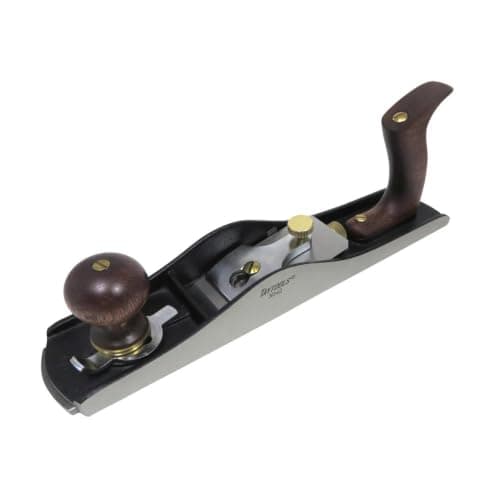
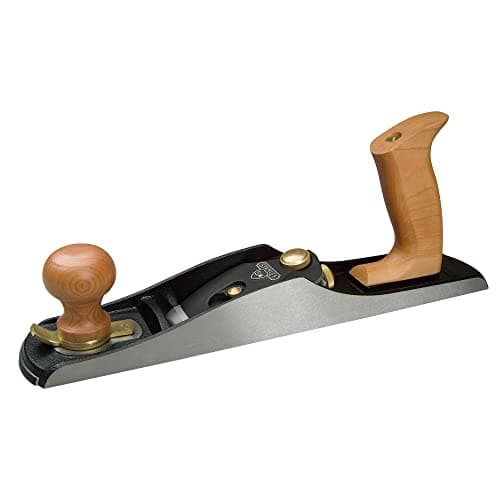
Bevel-up at a 12 degree bed, which means the bevel you grind sets the cutting angle. Grind three irons at three angles and one plane covers end grain, general work and figured hardwood.
A 12 degree bevel-up jack in stress-relieved ductile iron with a 3/16 in iron and an adjustable mouth, at roughly half what the Stanley No. 62 costs. The bevel-up trick — three irons, three cutting angles, one plane — works the same here.
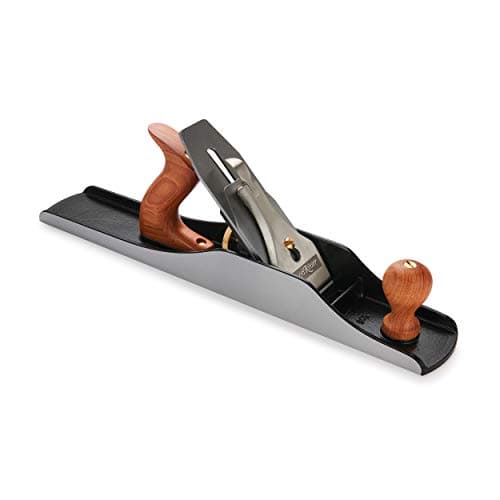
The same stress-relieved ductile castings and fully machined Bedrock-based frog as the WoodRiver #7, in the 18 in fore-plane length at 7-3/4 lb. For a home shop that joints medium edges and flattens panels, it is the one long plane that does both jobs without the weight of a No. 7.
The fore plane for a shop that will never buy a full jointer
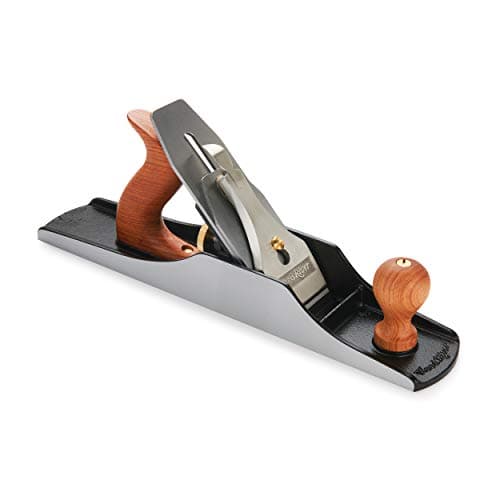
Woodcraft's house premium line in the wide 5-1/2 size: a 2-3/8 in iron, stress-relieved ductile castings, a fully machined Bedrock-based frog, and just over seven pounds of mass. It is the plane on this page for someone who flattens wide hardwood and never wants it to chatter.
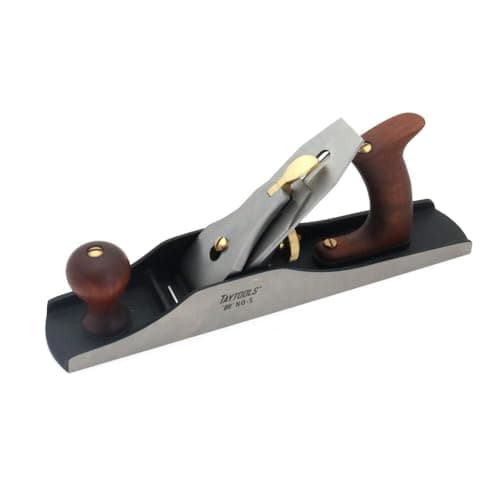
The same Bedrock-pattern frog and lapped ductile body as our best first plane, stretched to a 14 in jack, with a cryogenically treated O1 iron the maker actually publishes a thickness and hardness for. Nothing else on this page combines that frog, that iron and this price.
#ad· Live prices from the Amazon Product API, as of October 16, 2026. Where we have no verified live price we show none, and the cost-per-decade figure is suppressed with it — we would rather leave a gap than print a number that has rotted.
Buy the Stanley No. 62 Sweetheart low angle jack. A 12 degree bevel-up bed means the effective cutting angle is set by the bevel you grind, so a 25 degree bevel gives you about 37 degrees at the wood — and end grain is the one surface where that difference is obvious rather than theoretical. It also has an adjustable mouth and an A2 iron. If you want the same geometry for substantially less, the Taytools 468280 No. 62 is the pick. And if you shoot wide boards and want mass over geometry, the WoodRiver No. 6 is the only plane here whose maker publishes that its sides are machined flat and square to the sole.
A shooting board is a jig: a fence, a bed and a track. You lay the work against the fence, lay the plane on its side in the track and push, and the jig guarantees the cut is square and the plane cannot wander. It is how you trim a mitre to a perfect 45, how you square the end of a piece too small to hold, and how you sneak up on a length a thirty-second at a time without a saw.
And it changes which specification matters, completely. On every other page on this site the sole is the reference surface. On a shooting board the sole never touches the work at all — the side of the plane is the reference, and if that side is not flat, or not square to the sole, the jig delivers a cut that is wrong by exactly as much.
The specification nobody publishes
Here is the honest state of this category. Of the five planes on this page, exactly one has a maker who states in writing that its sides are machined flat and square to the sole: the WoodRiver No. 6, whose listing says so in those words. The rest say nothing about the sides at all, including both No. 62s, which are the planes most people buy specifically for this job.
That leaves you with something to check rather than something to trust, and it is a five-minute check. Stand the plane on its side on a known-flat surface and look for light under the ends. Set an engineer's square against the side with its blade on the sole and look for light along the blade. If either shows a gap, you have a plane that needs lapping on its side — the same job as flattening a sole, done on a different face, and a reliable square is the tool that tells you whether you are done. The best woodworking squares covers what makes one trustworthy.
There is also a workaround that costs nothing, and it is what experienced users do: if the plane is out of square by a consistent amount, shim the fence of the shooting board rather than lapping the plane. The jig is a piece of plywood you made; the plane is not. Build the board to suit the plane you own and the error cancels.
What else decides it
1. Bevel-up at a low bed angle. End grain is bundles of tubes presented end-on, and severing them cleanly wants a low cutting angle. A bevel-down bench plane is fixed at 45 degrees by its frog. A bevel-up plane bedded at 12 degrees lets the bevel do the deciding: grind 25 and you cut at 37; grind 38 and you cut at 50 for figured long grain. One plane, three characters — bevel up vs bevel down is the whole mechanism, and the best hand planes for end grain ranks on the geometry alone.
2. Mass. A shooting stroke is a push into end grain with the plane lying on its side, and momentum does a large part of the work. This is the one job where a heavy plane is unambiguously better, because you are not lifting it between strokes. The WoodRiver No. 6 at 7-3/4 lb and the 5-1/2 at just over 7 lb are the heaviest here; the No. 62s are around 4-1/2 lb.
3. An adjustable mouth. End grain tears out at the far corner of the cut, and a tight mouth supports the fibers right up to the edge. Both No. 62s have one; the bevel-down planes here do not, though a Bedrock-style frog lets you close the mouth without dismantling the plane.
4. A side wide enough to be stable. A narrow plane rocks in the track. This is the quiet argument for a 5-1/2 or a 6 over a No. 4: a 2-7/8 in body gives a broad bearing surface and will not tip as you push.
What the makers publish
Plane
Bed / cutting angle
Sides square to sole?
Weight
Stanley No. 62 Sweetheart
12 deg bevel-up; bevel sets the cut
Not published
Not published
Taytools 468280 No. 62
12 deg bevel-up; bevel sets the cut
Not published (sole lapped to 0.003 in)
4.6 lb
WoodRiver No. 6 V3
45 deg bevel-down, fixed
Yes — stated in the listing
7-3/4 lb
WoodRiver No. 5-1/2 V3
45 deg bevel-down, fixed
Not published
Just over 7 lb
Taytools No. 5 Bedrock-style
45 deg bevel-down, fixed
Not published (sides lapped)
Not published
The useful reading of that table is that the geometry column and the squareness column point at different planes, and you have to decide which you would rather have guaranteed. Our ranking puts the geometry first, because the squareness is something you can measure and correct in an evening and the bed angle is not.
What a shooting board asks of the iron
Shooting is the most demanding thing you will ask of an edge. You are cutting a full-width shaving of pure end grain, every stroke, with no long-grain fibers to help. Two consequences follow.
It must be genuinely sharp, not nearly sharp. An edge that works fine on long grain will crush end grain and leave a surface that looks burnished rather than cut. If the shaving is dust rather than a continuous ribbon, the iron is the problem and nothing else is. How to sharpen a plane iron is the routine and stropping explained is how you keep it between sharpenings.
It must be straight across, not cambered. Every other bench plane on this site wants a few thousandths of camber. A shooting plane wants none: a cambered iron cuts a convex end, which defeats the entire purpose of the jig. If you own one plane and it does both jobs, keep two irons — how to camber a plane iron explains why the two shapes are incompatible, and this is the clearest case on the site for a second iron.
Every pick, in full
The write-ups
01The one plane to own if you only own one
Size
No. 62 low angle jack, 14 in
Bed angle
12 deg, bevel up
Iron
A2, thick section
Mouth
Adjustable
Stanley No. 62 Sweetheart Low Angle Jack Plane
Stanley
8.2/10
Bevel-up at a 12 degree bed, which means the bevel you grind sets the cutting angle. Grind three irons at three angles and one plane covers end grain, general work and figured hardwood.
Cost per decade
Suppressed — no live price
Horizon · tier A
30 years — Lifetime warranty, cited
Stanley publishes a limited lifetime warranty on hand tools against material and workmanship defects. Note it excludes consumables including 'any blade' — the casting is covered, the iron is not. Bailey-pattern irons are a standard size and replacements are widely sold.
Rebuy risk
Low
lifetime warranty, parts listed, resharpenable
Sole & body
8.5
Iron & edge
8.5
Adjustment
8.0
Out of box
8.0
Parts & repair
9.0
Value
7.0
What it gets right
+One body, three effective cutting angles, if you buy spare irons
+Low bed angle plus adjustable mouth is the best end-grain setup at this price
+Simple architecture: no frog to fettle, fewer things to get wrong
What it costs you
−Spare irons are the whole point and they are an extra purchase
−Bevel-up geometry means a chipped edge changes your cutting angle, not just your sharpness
−Heavier and longer than a smoother if that is the only job
Skip this if…
…you have already committed to a bevel-down set. Mixing the two systems means two sharpening setups for no benefit.
A 12 degree bevel-up jack in stress-relieved ductile iron with a 3/16 in iron and an adjustable mouth, at roughly half what the Stanley No. 62 costs. The bevel-up trick — three irons, three cutting angles, one plane — works the same here.
Cost per decade
$72.00
Horizon · tier C
20 years — No lifetime warranty; parts purchasable and resharpenable
No lifetime warranty published at the date checked. The iron is a standard Bailey-pattern size, so aftermarket replacements from third-party makers are purchasable, and the body is a casting with no consumable part.
Rebuy risk
Medium
parts listed, resharpenable
Sole & body
8.0
Iron & edge
7.5
Adjustment
7.5
Out of box
7.5
Parts & repair
6.5
Value
8.5
What it gets right
+A 3/16 in iron, thicker than the Stanley's, on a bed the maker lapped to a published 0.003 in
+Adjustable mouth and a low bed, which is the end-grain setup that matters
+Stress-relieved ductile iron body at a price that undercuts every other No. 62 we found
+Lightest plane on the page, which some people prefer in a bevel-up jack
What it costs you
−The Amazon listing title says 55-60 HRC while the maker's own page says 60-65 HRc; one of them is wrong and we could not tell which
−No warranty published, against Stanley's limited lifetime cover on the No. 62
−Spare irons are the whole point of a bevel-up jack and the maker does not list one for this SKU
−Far less history behind the brand than Stanley
Skip this if…
…you plan to run the three-iron system. The Stanley has a listed replacement iron; this one does not, and a bevel-up jack without spare irons is just a long block plane.
03The fore plane for a shop that will never buy a full jointer
Size
No. 6 fore plane, 17-3/4 x 2-7/8 in, 7-3/4 lb
Iron
High carbon steel, 2-3/8 in wide, 25 deg bevel
Frog
Fully machined, adjustable, Bedrock-based
Body
Stress-relieved ductile iron; sole and sides machined flat and square
Warranty
None published; 30-day defect replacement per the retailer listing
WoodRiver #6 Bench Plane, V3
WoodRiver
7.8/10
The same stress-relieved ductile castings and fully machined Bedrock-based frog as the WoodRiver #7, in the 18 in fore-plane length at 7-3/4 lb. For a home shop that joints medium edges and flattens panels, it is the one long plane that does both jobs without the weight of a No. 7.
Cost per decade
$120.00
Horizon · tier C
20 years — No lifetime warranty; parts purchasable and resharpenable
No lifetime warranty published at the date checked. The iron is a standard Bailey-pattern size, so aftermarket replacements from third-party makers are purchasable, and the body is a casting with no consumable part.
Rebuy risk
Medium
parts listed, resharpenable
Sole & body
8.5
Iron & edge
7.5
Adjustment
8.5
Out of box
8.0
Parts & repair
7.5
Value
6.5
What it gets right
+The premium-pattern castings and frog of the #7 in a length most home shops can use every week
+Shares the same numbered V3 replacement blade (item 153919) as the #7, so the wear part is a catalog item
+Stress-relieved ductile iron, per the retailer's own spec sheet
+Nearly two pounds lighter than the #7, which matters over an afternoon of flattening
What it costs you
−Woodcraft does not publish the iron's thickness, hardness or the bed angle for this size either
−Flatness is described in words, not a number
−Priced above the Taytools #7, which is longer and publishes more
−Woodcraft's own site listed it below the Amazon price at the time of check
Skip this if…
…you regularly joint edges longer than about four feet. An 18 in sole starts to follow a long edge rather than straighten it; buy the No. 7 for that work.
Woodcraft's house premium line in the wide 5-1/2 size: a 2-3/8 in iron, stress-relieved ductile castings, a fully machined Bedrock-based frog, and just over seven pounds of mass. It is the plane on this page for someone who flattens wide hardwood and never wants it to chatter.
Cost per decade
$161.49
Horizon · tier C
20 years — No lifetime warranty; parts purchasable and resharpenable
No lifetime warranty published at the date checked. The iron is a standard Bailey-pattern size, so aftermarket replacements from third-party makers are purchasable, and the body is a casting with no consumable part.
Rebuy risk
Medium
parts listed, resharpenable
Sole & body
9.0
Iron & edge
8.0
Adjustment
8.5
Out of box
8.0
Parts & repair
7.0
Value
6.0
What it gets right
+The heaviest and widest plane on the page, which is exactly what a jack used for flattening wants
+Stress-relieved ductile castings and a fully machined frog, per the retailer's own spec sheet
+Woodcraft lists a V3 replacement blade that fits the 4-1/2, 5-1/2, 6 and 7
+In stock at a large retailer rather than on a small maker's waiting list
What it costs you
−Woodcraft does not publish the iron's thickness, hardness or the bed angle for this size
−Priced against the premium makers without a published warranty
−Too wide and heavy for a general-purpose first jack; a standard No. 5 is the better all-rounder
−Woodcraft's own listing was priced below the Amazon one at the time of check
Skip this if…
…this would be your only bench plane. A 5-1/2 is a specialist flattening plane; buy a No. 5 first and this second.
Bedrock-style, full-contact, mouth adjusts with iron in place
Body
Ductile cast iron, sole and sides lapped
Warranty
None published; 90-day return on unused items
Taytools #5 Bedrock-Style Jack Plane
Taytools
8.2/10
The same Bedrock-pattern frog and lapped ductile body as our best first plane, stretched to a 14 in jack, with a cryogenically treated O1 iron the maker actually publishes a thickness and hardness for. Nothing else on this page combines that frog, that iron and this price.
Cost per decade
$70.00
Horizon · tier C
20 years — No lifetime warranty; parts purchasable and resharpenable
No lifetime warranty published at the date checked. The iron is a standard Bailey-pattern size, so aftermarket replacements from third-party makers are purchasable, and the body is a casting with no consumable part.
Rebuy risk
Medium
parts listed, resharpenable
Sole & body
8.5
Iron & edge
8.0
Adjustment
8.5
Out of box
8.0
Parts & repair
7.0
Value
9.0
What it gets right
+Bedrock frog with full-surface contact to the body, adjustable without pulling the iron — the feature the premium makers charge for
+Maker publishes the iron spec: 0.120 in O1, cryogenically treated, 54-58 HRc
+Sole and sides stated as lapped flat over the full length, so it can shoot as well as flatten
+Roughly half the money of the Woodcraft and Rockler jacks below it
What it costs you
−No warranty published and no flatness tolerance figure, unlike the Rockler and Big Horn planes
−54-58 HRc is softer than the A2 and O1 irons on the premium planes; expect to hone sooner
−Taytools states its own basic replacement irons do NOT fit its Bedrock planes, so a spare iron is not a catalog item
−Listed with a real but modest stock count at the time of check
Skip this if…
…you want a documented lifetime warranty. The Jorgensen one row down has one; this plane is here on the strength of its frog and iron, not its paperwork.
We earn nothing on this one
The best No. 5 you can buy in North America is a Lie-Nielsen, and it is not sold on Amazon, so we earn nothing on it. Ductile iron, a 0.125 in cryo-treated A2 iron at Rockwell 60-62, and — verbatim from the product page — materials and workmanship guaranteed for the life of the tool, with parts and repairs on request. Every figure there is quoted from the No. 5 product page at Lie-Nielsen Toolworks.
Best overall: the Stanley No. 62 Sweetheart. The 12 degree bevel-up bed, the adjustable mouth and the A2 iron are the three things a shooting plane wants, and Stanley publishes a limited lifetime warranty on the casting. Check the side for square when it arrives and shim your fence to suit.
The same geometry for less: the Taytools 468280 No. 62. A 12 degree bed, a 3/16 in iron at 60–65 HRc per the maker, a sole lapped to a published 0.003 in and a stated 4.6 lb. No warranty beyond a 90-day return, which at this price is the trade.
If you want the squareness in writing: the WoodRiver No. 6 V3. The only plane here whose listing says the sides are machined flat and square to the sole, and at 7-3/4 lb the mass does real work in the cut. It is fixed at 45 degrees, so end grain is harder work than with a No. 62.
If you shoot mitres on wide stock: the WoodRiver No. 5-1/2. A 2-7/8 in body is the broadest bearing surface here, over seven pounds of momentum, and a Bedrock frog that closes the mouth with the iron in place.
If you want one plane for everything and shooting is occasional: the Taytools No. 5. A published 0.120 in cryo-treated O1 iron, lapped sides and a Bedrock-style frog, and it is a better general bench plane than anything above it in this list. It is last here only because 45 degrees is the wrong angle for end grain.
Building and using the board
Make the board to fit the plane you own. The track should be a touch wider than the plane's side and the bed should hold the work a hair above the track so the iron clears. Plywood is fine and MDF is fine.
Shim the fence until a test cut is square. Cut a scrap, flip it, and check the two cut faces against each other. Any error doubles when you flip, which makes this the most sensitive test available — and it corrects for a plane that is out of square without touching the plane.
Back up the far corner. End grain breaks out where the iron exits. A sacrificial block behind the work, or a fence you let the plane cut into once and then leave alone, removes the problem entirely.
Take thin shavings and take several. A thick shaving of end grain will stall the plane or lift the work off the fence. Set the iron fine and push more times.
Wax the track. A stroke with seven pounds of iron dragging on plywood is harder than it needs to be. Cleaning and waxing hand tools covers what to use, and it keeps the side from rusting where it slides.
Cost per decade on a side you will lap once
A shooting plane has an unusually easy life. The iron cuts pure end grain, which dulls it faster than long grain does, but there is no grit, no nails and no twisting load on the casting. The side gets lapped once, if at all, and then never again.
So the long-run cost is the iron, and the long-run question is whether you can buy another one. Woodcraft catalogs WoodRiver irons by size and Taytools sells plane blades as catalog items; Stanley publishes a limited lifetime warranty that excludes blades by name, leaving the aftermarket — which for the No. 62 is well supplied. The best replacement plane irons has the options, and cost per decade has the arithmetic. On a tool whose casting will outlive you, that catalog is the whole of the durability story.
Questions
Frequently asked
What plane is best for a shooting board?+
A low-angle bevel-up jack, which on this page means a No. 62. The 12 degree bed lets the bevel you grind set the cutting angle, and about 37 degrees at the wood is what cleanly severs end grain. A heavy bevel-down No. 5-1/2 or No. 6 is the alternative and trades geometry for mass.
Does a shooting board plane need square sides?+
It needs sides that are flat, and it needs the error between side and sole to be known. Perfect squareness is nice and is not necessary, because you can shim the fence of the shooting board to cancel a consistent error. What you cannot fix with a shim is a side that is not flat, because the plane will rock in the track.
Can you use a No. 4 on a shooting board?+
Yes, and plenty of people do. The drawbacks are that it is light, so it stalls in end grain more easily, and that its side is narrow, so it tips more readily in the track. If a No. 4 is the plane you own, make the track a close fit, set the iron fine and it will work.
Do I need a dedicated shooting plane?+
No. Dedicated shooting planes exist, with a handle angled so your wrist sits naturally and a sole skewed to the cut, and they are genuinely better at the job and bought by very few people. A low-angle jack does nearly everything they do and also works as a bench plane, which is why nothing on this page is a dedicated shooter.
Should the iron be cambered for shooting?+
No — straight across, with the corners just relieved so they do not dig in. A cambered iron cuts a convex end, and a convex end is exactly what the jig exists to prevent. If the same plane also smooths, keep two irons: a straight one for shooting and a cambered one for everything else.
We have not handled these tools. Nobody here has tested one, owned one, or taken one apart. Specifications come from the manufacturer or the retailer listing; warranty terms come from the maker's own warranty page; the cost-per-decade arithmetic is ours and reproducible. Where we could not verify a figure we say so on the page rather than quietly leaving it out. Read the full method.