The backsaw that cuts the cheeks of a mortise-and-tenon joint, ranked on what each maker will write down: the steel, the back, the handle fixing, and whether the teeth can ever be filed again.
We earn a commission when you buy through our Amazon links, at no extra cost to you. It never decides a ranking, and where the best tool in a class is one we earn nothing on, we say so and link it anyway. How this works.
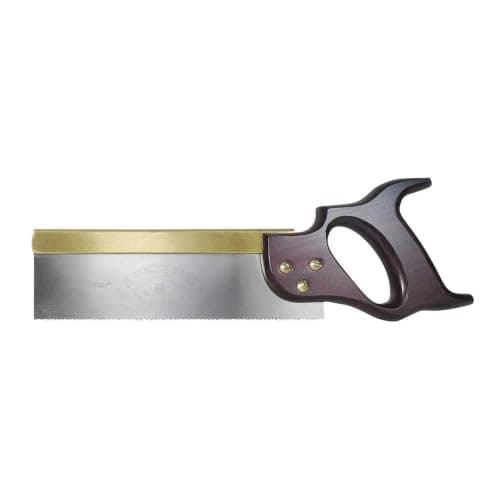
Robert Sorby's own catalog lists this as a solid brass back with brass fasteners, a lacquered high carbon steel blade, and 13 PPI resharpenable precision cross-ground teeth — the fullest spec sheet of any saw on this page, at roughly half what the Sheffield-made premium saws cost. The catch is in the same sentence: the teeth are universal, not rip-filed.
The 12-inch brass-backed saw that publishes the most and costs the least
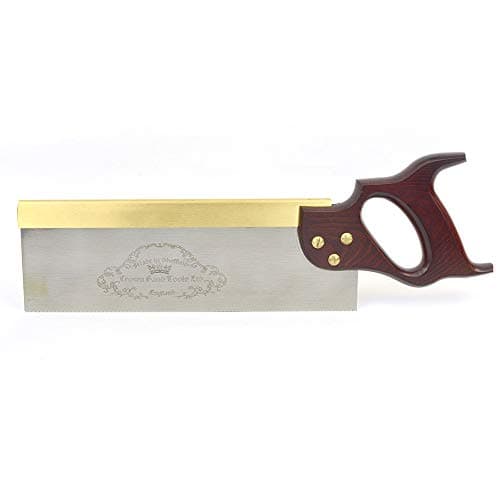
Crown Hand Tools of Sheffield publishes exactly three things about this saw and every one of them is the right answer: a resharpenable high carbon steel blade, a brass back, and a stained beechwood handle secured with screws rather than rivets. It is also the most expensive saw on this page by a wide margin, and Crown does not publish the tooth filing or a warranty.
A Sheffield brass-backed saw at the right length and the wrong price
Thomas Flinn is the last traditional saw maker left in Sheffield, and the Lynx line is the reason to care: Sheffield alloy spring steel, a folded brass back that holds the plate under tension, brass button screws, and teeth hand sharpened at the factory. It is also the only saw on this page whose listing states the filing — and what it states is crosscut, which is not what a tenon cheek wants.
The best-made saw here, and the only one that tells you how it is filed
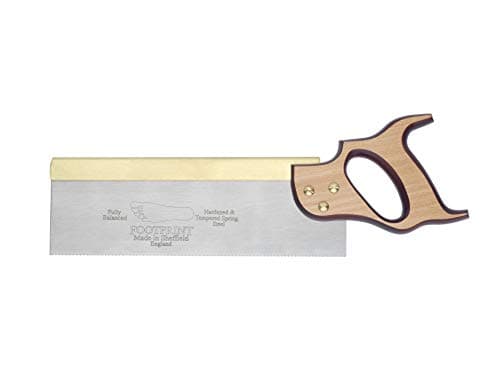
Footprint's own listing for the 256 range says the thing this site exists to look for: a spring alloy steel blade that can be re-sharpened time and time again, a heavy-duty brass back, three brass screws holding a two-tone lacquered beech handle, and Sheffield on the label. At 10 in and 15 TPI it is a carcass-weight saw, and Footprint does not publish the filing either.
Replaceable brass screws and a plate the maker says files forever
Sheffield-made, filed teeth, a proper back, and a price that does not assume you are a collector. This is the western answer to the dozuki for anyone who wants to sharpen rather than replace.
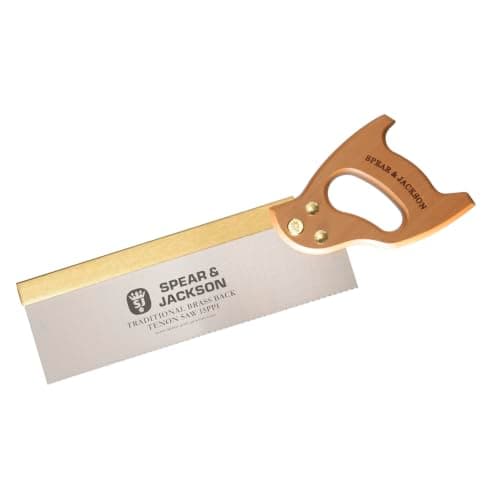
Spear & Jackson's own page for the B9812 says 15 PPI hard pointed teeth, a solid steel back and a high impact polystyrene handle. Hard pointed means the teeth are hardened past the point a file will touch, so this saw cannot be renewed — when the teeth dull, it is finished. It costs about a sixth of the Crown and it is on this page precisely so nobody buys it by accident.
The honest answer when you need a backsaw today and will not sharpen it
#ad· Live prices from the Amazon Product API, as of October 16, 2026. Where we have no verified live price we show none, and the cost-per-decade figure is suppressed with it — we would rather leave a gap than print a number that has rotted.
A tenon saw is a backsaw: a stiff, shallow plate with a folded or solid spine along its top edge, sized to cut the two cheeks and two shoulders of a mortise-and-tenon joint accurately and by hand. The spine is the whole idea. It stops the plate flexing, which means the saw goes where you point it instead of where the wood prefers, and it is also the reason a tenon saw can only cut as deep as the distance from its teeth to its back. If you want the mechanism before the shopping, what is a backsaw covers it, and how to cut tenons by hand covers the joint this tool exists for.
This page exists because the hand-saws hub had a roundup for general saws, one for dovetail saws and one for Japanese pull saws, and nothing ranked for the class that the word “tenon saw” actually names. It also exists because researching it turned up something we did not expect, and that finding ended up deciding the order.
How we ranked them
We have not cut a tenon with any of these saws. What we did is what this whole site does: open every maker's and retailer's own product page, write down only what they are willing to publish, and rank on that. The sources are listed at the bottom and quoted in the write-ups. Four things decided the order.
Can the teeth be filed again? This is the first question on a buy-it-for-life site and on a backsaw it is close to the only one, because a backsaw has no replaceable blade — the plate is the tool. Teeth that are hand-filed or cross-ground can be sharpened and reset with a file for as long as there is plate left, which is why nineteenth-century saws are still in working use. Teeth that are hard pointedor impulse-hardened are harder than a file, cut well, and then die. Six of the seven saws here publish that their teeth are resharpenable. One publishes, in its own words, “15 PPI Hard Pointed teeth,” and it is ranked last for that reason alone.
How is the handle fixed on? A detail that sounds cosmetic and is not. To file a saw properly you clamp the plate in a vise, and on most backsaws that means taking the handle off. Crown and Footprint both publish that their handles are held by screws: Footprint says three brass screws, Crown says secured with screws. Spear & Jackson and the Robert Sorby traditional saw publish handles held by three bifurcated rivets, which are meant to be permanent. The Predator's handle is molded polystyrene and is not coming off at all. A screwed handle is a saw designed to be maintained; a riveted one is a saw designed to be used.
What is the back made of, and is it folded or solid? Brass is heavier than steel, and a heavier spine both stiffens the plate and helps the saw fall through the cut on its own weight. There is a second distinction most listings skip: a folded back is wrapped around the plate and holds it under tension, which keeps it dead straight; a solidback is slotted and supports the plate without tensioning it. Thomas Flinn publishes that the Lynx back is folded brass holding the blade under tension. Sorby and Spear & Jackson publish solid brass. Crown publishes “brass back” and leaves it there. The Predator publishes a solid steel back, which is rigid and is not brass.
Are the teeth filed rip, crosscut, or neither?Here is the finding. A tenon's cheeks are cut along the grain, which is rip work, and rip teeth — filed with near-vertical faces so each tooth acts like a tiny chisel — cut long grain far faster and more cleanly than crosscut teeth do. The shoulders are cut across the grain and want crosscut teeth. So the filing matters more on this saw than on any other backsaw, and almost nobody publishes it. Of the seven saws here, exactly one maker states it: Thomas Flinn, whose 10 in Lynx is filed for crosscutting and whose 14 in Lynx is filed for rip. Robert Sorby publishes “universal teeth for cutting along and across the grain,” which is an honest description of a compromise. Spear & Jackson describes a fine cutting action suitable for use along and across the grain. Crown and Footprint publish nothing about the filing at all. Rip vs crosscut teeth is the page for why this is not a small thing.
What is not on this page, and why
The rip-filed Lynx 14 in is, on the published evidence, the correct tenon saw in this whole survey: 14 in and 355 mm of plate, a 3 in depth of cut, 19 in overall, solid brass backing and screws, a lacquered and stained beech handle, made in Sheffield, and filed rip for cutting with the grain. It is not a ranked pick because when we checked the listing it showed six units left, and we do not feature inventory that thin — the same rule that kept a three-unit Clifton off the jointer roundup. If it restocks properly it belongs at the top of this page. It is worth looking for by name.
The Pax 12 in brass-backed tenon saw, also Thomas Flinn, was listed temporarily out of stock. Pax is the older and dearer of Flinn's two lines and would have ranked high. A Taytools-branded Lynx 10 in was showing five units. Both are omissions of availability, not of quality.
Lie-Nielsen and Veritasmake the best tenon saws sold in North America and neither sells through Amazon, so neither can be a ranked pick and we earn nothing if you buy one. Lie-Nielsen's is linked from the top pick's card as a plain reference with what its own page publishes: a 16 in, .032 in thick plate, 21-1/4 in overall, a 3 in depth of cut, a cherry handle, brass fittings and a stout 3/4 x 1/4 in milled brass back, based on a classic Henry Disston model — and every Lie-Nielsen saw precision set, filed and test cut in hardwood before it ships. It is filed rip. At around two hundred and fifty dollars it is more than the Crown and it is a materially better saw.
Japanese pull saws are not here, and for tenons they are a serious alternative rather than an also-ran: a ryoba has rip teeth on one edge and crosscut on the other, which is exactly the two filings this joint needs, in one tool. Japanese vs western saws argues it out and best Japanese saws ranks them. The catch is renewability: most are impulse-hardened and cannot be filed, so you are buying replacement blades instead of a file.
The order, briefly
The Robert Sorby Select is first because it publishes more than anything else here — high carbon steel with a protective lacquer, a solid brass back andbrass fasteners, 13 PPI, and resharpenable precision cross-ground teeth — at 12 in, which is the right length, for roughly half the Crown's money. It is not first on quality; it is first on the combination of the right size, a documented spec sheet, real stock and a sane price. The Crown 195 is second: Sheffield, brass-backed, resharpenable, screw-fixed handle, and the most expensive saw on the page by a distance with the shortest spec sheet. The Lynx 10 in is third and is the best-made saw here, held back because 15 TPI filed for crosscutting makes it a carcass saw doing a tenon saw's job. The Footprint is fourth for its explicit “re-sharpened time and time again” claim and three brass screws, at 10 in. The Spear & Jackson 12 in is fifth and is the value answer on this page by a wide margin; the 10 in version sixth. The Predator is seventh because its teeth cannot be sharpened, which on this site is disqualifying rather than a deduction.
Every pick, in full
The write-ups
01The 12-inch brass-backed saw that publishes the most and costs the least
Size
12 in (300 mm), 13 PPI
Blade
Hardened high carbon steel, protective lacquer
Back
Solid brass back and brass fasteners
Teeth
Universal, resharpenable precision cross-ground
Warranty
Lifetime guarantee published on tool SETS, registration required
Robert Sorby Select Professional Tenon Saw, 12 in 13 PPI
Robert Sorby
8.7/10
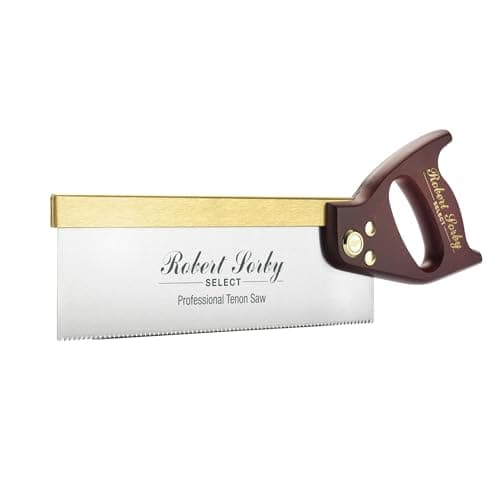
Robert Sorby's own catalog lists this as a solid brass back with brass fasteners, a lacquered high carbon steel blade, and 13 PPI resharpenable precision cross-ground teeth — the fullest spec sheet of any saw on this page, at roughly half what the Sheffield-made premium saws cost. The catch is in the same sentence: the teeth are universal, not rip-filed.
Cost per decade
$37.20
Horizon · tier C
20 years — No lifetime warranty; parts purchasable and resharpenable
No lifetime warranty published at the date checked. The teeth are filed rather than impulse-hardened, so they can be resharpened and reset by hand indefinitely — the reason nineteenth-century saw plates are still in working use.
Rebuy risk
Medium
parts listed, resharpenable
Cut quality
8.0
Blade life
9.0
Control
8.0
Renewability
9.5
Value
9.0
What it gets right
+Sorby's catalog states the teeth are resharpenable, which is the one promise that matters on a backsaw
+Solid brass back plus brass fasteners at a price where most saws get a folded steel back
+12 in is the right length for tenon cheeks, and the only 13 PPI saw here in stock without a thin-inventory warning
+The published spec sheet is the most complete of the seven — steel, coating, back, fasteners and tooth type are all stated
What it costs you
−The teeth are filed universal for cutting along and across the grain, so they are a compromise on tenon cheeks rather than the rip filing the job wants
−Sorby's lifetime guarantee is published for tool sets registered from a warranty card; a single saw bought loose is not obviously covered
−The catalog describes a slow, extra fine cut, which is accurate and means it is not the saw for deep tenons in hardwood
−Cross-ground teeth take more work to file back to a clean rip profile than hand-filed teeth do
Skip this if…
…you are cutting tenons all day in hard maple. The universal filing will make you work for every cheek, and a rip-filed 14 in plate is the honest answer.
We earn nothing on this one
The best tenon saw sold in North America is Lie-Nielsen's, it is not sold on Amazon, and we earn nothing on it. Verbatim from its product page: a 16 in long, .032 in thick blade, 21-1/4 in overall, a 3 in depth of cut, a cherry handle, brass fittings and a stout 3/4 x 1/4 in milled brass back, based on a classic Henry Disston model, and every Lie-Nielsen saw is precision set, filed and test cut in hardwood before it leaves the shop. It is filed rip, which is the thing nothing on this page except the thin-stocked Lynx 14 in gets right. Every one of those figures is quoted from the product page at Lie-Nielsen Toolworks.
Price as of October 16, 2026. Prices move; Amazon's is the one that counts.
#ad · we may earn a commission from this link to Robert Sorby Select Professional Tenon Saw, 12 in 13 PPI
02A Sheffield brass-backed saw at the right length and the wrong price
Size
12 in (305 mm), 13 TPI
Blade
Resharpenable high carbon steel
Back
Brass back
Handle
Stained beechwood, secured with screws
Warranty
None published
Crown 195 Tenon Saw, 12 in 13 TPI Brass Back
Crown Hand Tools
8.2/10
Crown Hand Tools of Sheffield publishes exactly three things about this saw and every one of them is the right answer: a resharpenable high carbon steel blade, a brass back, and a stained beechwood handle secured with screws rather than rivets. It is also the most expensive saw on this page by a wide margin, and Crown does not publish the tooth filing or a warranty.
Cost per decade
$79.52
Horizon · tier C
20 years — No lifetime warranty; parts purchasable and resharpenable
No lifetime warranty published at the date checked. The teeth are filed rather than impulse-hardened, so they can be resharpened and reset by hand indefinitely — the reason nineteenth-century saw plates are still in working use.
Rebuy risk
Medium
parts listed, resharpenable
Cut quality
8.5
Blade life
9.0
Control
8.5
Renewability
9.5
Value
5.5
What it gets right
+Crown's own page states the blade is resharpenable high carbon steel, made in Sheffield, England
+The handle is held by screws, so it comes off for filing and goes back on — the detail that makes a saw genuinely renewable
+13 TPI at 12 in is the traditional tenon-saw geometry rather than a finer carcass filing
+Crown has manufactured traditional hand tools in Sheffield for over fifty years and signs its work
What it costs you
−It costs roughly double the Sorby and nearly four times the Spear & Jackson for a spec sheet that is shorter, not longer
−Crown publishes no tooth filing, no plate thickness, no depth of cut and no warranty terms on the product page
−No published statement on whether the back is folded or solid brass, which is the difference between plate tension and plate support
−At this money the Lie-Nielsen is only a stretch further and is rip-filed and set by hand
Skip this if…
…the price is doing any of the deciding. The Spear & Jackson two rows down resharpens just as indefinitely for a quarter of the outlay.
03The best-made saw here, and the only one that tells you how it is filed
Size
10 in, 15 TPI, filed for crosscutting
Blade
Sheffield alloy spring steel
Back
Folded brass back, plate held under tension
Handle
Stained European beech, brass button screws
Origin
Made in Sheffield, England
Lynx Tenon Saw, 10 in 15 TPI Crosscut
Lynx (Thomas Flinn)
8.6/10
Thomas Flinn is the last traditional saw maker left in Sheffield, and the Lynx line is the reason to care: Sheffield alloy spring steel, a folded brass back that holds the plate under tension, brass button screws, and teeth hand sharpened at the factory. It is also the only saw on this page whose listing states the filing — and what it states is crosscut, which is not what a tenon cheek wants.
Cost per decade
$50.84
Horizon · tier C
20 years — No lifetime warranty; parts purchasable and resharpenable
No lifetime warranty published at the date checked. The teeth are filed rather than impulse-hardened, so they can be resharpened and reset by hand indefinitely — the reason nineteenth-century saw plates are still in working use.
Rebuy risk
Medium
parts listed, resharpenable
Cut quality
9.0
Blade life
9.5
Control
8.5
Renewability
9.5
Value
6.5
What it gets right
+Thomas Flinn states its saws are hand sharpened before leaving the factory and can be resharpened
+A folded brass back tensions the plate rather than merely weighting it, which is the better of the two constructions
+The only listing on this page that publishes whether the teeth are rip or crosscut — the spec that decides the saw
+Sheffield alloy spring steel is the traditional plate material and files cleanly when the teeth need renewing
What it costs you
−Filed for crosscutting at 15 TPI, which makes it a carcass saw in a tenon saw's clothing — it will cut shoulders beautifully and fight you on cheeks
−10 in and a shallow plate limit how deep a tenon you can cut before the back bottoms out
−Thomas Flinn publishes no warranty terms we could find
−Stock on this listing carried an order-soon warning when we checked, and the rip-filed 14 in was thinner still
Skip this if…
…you are buying one backsaw for tenons. Crosscut teeth at 15 TPI are the wrong tool for the long grain of a cheek; buy a 12 in and keep this one for shoulders.
04Replaceable brass screws and a plate the maker says files forever
Size
10 in (250 mm), 15 TPI
Blade
Spring alloy steel, re-sharpenable repeatedly
Back
Heavy-duty brass back (listed as a rigid brass spine)
Handle
Two-tone lacquered beechwood, three brass screws
Origin
Made in Sheffield, England
Footprint 256 Tenon Saw, 10 in 15 TPI Brass Back
Footprint
8.5/10
Footprint's own listing for the 256 range says the thing this site exists to look for: a spring alloy steel blade that can be re-sharpened time and time again, a heavy-duty brass back, three brass screws holding a two-tone lacquered beech handle, and Sheffield on the label. At 10 in and 15 TPI it is a carcass-weight saw, and Footprint does not publish the filing either.
Cost per decade
$51.09
Horizon · tier C
20 years — No lifetime warranty; parts purchasable and resharpenable
No lifetime warranty published at the date checked. The teeth are filed rather than impulse-hardened, so they can be resharpened and reset by hand indefinitely — the reason nineteenth-century saw plates are still in working use.
Rebuy risk
Medium
parts listed, resharpenable
Cut quality
8.5
Blade life
9.5
Control
8.0
Renewability
9.5
Value
7.0
What it gets right
+Footprint states plainly that the blade can be re-sharpened time and time again — an explicit renewability claim, not an implied one
+Three brass screws rather than bifurcated rivets, so the handle comes off for filing and the fasteners are replaceable
+Heavy-duty brass back on a 10 in plate makes it noticeably stiff for the size
+Sheffield manufacture at meaningfully less than the Crown
What it costs you
−Footprint publishes no tooth filing, so whether these teeth are rip, crosscut or universal is unknown
−15 TPI and a 10 in plate is carcass geometry; deep tenons in thick stock will run out of depth
−No warranty terms published on the maker's or retailer's pages
−Inventory carried an order-soon warning when we checked, so the listing may not be there next month
Skip this if…
…you want one saw for tenons and nothing else. This is a joinery backsaw that will cut shoulders and small cheeks; it is not a 14 in rip-filed tenon saw.
Price as of October 16, 2026. Prices move; Amazon's is the one that counts.
#ad · we may earn a commission from this link to Footprint 256 Tenon Saw, 10 in 15 TPI Brass Back
05A resharpenable western backsaw at a sane price
Length
12 in
Teeth
15 PPI, filed
Type
Tenon saw, backed
Action
Push stroke
Spear & Jackson Tenon Saw, 12 in 15 PPI
Spear & Jackson
8.7/10
Sheffield-made, filed teeth, a proper back, and a price that does not assume you are a collector. This is the western answer to the dozuki for anyone who wants to sharpen rather than replace.
Cost per decade
$15.66
Horizon · tier C
20 years — No lifetime warranty; parts purchasable and resharpenable
No lifetime warranty published at the date checked. The teeth are filed rather than impulse-hardened, so they can be resharpened and reset by hand indefinitely — the reason nineteenth-century saw plates are still in working use.
Rebuy risk
Medium
parts listed, resharpenable
Cut quality
8.0
Blade life
9.5
Control
8.0
Renewability
9.5
Value
8.5
What it gets right
+Filed teeth mean this saw can be renewed indefinitely
+15 PPI is fine enough for joinery, coarse enough to be efficient
+Substantial back keeps the plate genuinely rigid
What it costs you
−Needs its teeth dressed and set before it does its best work
−Wider kerf than any Japanese equivalent
−Handle finish is rough at the price
Skip this if…
…you will not sharpen it. Everything good about this saw is downstream of that.
The 12 inch shortened to a size that suits small joinery. Same filed teeth, same renewability, more control.
Cost per decade
$15.02
Horizon · tier C
20 years — No lifetime warranty; parts purchasable and resharpenable
No lifetime warranty published at the date checked. The teeth are filed rather than impulse-hardened, so they can be resharpened and reset by hand indefinitely — the reason nineteenth-century saw plates are still in working use.
Rebuy risk
Medium
parts listed, resharpenable
Cut quality
7.5
Blade life
9.5
Control
8.5
Renewability
9.5
Value
8.5
What it gets right
+Easier to control than the 12 inch on small work
+Resharpenable indefinitely
+Cheaper than any premium dovetail saw by a wide margin
What it costs you
−15 PPI is still coarser than an ideal dovetail filing
−Requires the same tooth-dressing work before it excels
−Kerf is wide for fine pins
Skip this if…
…you want the cleanest possible dovetail out of the box. That is the dozuki, and it is not close.
07The honest answer when you need a backsaw today and will not sharpen it
Size
12 in (305 mm), 15 PPI
Teeth
Hard pointed — NOT resharpenable
Blade
Hardened and tempered carbon steel
Back
Solid steel back
Handle
High impact polystyrene, 45/90 deg angle guide
Spear & Jackson Predator Tenon Saw, 12 in 15 PPI
Spear & Jackson
6.1/10
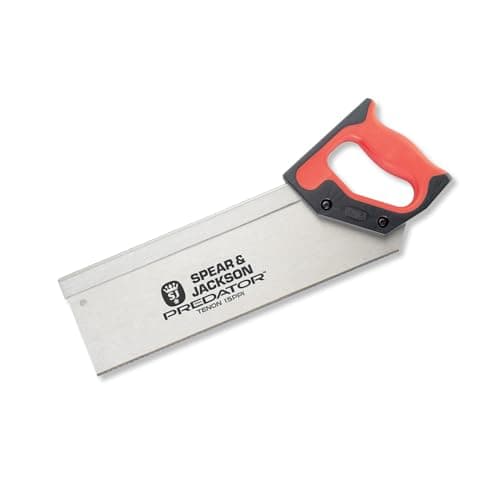
Spear & Jackson's own page for the B9812 says 15 PPI hard pointed teeth, a solid steel back and a high impact polystyrene handle. Hard pointed means the teeth are hardened past the point a file will touch, so this saw cannot be renewed — when the teeth dull, it is finished. It costs about a sixth of the Crown and it is on this page precisely so nobody buys it by accident.
Cost per decade
$16.99
Horizon · tier D
10 years — No warranty and no parts availability found
Impulse-hardened teeth cannot be resharpened, and we could not find a replacement blade listing for this model at the date checked. When the teeth go, the saw goes — which is what the rating below is telling you.
Rebuy risk
High
none of the three met
Cut quality
7.5
Blade life
6.0
Control
7.0
Renewability
1.5
Value
8.5
What it gets right
+Cuts cleanly and accurately out of the box, and hard pointed teeth stay sharp longer than filed teeth do before they die
+The cheapest saw here by a wide margin, and genuinely in stock
+The molded handle includes 45 and 90 degree guide faces, which is useful on shoulder cuts
+A steel back is still a rigid back; this is not a floppy plate
What it costs you
−Hard pointed teeth cannot be filed or reset, so the saw is a consumable with no replacement blade — the opposite of everything else on this page
−The polystyrene handle cannot be removed for filing and will not be repaired or replaced in thirty years
−Spear & Jackson publishes no warranty terms for it
−15 PPI is a fine crosscut-weight filing, so it is slow in the long grain of a tenon cheek
Skip this if…
…you expect to still own this saw in ten years. You will not. Every other saw on this page can be filed back to new; this one gets thrown away, and that is the whole reason it is ranked last.
Price as of October 16, 2026. Prices move; Amazon's is the one that counts.
#ad · we may earn a commission from this link to Spear & Jackson Predator Tenon Saw, 12 in 15 PPI
How
What actually decides it
Buying guide
What length, and how deep a tenon can it cut?
The number that constrains a backsaw is not its length, it is the depth of cut — teeth to the underside of the spine. That is the deepest single cheek you can saw before the back stops on the wood. A 10 in tenon saw typically gives you a little over 2 in; the 14 in Lynx publishes 3 in; the Lie-Nielsen 16 in publishes 3 in. For the tenons most furniture actually uses, on stock up to about 1-1/2 in thick, 2 in of depth is enough. If you are cutting big frame tenons, door rails or bench joinery, you want 3 in and you want the extra length, because a longer plate means fewer strokes and a steadier line. Most makers do not publish a depth of cut, which is why only two numbers appear in this paragraph.
On 12 in versus 10 in: 12 in is the traditional tenon-saw size and the one to buy if you are buying one saw for this joint. A 10 in backsaw filed fine is really a carcass saw — excellent for shoulders, small joinery and cutting across narrow stock, and workable on small cheeks. Three of the seven saws here are 10 in, which is worth knowing before you order. Tenon saw vs dovetail saw sets out where this class stops and the smaller saws begin.
Reading the tooth count
PPI (points per inch) and TPI (teeth per inch) are used interchangeably by most of these makers and differ by one; nobody on this page is precise enough about it for the distinction to change a buying decision. Saw TPI explained has the arithmetic. The practical range: 13 PPI is the traditional tenon-saw filing and the coarser, faster choice — it is what the Sorby, the Crown and the rip-filed Lynx 14 in all use, and it is what you want for cheeks. 15 PPI is finer, leaves a cleaner surface, cuts more slowly, and is the better choice if the saw will mostly cut shoulders and small joinery. Finer is not better; finer is slower. For a saw that has to do both jobs, 13 is the more useful compromise, which is part of why the 13 PPI saws rank above the 15 PPI ones here.
The renewability question, honestly
Not one of the seven saws on this page publishes a warranty we could find. Crown publishes none. Footprint publishes none. Thomas Flinn publishes none. Spear & Jackson publishes none for either the traditional saws or the Predator. Robert Sorby does publish a lifetime guarantee, but it is published for tool sets, activated by registering the set's number from a warranty card and keeping the receipt, and it excludes wear through natural usage — so a single saw bought loose is not obviously covered, and on a saw, sharpening is natural usage. We have not rated any saw here as carrying a lifetime warranty, because none of them demonstrably does.
That sounds bleak and it is actually the point. A filed backsaw does not need a warranty, because there is no consumable in it and nothing to fail: a plate, a spine and a handle. What it needs is teeth you can renew and a handle you can take off to renew them, and six of these seven have both. That is a stronger promise than a warranty document, and it is the promise the cost-per-decade figure on each card is built on. The whole maker-by-maker picture is on warranties and repairability, and the arithmetic is on cost per decade.
You will need a saw file, and that is fine
Every saw on this page except the Predator arrives good and gets better, or gets worse, depending entirely on whether you learn to file it. This is a genuinely easy skill — far easier than sharpening a plane iron to a mirror — and it needs a taper file of the right size for the tooth pitch, a saw vise or a shop-made wooden one, and a saw set for re-setting the teeth every few sharpenings. How to sharpen a hand saw is the page for it. One worthwhile trick specific to these saws: several of them arrive with more set than a backsaw wants, which widens the kerf and makes the saw wander. Lightly stoning the sides of the teeth with a fine stone before first use often does more for the cut than anything else you can do in ten minutes.
A note on the same saw under different names
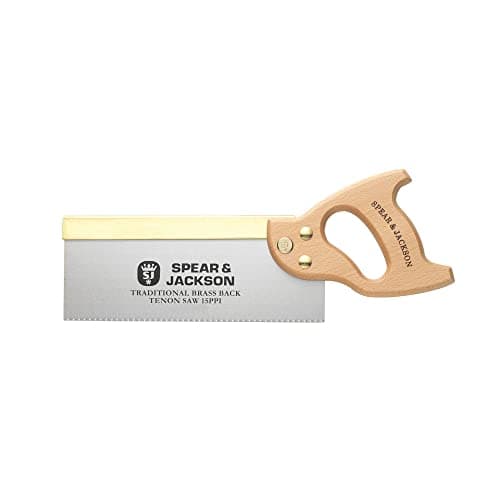
Something to know before you pay a premium for a badge. Robert Sorby's own 2025 catalog lists its Traditional Brass Back Tenon Saw as RS-9550B, 12 in (305 mm), 15 PPI, hardened carbon steel, solid brass back, handle secured with three bifurcated rivets. Spear & Jackson's own site lists its 12 in 15 PPI Traditional Tenon Saw as part 9550B— hardened and tempered carbon steel, brass back, resharpenable teeth, wooden handle with three bifurcated rivets. The part number and the published specification are the same. The Sheffield saw trade has always worked this way, and it means the honest move is to buy on the published spec and the price rather than on the name struck into the plate. It is also why the Spear & Jackson at a fraction of the money scores so well here.
If the budget is tight
Buy the Spear & Jackson 12 in, spend a little on a taper file and a saw set, and spend nothing else. You will have a brass-backed, resharpenable, Sheffield-pattern tenon saw for less than the price of a mid-range chisel, and the skill you buy with the file is worth more over thirty years than any upgrade on this page. What you give up against the Crown and the Lynx is a screwed handle instead of rivets, and a maker who signs the work. What you do not give up is renewability, which is the only thing that decides whether a tool is still yours in forty years.
The one thing worth not economizing on: do not buy the Predator thinking you will replace it later. Hard pointed teeth mean the saw is a consumable, and two of those over a decade costs more than one saw you can file. If eighteen dollars is genuinely the budget today, buy it and cut your joint — but buy it knowing what it is.
What else the joint needs
A tenon saw cuts half of a mortise-and-tenon. The other half is a mortise, and that is chisel work: best mortise chisels ranks the tools for it, and bench chisels vs mortise chisels explains why a bench chisel is the wrong tool to lever waste out of a deep mortise. If you are assembling a first set of saws rather than adding to one, the main saw roundup is the place to start and saw types compared lays the whole family out in one table.
Questions
Frequently asked
What is the best tenon saw?+
On what the makers publish, the Robert Sorby Select Professional 12 in: a solid brass back with brass fasteners, a lacquered high carbon steel blade, 13 PPI, and resharpenable precision cross-ground teeth, at roughly half what the Sheffield premium saws cost. The honest caveat is in Sorby's own wording — the teeth are universal, filed for cutting along and across the grain, rather than rip-filed. The best tenon saw we found anywhere is the Lie-Nielsen 16 in, which is filed rip, hand set and test cut before it ships, and is not sold on Amazon.
What size tenon saw should I buy?+
Twelve inches, if you are buying one saw for cutting tenons. A 12 in plate gives you enough length for a steady stroke and enough depth of cut for the tenons most furniture uses. Ten inches is really carcass-saw territory — excellent for shoulders and small joinery, limited on deep cheeks. Fourteen to sixteen inches is what you want for door rails, frames and bench joinery, and there the depth of cut, published at 3 in on both the Lynx 14 in and the Lie-Nielsen 16 in, is the number that matters.
Should a tenon saw be filed rip or crosscut?+
Rip, for the cheeks. A tenon's cheeks are cut along the grain, and rip teeth with near-vertical faces cut long grain much faster and more cleanly than crosscut teeth. The shoulders are crosscuts and want the opposite. Because most people own one backsaw, most makers file a compromise and call it universal. Only Thomas Flinn publishes the filing on the saws we surveyed: the 10 in Lynx is crosscut, the 14 in Lynx is rip. Rip vs crosscut teeth has the detail.
What is the difference between a tenon saw and a dovetail saw?+
Size and tooth pitch, mostly. A tenon saw is a bigger backsaw — usually 10 to 16 in at around 13 to 15 points — with enough depth of cut for the cheeks of a joint. A dovetail saw is a small backsaw, typically 6 to 10 in at 14 to 20 points, with a thinner plate and less set so it leaves a narrow kerf for fine pins and tails. They are not interchangeable in either direction. Tenon saw vs dovetail saw covers it properly, and best dovetail saws ranks the smaller class.
Can a tenon saw be resharpened?+
A traditional one, yes, indefinitely — that is the entire argument for buying one. The teeth are filed rather than hardened past the point a file will cut, so you can sharpen and reset them for as long as there is plate left. Six of the seven saws on this page publish that their teeth are resharpenable. The exception is the Spear & Jackson Predator, whose own page describes hard pointed teeth: it cuts well, cannot be filed, and has no replacement blade, which is why it is ranked last.
Which tenon saw has the best warranty?+
None of them has one we could verify for a single saw. Crown, Footprint, Thomas Flinn and Spear & Jackson publish no warranty terms on these products. Robert Sorby publishes a lifetime guarantee, but for tool sets, activated by registering the set's number and keeping the receipt, and excluding wear through natural usage. On a backsaw this matters less than it sounds: there is no consumable part, so what you actually want is resharpenable teeth and a handle that comes off to file them.
Is a Japanese saw better for cutting tenons?+
For cutting speed and surface quality out of the box, a ryoba is hard to beat, because it carries rip teeth on one edge and crosscut on the other — the two filings a tenon needs, in one tool — and a thin plate that pulls rather than pushes. The trade is renewability: most are impulse-hardened and cannot be filed, so you buy replacement blades rather than a saw file. Japanese vs western saws is the full argument.
We have not handled these tools. Nobody here has tested one, owned one, or taken one apart. Specifications come from the manufacturer or the retailer listing; warranty terms come from the maker's own warranty page; the cost-per-decade arithmetic is ours and reproducible. Where we could not verify a figure we say so on the page rather than quietly leaving it out. Read the full method.