We earn a commission when you buy through our Amazon links, at no extra cost to you. It never decides a ranking, and where the best tool in a class is one we earn nothing on, we say so and link it anyway. How this works.
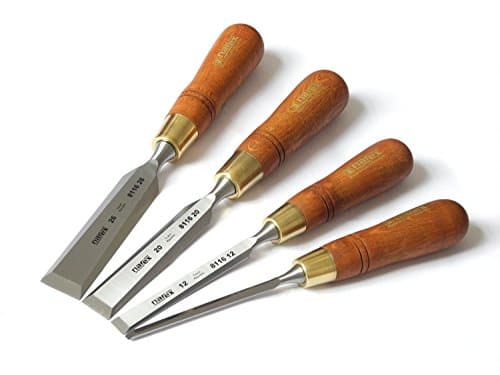
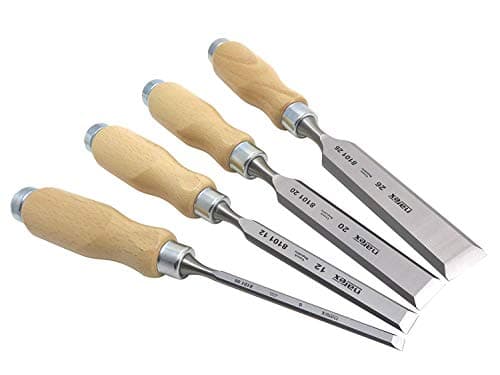
The set that makes the case for this whole site. Four sizes, Czech chrome-vanadium hardened properly, beech handles, and a price that leaves budget for the stone you will need anyway.
The classic set with hornbeam handles instead of beech and better fit and finish throughout. The steel is the same, which is the point: you are buying the handle and the finishing.
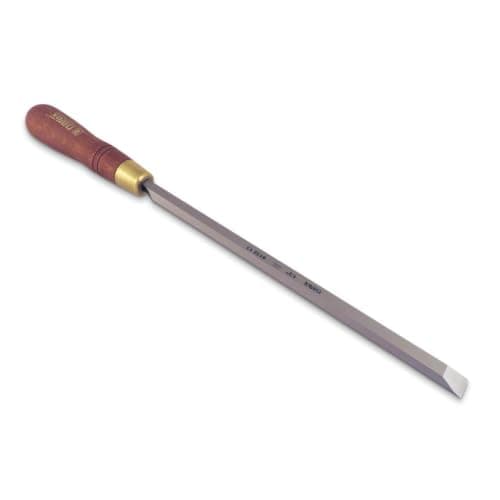
The same Cr-Mn steel at the same published 59 HRc as the Narex bench chisels, in a blade nearly two and a half times as long. Everything you are paying for here is geometry: a 245 mm blade in a 390 mm tool, ground at 25 degrees, on a hornbeam handle with a brass ferrule and a heavy seated tang.
The first paring chisel, once a bench chisel is no longer enough
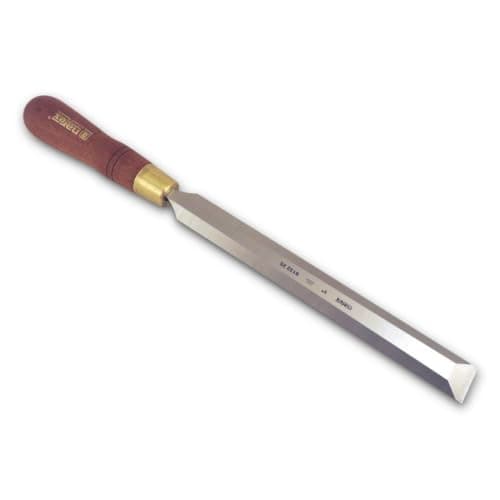
The same chisel one size up, and the width that actually earns a paring chisel its keep. A wide blade held flat on a surface is a straightedge with an edge on it, and that is the job a bench chisel is too short to do reliably.
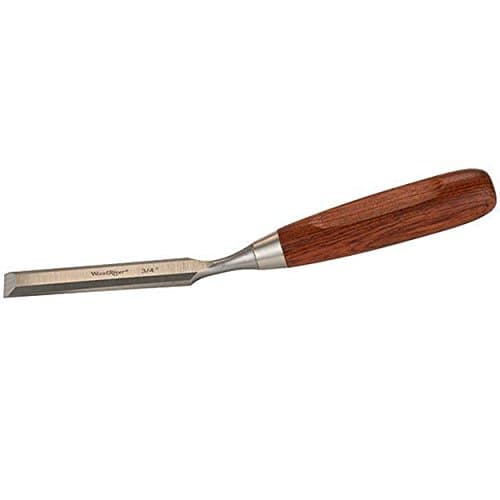
The cranked-neck variant, and the one geometry a straight chisel genuinely cannot copy: an 18 degree bent tang lifts your hand clear of the work so the blade can lie flat well inside a panel. Woodcraft publishes the bend angle and the length and nothing whatever about the steel.
#ad· Live prices from the Amazon Product API, as of October 21, 2026. Where we have no verified live price we show none, and the cost-per-decade figure is suppressed with it — we would rather leave a gap than print a number that has rotted.
A bench chisel is a generalist that pares, chops and cleans up joints. A paring chisel is a specialist that does one of those three things better and the other two not at all. If you own one type of chisel, own bench chisels. The question this page answers is when the second type starts earning its place, and the answer is narrower than the category's marketing suggests.
What makes this a genuinely clean comparison is that you can hold the two families constant on everything except shape. Narex sells both, cut from the same chrome-manganese steel at the same published 59 HRc, with the same stained hornbeam handles, from the same factory in the Czech Republic. Put the bench chisel and the paring chisel side by side and the steel is not a variable. Only the geometry is — and the geometry is the argument.
The four differences, in order of how much they matter
1. Length.This is the whole tool. A Narex Premium paring chisel carries a 245 mm blade in a 390 mm overall length. A bench chisel of the same width is roughly a third of that. Length is not reach — it is registration. A long blade laid on a surface has two widely separated points of contact, so it tracks that surface instead of pivoting off it. The longer the blade, the more the tool wants to stay flat and the less your hand can tip it into the work. Everything people describe as “control” in a paring chisel is that one geometric fact.
2. The bevel angle.Bench chisels are ground at 25 degrees and usually honed with a secondary bevel a little steeper, because they get struck and a shallow edge folds. A paring chisel is ground at 25 degrees and honed shallower rather than steeper — often nearer 20 — because it is only ever pushed, and a lower included angle slices end grain with less force. That lower edge is faster and cleaner in the cut and measurably more fragile. It is a straight trade, and it is only available to a tool that will never meet a mallet. The angles themselves are covered on sharpening angles explained.
3. Section and flex. A paring chisel blade is thinner through its section than a bench chisel of the same width, and at that length it visibly flexes. That is deliberate: a slight bow lets the blade follow a surface rather than chatter across it. It is also exactly why levering a paring chisel is how you break one. A bench chisel tolerates being twisted out of a cut. A paring chisel does not, and neither does your wrist when it lets go.
4. The handle, and the rule it enforces.A bench chisel handle is built to be hit: a hoop, a leather washer, or at minimum a thick ferrule and a shape that survives a mallet. A paring chisel handle is long, often turned to a comfortable palm shape, and carries a brass ferrule to hold the tang rather than a steel hoop to take blows. There is no version of “just a light tap” on one of these. Strike it and you split the handle or bend the blade, and neither is a warranty claim.
Where a bench chisel already pares perfectly well
Here is the part a page selling paring chisels is supposed to leave out. A sharp bench chisel pares most fitting work in a normal shop, and the honest reason most people find their paring disappointing is that the chisel is dull, not short. Dovetail cheeks, small tenon shoulders, hinge mortises, cleaning up a rebate, trimming a dowel — all of it is bench chisel work, and a bench chisel does it with a tool you already own and can also hit when you need to.
Before you buy anything, sharpen what you have and try the work again. How to sharpen a chisel is the whole procedure and how to flatten a chisel back is the half of it people skip, which is unfortunate because on any chisel used for paring the back is the reference face. A flat back is worth more than a longer blade, and it costs an evening rather than the price of a tool.
The three jobs that genuinely want a paring chisel
Truing a long tenon cheek or a half-lap floor. A wide blade held flat on a surface is a straightedge with an edge on it. Over a few inches, a bench chisel does this fine. Over the length of a real tenon, the short blade starts riding its own cut and you dish the surface. Length is what stops that.
Fitting to a shaving. When a joint is a hair tight and you need to take off something closer to dust than wood, the low honed bevel and the two-handed push of a paring chisel give a resolution a struck tool cannot. This is the work paring chisels are named for.
Reaching flat into the middle of a wide surface. This is the one job where geometry beats everything, and it is what a cranked-neck chisel exists for: the bent tang lifts your hand clear of the board so the blade can lie genuinely flat well inside a panel. A straight chisel of any length cannot do that, because your knuckles get there first.
Which to buy, honestly
If you do not own good bench chisels, buy those and stop. The main roundup is the best wood chisels, and a four-piece set plus a stone will do more for your joinery than any specialist chisel.
If you own sharp bench chisels and keep hitting the same wall on the same operation, buy one paring chisel in the width that operation needs — not a set. A 1/2 in covers general fitting, a 1 in covers surfacing, and a cranked-neck 3/4 in covers flush work in the field of a board. Which of the three you want depends entirely on what has been annoying you, and the picks below are ordered so that the bench chisels come first, because for most readers that is still the right purchase.
Once you have decided it is a paring chisel you want, the best paring chiselsis the page that ranks them against each other — on published steel and hardness, blade and handle length, and the cranked-neck and skew geometries, rather than on the bench-versus-paring question this page answers.
Every pick, in full
The write-ups
01Best chisels overall, and the end of the argument
Set
4 pieces
Steel
Cr-Mn / Cr-V, hardened
Handles
Beech, tanged
Warranty
Not published by the maker
Narex Bevel Edge Chisel Set, 4 Piece
Narex
8.4/10
The set that makes the case for this whole site. Four sizes, Czech chrome-vanadium hardened properly, beech handles, and a price that leaves budget for the stone you will need anyway.
Cost per decade
$24.45
Horizon · tier C
20 years — No lifetime warranty; parts purchasable and resharpenable
A UK specialist retailer states a lifetime guarantee on Narex chisels; we could not find published warranty terms from Narex itself, so we do not rate it tier A. Unhandled blade blanks are sold separately, and the tool is resharpenable indefinitely.
Rebuy risk
Medium
parts listed, resharpenable
Steel & edge
8.5
Back flatness
8.0
Handle
7.5
Sizes covered
8.5
Value
9.5
What it gets right
+Edge retention indistinguishable from sets at four times the price in normal use
+Backs are flat enough that lapping is a job, not an ordeal
+Four sizes is genuinely the number most people use
+Nothing on the tool is consumable: sharpening renews it indefinitely
What it costs you
−Narex publishes no warranty terms we could find, so it cannot rate tier A
−Lacquer on the handles is functional rather than lovely
−Side lands are thicker than a dedicated dovetail chisel's
Skip this if…
…you cut a lot of tight dovetails. The side lands will bruise the pins; buy a dedicated dovetail chisel for those and keep these for everything else.
The classic set with hornbeam handles instead of beech and better fit and finish throughout. The steel is the same, which is the point: you are buying the handle and the finishing.
Cost per decade
$35.50
Horizon · tier C
20 years — No lifetime warranty; parts purchasable and resharpenable
A UK specialist retailer states a lifetime guarantee on Narex chisels; we could not find published warranty terms from Narex itself, so we do not rate it tier A. Unhandled blade blanks are sold separately, and the tool is resharpenable indefinitely.
Rebuy risk
Medium
parts listed, resharpenable
Steel & edge
8.5
Back flatness
8.5
Handle
8.5
Sizes covered
8.5
Value
8.5
What it gets right
+Hornbeam is denser than beech and takes mallet work better over decades
+Better ground out of the box than the entry set
+Metric sizing maps cleanly onto common joint dimensions
What it costs you
−Costs meaningfully more for the same cutting performance
−Metric sizes annoy people working to imperial plans
−Still no published warranty
Skip this if…
…you are buying your first set. Buy the cheaper Narex, spend the difference on a stone, and see whether you want better handles later.
Price as of October 21, 2026. Prices move; Amazon's is the one that counts.
#ad · we may earn a commission from this link to Narex Czech Steel Premium Chisels, 4 Piece Hornbeam
03The first paring chisel, once a bench chisel is no longer enough
Steel
Chrome-manganese, 59 HRc (maker)
Blade
245 mm (9-1/2 in) long, 1/2 in wide
Overall
390 mm (15-1/4 in)
Handle
Stained European hornbeam, brass ferrule, heavy steel tang
Bevel
Ground at 25 degrees
Narex Premium Paring Chisel, 1/2 in
Narex
7.8/10
The same Cr-Mn steel at the same published 59 HRc as the Narex bench chisels, in a blade nearly two and a half times as long. Everything you are paying for here is geometry: a 245 mm blade in a 390 mm tool, ground at 25 degrees, on a hornbeam handle with a brass ferrule and a heavy seated tang.
Cost per decade
$25.84
Horizon · tier C
20 years — No lifetime warranty; parts purchasable and resharpenable
A UK specialist retailer states a lifetime guarantee on Narex chisels; we could not find published warranty terms from Narex itself, so we do not rate it tier A. Unhandled blade blanks are sold separately, and the tool is resharpenable indefinitely.
Rebuy risk
Medium
parts listed, resharpenable
Steel & edge
8.0
Back flatness
8.0
Handle
8.5
Sizes covered
6.5
Value
8.0
What it gets right
+Published steel, published hardness and published dimensions, which is more than most of this category discloses
+1/2 in is the width that does most fitting work, so it is the right single chisel to start with
+The 245 mm blade is what registration is actually for — length is the feature, not a styling choice
+Brass ferrule and a heavy seated tang, the two places a long-handled chisel fails first
What it costs you
−Narex publishes no warranty terms we could find, so it cannot rate tier A
−It must never be struck, and a hornbeam handle with no hoop makes that obvious in the worst way
−The long blade is more steel to keep dead flat on the stone than a bench chisel back
−At 59 HRc it holds an edge respectably rather than exceptionally, and a low bevel dulls faster
Skip this if…
…you do not already own sharp bench chisels. A paring chisel is a third or fourth purchase, and a dull bench chisel is the problem it will not solve.
Stained European hornbeam, brass ferrule, heavy steel tang
Bevel
Ground at 25 degrees
Narex Premium Paring Chisel, 1 in
Narex
7.6/10
The same chisel one size up, and the width that actually earns a paring chisel its keep. A wide blade held flat on a surface is a straightedge with an edge on it, and that is the job a bench chisel is too short to do reliably.
Cost per decade
$27.34
Horizon · tier C
20 years — No lifetime warranty; parts purchasable and resharpenable
A UK specialist retailer states a lifetime guarantee on Narex chisels; we could not find published warranty terms from Narex itself, so we do not rate it tier A. Unhandled blade blanks are sold separately, and the tool is resharpenable indefinitely.
Rebuy risk
Medium
parts listed, resharpenable
Steel & edge
8.0
Back flatness
7.5
Handle
8.5
Sizes covered
6.5
Value
7.5
What it gets right
+Width plus length is what lets the blade reference off the surface instead of digging into it
+The right chisel for tenon cheeks, half-lap floors and trimming plugs flush
+Same published steel and hardness as the Narex bench chisels, so the comparison is geometry alone
+Sold as a single, so you can own the two widths that matter without buying a five-piece set
What it costs you
−A 1 in back is a genuinely long lapping session before the first use
−Too wide for most dovetail and small frame work, so it does not replace a bench chisel
−No published warranty terms from Narex
−Never struck means never — the temptation with a wide blade in hardwood is real
Skip this if…
…your fitting work is small-scale joinery. At this width the chisel is a surfacing tool, and a 1/2 in paring chisel will feel more useful more often.
'Durable hardened steel'; grade and hardness not published
Handle
Hardwood
WoodRiver Bent Paring Chisel, 3/4 in
WoodRiver
6.6/10
The cranked-neck variant, and the one geometry a straight chisel genuinely cannot copy: an 18 degree bent tang lifts your hand clear of the work so the blade can lie flat well inside a panel. Woodcraft publishes the bend angle and the length and nothing whatever about the steel.
Cost per decade
$24.99
Horizon · tier C
20 years — No lifetime warranty; parts purchasable and resharpenable
No lifetime warranty published by the manufacturer at the date checked. Monolithic edge tool: no separately consumable part, and the edge is renewable by sharpening for as long as there is steel left.
Rebuy risk
Medium
parts listed, resharpenable
Steel & edge
6.0
Back flatness
6.5
Handle
7.0
Sizes covered
6.0
Value
7.5
What it gets right
+The bent tang does something no straight chisel can: keeps knuckles off the board while the blade stays flat
+3/4 in is a sensible single width for trimming plugs, dogs and proud tenons flush
+Shorter and cheaper than a full-length paring chisel, so it is a smaller commitment to the idea
+Nothing on it is consumable — resharpenable until the steel runs out
What it costs you
−Neither the steel grade nor the hardness is published, so edge life is unknowable in advance
−At about 10 in it is far shorter than a true paring chisel, which costs you registration
−Blade length and bevel angle are not published either
−No warranty terms published
Skip this if…
…what you actually need is length. A cranked neck solves clearance, not registration, and for truing a long tenon cheek a straight 15 in chisel is the better tool.
The rule sounds like fussiness and is not. Three things follow from it, and together they explain every design difference on this page.
The handle can be optimized for grip instead of for impact, which is why paring handles are long and shapely rather than stubby and hooped. The bevel can be honed lower than a struck tool could survive, which is where the clean slicing cut comes from. And the blade can be made thin and long, because it never has to resist a shock load travelling down its length. Take away the mallet and you get a better paring tool. Add the mallet back and you get a broken one.
The practical consequence is that a paring chisel is an addition to a set, never a substitution. You still need something you can hit, which is the argument bench chisels versus mortise chisels makes from the other end of the same spectrum: chop with the tool built for chopping, pare with the tool built for paring, and the tool in the middle is the bench chisel that does both adequately.
Straight or cranked neck
Paring chisels come in two neck geometries and they solve different problems, which is why owning one does not make the other redundant.
A straight paring chisel is the registration tool. All of its advantage is in blade length, and it is what you want for tenon cheeks, long shoulders and anything where the blade needs to reference off a surface over distance.
A cranked-neckchisel trades length for clearance. Woodcraft publishes an 18 degree bent tang on the WoodRiver, which is enough to get your hand above the work while the cutting edge stays flat on it. That lets you trim a plug, a dog or a proud tenon flush in the middle of a wide panel — work a straight chisel physically cannot reach without lifting the edge. It is shorter overall, so it gives up registration to buy that clearance.
If you are buying one specialist chisel, buy the straight one; the job it does comes up more often. Buy the cranked neck when flush-trimming inside a panel is a thing you actually do.
Widths: two, not five
Narex sells these in 1/4, 1/2, 3/4, 1 and 1-1/4 in, and the five-piece set is a handsome object. It is also, for most people, four chisels and a spare. Paring widths do not need to ladder the way bench chisel widths do, because a wide paring chisel used on a narrow surface still works — it simply overhangs — whereas a narrow one on a wide surface digs in at the corners.
So the useful pair is one middling width for fitting and one wide width for surfacing. Buy singles, find out which one lives on the bench, and add the third later if it turns out you need it. Compare the live prices in the table above before you assume the set is the saving. The general version of this question is on how many chisels do you need, and chisel sizes explained covers how the widths are designated.
Sharpening one is not sharpening a bench chisel
Two differences, and both are consequences of the shape rather than the steel.
The back matters more than on any other chisel. A paring chisel references off its back; if the back is not genuinely flat for the first inch or so behind the edge, the length that was supposed to buy you accuracy buys you a repeatable error instead. Budget real time for lapping a new one, and more time on the 1 in than on the 1/2 in, because it is more steel.
The bevelgoes the other way from every other chisel you own. Where a bench chisel wants a secondary bevel a little steeper than its grind and a mortise chisel wants 30 to 35 degrees, a paring chisel wants to stay at or below its 25 degree grind. Do not put a steep microbevel on one out of habit — you will have ground away the only reason you bought it. If you use a jig, set it once and keep the setting; how to use a honing guide covers the repeatability, and microbevels explained covers when to skip one entirely.
What the published numbers do and do not tell you
Narex publishes chrome-manganese steel at 59 HRc, a 245 mm blade, a 390 mm overall length and a 25 degree grind for the Premium paring chisels, plus a brass ferrule and a heavy seated tang. That is an unusually complete disclosure for this price bracket and it is why those two picks rank as they do. What Narex does not publish is any warranty term we could find, which is why the tool rates tier C on our cost-per-decadescale rather than tier A — a retailer's lifetime claim is not a manufacturer's document.
Woodcraft publishes the bend angle and the overall length on the WoodRiver and describes the steel as “durable hardened steel” without naming a grade or a hardness. That is not evidence the steel is poor. It is evidence you are trusting rather than checking, and the scores on that card reflect the gap rather than a judgment about the metal. What the designations mean when a maker does publish them is on chisel steel explained.
One number worth putting in perspective: 59 HRc is the same hardness as the standard Narex bench chisels, so a paring chisel does not hold its edge longer. It holds it slightly less long in practice, because the honed bevel is lower. You are buying geometry, and you are paying for it in sharpening frequency as well as in money.
Questions
Frequently asked
What is the difference between a paring chisel and a bench chisel?+
Length, bevel angle, section and whether it can be struck. A paring chisel has a much longer and thinner blade — Narex publishes a 245 mm blade in a 390 mm tool — honed at a lower angle and only ever pushed by hand. A bench chisel is shorter, thicker, honed steeper and built to take a mallet. The steel is often identical; the shape is the whole difference.
Can I use a bench chisel for paring?+
Yes, and for most fitting work in most shops it is the right tool. A sharp bench chisel pares dovetail cheeks, hinge mortises and small shoulders perfectly well. Where it falls short is truing a surface longer than its own blade, where the short length starts riding the cut. If your paring is disappointing, sharpen first — that is the fault far more often than blade length is.
Can you hit a paring chisel with a mallet?+
No. The handle has no hoop, the blade is thin and long, and the honed bevel is lower than a struck edge survives. Striking one splits the handle, bends the blade or folds the edge. This is not a durability quibble — it is the design constraint that buys every advantage a paring chisel has.
What angle should a paring chisel be sharpened to?+
At or below its ground bevel. Narex grinds these at 25 degrees, and a paring chisel is honed flat to that or a touch lower rather than given the steeper secondary bevel a bench chisel gets. The lower included angle is what slices end grain cleanly, and it only survives because the tool is never struck. See sharpening angles explained.
Do I need a paring chisel?+
Only if you already own sharp bench chisels and keep hitting the same wall: truing a long tenon cheek, fitting to a shaving, or trimming flush in the middle of a wide board. It is a third or fourth purchase, not a first. If you own no good chisels yet, buy a bench set and a stone instead.
What size paring chisel should I buy first?+
A 1/2 in if you want one for general fitting; a 1 in if the job you have in mind is surfacing tenon cheeks and half-laps. Buy singles rather than a five-piece set — paring widths do not ladder the way bench chisel widths do, and two widths cover almost everything.
What is a cranked-neck paring chisel for?+
Clearance, not length. The bent tang — Woodcraft publishes 18 degrees on the WoodRiver — lifts your hand above the work so the blade can lie flat well inside a wide panel. That lets you trim plugs and proud tenons flush in the middle of a board, which a straight chisel cannot do without lifting the cutting edge.
Are paring chisels made from better steel than bench chisels?+
Usually not. Narex publishes the same chrome-manganese steel at the same 59 HRc for its Premium bench chisels and its Premium paring chisels. You are buying blade length, section and handle geometry, not a metallurgical upgrade — and because the paring bevel is honed lower, the edge tends to need renewing slightly more often, not less.
We have not handled these tools. Nobody here has tested one, owned one, or taken one apart. Specifications come from the manufacturer or the retailer listing; warranty terms come from the maker's own warranty page; the cost-per-decade arithmetic is ours and reproducible. Where we could not verify a figure we say so on the page rather than quietly leaving it out. Read the full method.