We earn a commission when you buy through our Amazon links, at no extra cost to you. It never decides a ranking, and where the best tool in a class is one we earn nothing on, we say so and link it anyway. How this works.
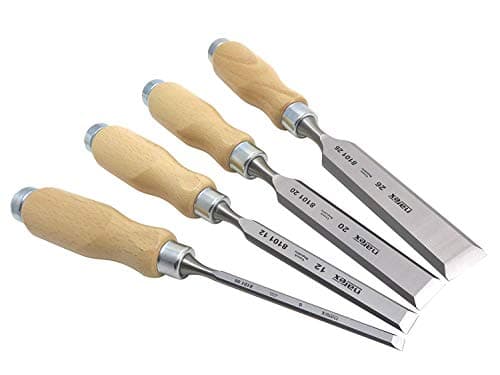
The set that makes the case for this whole site. Four sizes, Czech chrome-vanadium hardened properly, beech handles, and a price that leaves budget for the stone you will need anyway.
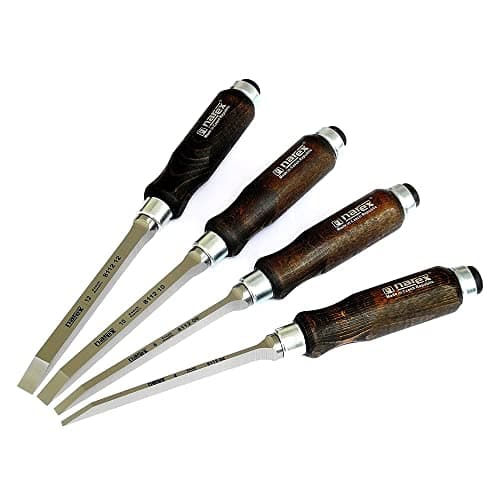
Thick, square in section, and designed to be levered against. If you chop mortises by hand this is not an upgrade over bench chisels, it is a different tool doing a job they will fail at.
#ad· Live prices from the Amazon Product API, as of October 21, 2026. Where we have no verified live price we show none, and the cost-per-decade figure is suppressed with it — we would rather leave a gap than print a number that has rotted.
Chisel catalogs list a dozen types and imply you need a representative sample. You do not. Most woodworking is done with one family, and the others exist for jobs you either do not do or that a machine does for you. Here is what each family physically is, and what happens when you use the wrong one.
Bench chisels — buy these
Bevel-edged, moderate blade length, handles designed to be struck with a mallet. They pare, they chop, they clean up joints, and they are what people mean when they say “chisels”. A four-piece set covers the overwhelming majority of furniture work.
The beveled sides are the important feature: they let the chisel get into an acute corner — the socket of a dovetail — without the square shoulder of the blade bruising the pin beside it. How thin those side lands are is a genuine quality differentiator.
Mortise chisels — only if you chop mortises
Thick, square in section, often with an oval hooped handle, and dramatically stiffer than a bench chisel. The section thickness is the whole point: a mortise is chopped by driving the chisel in and then levering the waste out, and that levering is what a bench chisel will not survive.
A bench chisel used to lever mortise waste does not bend. It snaps, usually where the blade meets the tang, usually without warning. This is the single most common way people break a chisel.
If you cut mortises by hand you want two or three sizes matched to your tenon thicknesses. If you cut them with a router or a drill press and clean up by hand, you need none, and a bench chisel does the cleanup safely because there is no levering involved. The best mortise chisels ranks the ones worth owning and gives the published hardness figures for each.
Paring chisels — useful, rarely essential
Long, thin, flexible blades with long handles, designed for two-handed pushing and never to be struck. The length gives control and lets the blade reach into places a bench chisel cannot; the thinness lets it follow a surface.
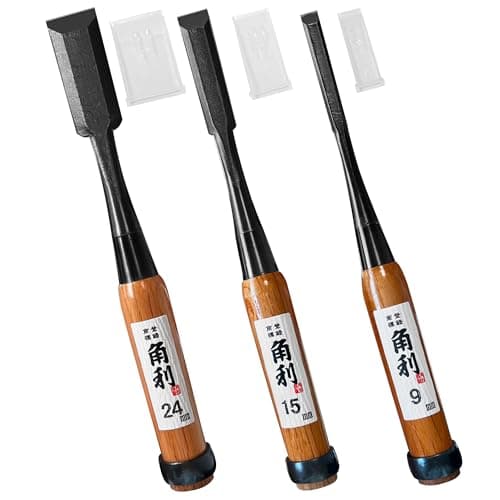
Hitting a paring chisel with a mallet damages it, and that is easy to do by reflex. They are a genuine pleasure for fitting work and they are the third or fourth purchase, not the first. The Japanese long-handled sets are the accessible version. The straight head-to-head, with published lengths and hardness figures for both families and which widths are worth buying, is on paring chisel versus bench chisel.
Firmer chisels — probably not
Square-sided rather than bevel-edged, and stronger for it. General carpentry and timber framing, where strength matters more than access. For furniture work the square shoulder is exactly the wrong feature, because it prevents the one thing bevel edges exist for.
The name is worth unpicking, because it causes more confusion than the tool does. A firmer chisel is not a heavier bench chisel and it is not a light mortise chisel. It is defined by one thing: the sides of the blade are left square instead of being ground away into bevels. That gives a stronger blade with more steel in the same width, at the cost of a shoulder that fouls anything with an acute internal corner. It will chop a hinge gain or clean a timber-frame housing all day; it will bruise the pin the moment you put it in a dovetail socket. The full breakdown is on what is a firmer chisel.
The reason it survives in catalogs is that most of the world's chisels are not sold to furniture makers. Site carpentry, formwork and timber framing all favor strength over access, and a square-sided blade is cheaper to make because grinding the lands is a separate operation. When a very cheap “bevel edge” set arrives with lands so thick they are barely bevels, that is the same economics showing through, and it is one of the specific things you give up on the best budget chisel sets.
The four families, side by side
Section, handle and intended abuse are the three things that actually separate the families. Everything else — steel, price, country of origin — varies inside each family rather than between them.
Family
Blade section
Struck?
What it is for
Skip it if
Bench
Thin, flat, beveled side lands
Yes, mallet
Paring, chopping, cleaning joints — the generalist
Never. This is the family everyone needs
Mortise
Deep, square, nearly as thick as it is wide
Yes, hard
Chopping mortises and levering the waste out
You cut mortises by machine, or not at all
Paring
Long, thin, flexes deliberately
Never
Fitting to a shaving; truing long surfaces
Your bench chisels are sharp and long enough
Firmer
Square sides, no bevels, extra steel
Yes, hard
Carpentry, timber framing, hinge gains
You build furniture — the square shoulder fouls the work
Where the families overlap, and where they genuinely do not
Most of the practical confusion comes from assuming the boundaries are sharper than they are. Three of the four overlaps are real, and one is not.
Bench chisels do most paring work. This overlap is large. A sharp bench chisel pares dovetail cheeks, hinge mortises and small shoulders perfectly well, and the honest reason people find their paring disappointing is usually a dull edge rather than a short blade.
Bench chisels do mortise cleanup. Also real, with one condition: chop and pare, never lever. If the waste is drilled or routed out first, a bench chisel squares the walls safely because nothing is prying against them.
Firmer chisels do bench work badly but do it. Real, and unpleasant. You can build furniture with square-sided chisels; you simply cannot clean an acute corner, so dovetails come out bruised.
Bench chisels do not lever mortises. This is the one boundary with nothing on the other side of it. It is not a matter of technique or of buying a better bench chisel: a thin blade with beveled lands has a small cross-section at the neck, and levering loads it in exactly the direction it has least material. The side-by-side is on bench chisels versus mortise chisels.
What the widths mean across the families
Widths behave differently in each family and this trips people up when they buy a second type. A bench chisel width is a preference — a 3/4 in chisel will clean a 1/2 in shoulder perfectly happily. A mortise chisel width is a specification: the chisel defines the joint, so a 10 mm chisel cuts a 10 mm mortise and nothing else, which is why mortise chisels are bought in ones and twos rather than in sets. A paring chisel width is about registration — wider blades reference off a surface better and overhang harmlessly, so you want fewer and wider rather than a full ladder.
The upshot is that a “set” is the right purchase in exactly one family. In the others, buy the width the job needs. Chisel sizes explained covers how the designations work, including the metric-imperial trap.
The specialists
Corner chisels, skew chisels, fishtails, cranked-neck paring chisels, slicks. All real tools solving real problems, and every one is a purchase made after a specific job has made you want it. Buying a specialist chisel speculatively is how a drawer fills with tools nobody has sharpened.
The short answer
Buy a four-piece bevel-edge bench chisel set. Add two or three mortise chisels if and when you start chopping mortises by hand. Add a long paring chisel when the reach of a bench chisel starts annoying you. That is a complete chisel collection, and most people never get past the first item.
The chisel that is not in this family at all
Every chisel above is a woodworking chisel: a thin, keen edge at 25 to 30 degrees, backed by steel hard enough to hold it. A cold chisel shares the name and almost nothing else — roughly a 60 degree edge, one forged bar with no handle, and a struck end deliberately left soft. Wood chisel vs cold chiselsets the two side by side and covers what happens if you use either in the other's job.
Every pick, in full
The write-ups
01Best chisels overall, and the end of the argument
Set
4 pieces
Steel
Cr-Mn / Cr-V, hardened
Handles
Beech, tanged
Warranty
Not published by the maker
Narex Bevel Edge Chisel Set, 4 Piece
Narex
8.4/10
The set that makes the case for this whole site. Four sizes, Czech chrome-vanadium hardened properly, beech handles, and a price that leaves budget for the stone you will need anyway.
Cost per decade
$24.45
Horizon · tier C
20 years — No lifetime warranty; parts purchasable and resharpenable
A UK specialist retailer states a lifetime guarantee on Narex chisels; we could not find published warranty terms from Narex itself, so we do not rate it tier A. Unhandled blade blanks are sold separately, and the tool is resharpenable indefinitely.
Rebuy risk
Medium
parts listed, resharpenable
Steel & edge
8.5
Back flatness
8.0
Handle
7.5
Sizes covered
8.5
Value
9.5
What it gets right
+Edge retention indistinguishable from sets at four times the price in normal use
+Backs are flat enough that lapping is a job, not an ordeal
+Four sizes is genuinely the number most people use
+Nothing on the tool is consumable: sharpening renews it indefinitely
What it costs you
−Narex publishes no warranty terms we could find, so it cannot rate tier A
−Lacquer on the handles is functional rather than lovely
−Side lands are thicker than a dedicated dovetail chisel's
Skip this if…
…you cut a lot of tight dovetails. The side lands will bruise the pins; buy a dedicated dovetail chisel for those and keep these for everything else.
02Chopping mortises without breaking a bench chisel
Set
4 pieces (4, 6, 10, 12 mm)
Type
Mortise, square section
Steel
Czech Cr-Mn
Handles
Beech, hooped
Narex Mortise Chisel Set, 4 Piece
Narex
8.2/10
Thick, square in section, and designed to be levered against. If you chop mortises by hand this is not an upgrade over bench chisels, it is a different tool doing a job they will fail at.
Cost per decade
$41.58
Horizon · tier C
20 years — No lifetime warranty; parts purchasable and resharpenable
A UK specialist retailer states a lifetime guarantee on Narex chisels; we could not find published warranty terms from Narex itself, so we do not rate it tier A. Unhandled blade blanks are sold separately, and the tool is resharpenable indefinitely.
Rebuy risk
Medium
parts listed, resharpenable
Steel & edge
8.5
Back flatness
8.0
Handle
8.5
Sizes covered
7.5
Value
8.5
What it gets right
+Section thickness is what lets you lever waste out without snapping the blade
+Hooped handles survive sustained mallet work
+Sizes chosen for common mortise widths rather than a catalog spread
What it costs you
−Useless for paring; this is a chopping tool only
−Heavy and clumsy if you reach for one out of habit
−Most people cutting occasional mortises do not need four
Skip this if…
…you cut mortises with a router or a drill press. Then these are a set of very well-made objects doing nothing.
03Paring, where the extra handle length does the work
Set
3 pieces
Handle
Long pattern
Construction
Laminated
Origin
Listing states Made in Japan
KAKURI Japanese Chisel Set, 3 Piece Long Handle
KAKURI
8.1/10
The same laminated construction with a longer handle, which changes what the tool is for: controlled two-handed paring rather than mallet work.
Cost per decade
$33.90
Horizon · tier C
20 years — No lifetime warranty; parts purchasable and resharpenable
No warranty terms published for the US market at the date checked. A laminated hagane-over-jigane edge is renewable by sharpening until the hard layer runs out, which on a full-size chisel or plane iron is a working lifetime.
Rebuy risk
Medium
parts listed, resharpenable
Steel & edge
9.0
Back flatness
9.0
Handle
8.5
Sizes covered
6.5
Value
7.5
What it gets right
+Length gives genuine two-handed control for paring
+Same laminated edge quality as the standard set
+Reaches into joints a short chisel cannot
What it costs you
−Longer handle is worse for accurate mallet chopping
−Costs more than the standard set for a narrower use case
−Three sizes
Skip this if…
…this is your only Japanese set. Buy the standard-length one first; it is the more general tool.
Price as of October 21, 2026. Prices move; Amazon's is the one that counts.
#ad · we may earn a commission from this link to KAKURI Japanese Chisel Set, 3 Piece Long Handle
Questions
Frequently asked
What is the difference between a bench chisel and a mortise chisel?+
Section thickness. A mortise chisel is much thicker and squarer, so it survives being levered against when you clear mortise waste. A bench chisel used the same way snaps, usually at the tang.
Can I use a bench chisel to cut a mortise?+
You can chop with it, but you cannot lever with it. If you drill out the waste first and use the bench chisel only to pare the walls, it is fine. Levering is what breaks it.
What is a paring chisel for?+
Two-handed pushing cuts, for fitting and cleanup where control matters more than power. Long, thin and flexible — and never struck with a mallet, which damages it.
Do I need firmer chisels?+
Only for carpentry or timber framing. Their square sides make them stronger and prevent them getting into the acute corners that bevel-edge chisels exist for, so for furniture work they are the wrong tool.
We have not handled these tools. Nobody here has tested one, owned one, or taken one apart. Specifications come from the manufacturer or the retailer listing; warranty terms come from the maker's own warranty page; the cost-per-decade arithmetic is ours and reproducible. Where we could not verify a figure we say so on the page rather than quietly leaving it out. Read the full method.