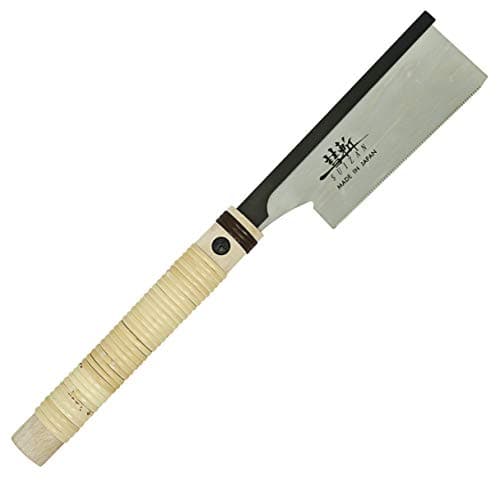
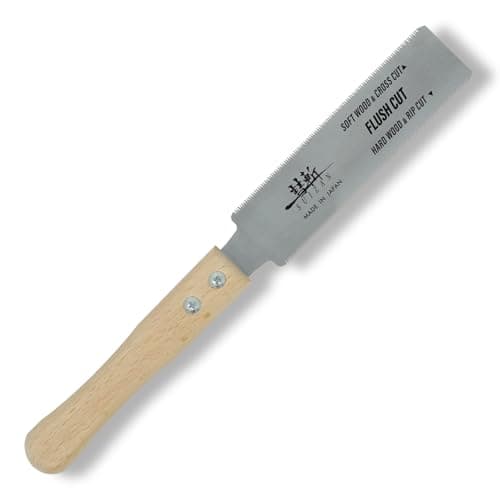
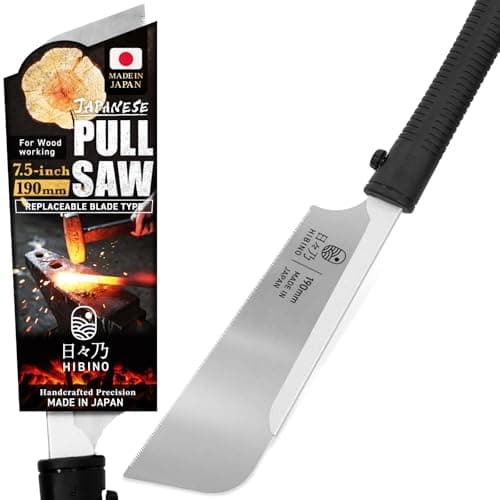
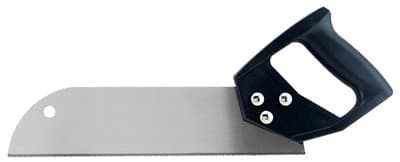
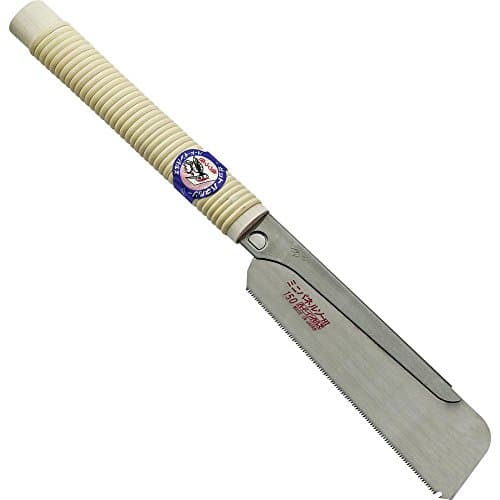
For a clean edge on a visible plywood face, buy the Rockler mini dozuki panel saw — 106 teeth on a 150 mm blade is roughly 18 teeth per inch, the finest count here, and on veneer the tooth count is the whole argument. If you want one saw that also handles cuts deeper than a backed blade can reach, the HIBINO 7.5 in kataba at a published 14 TPI is the pick. And if the job is trimming edge banding or a plug flush to a veneered surface, nothing on this page substitutes for the SUIZAN flush cut saw, because it is the only one with no tooth set at all.
Start with an honest admission, because the alternative is to pretend. If you are breaking down full sheets of plywood, a circular saw running against a straightedge or a track saw is the right tool and no hand saw on this page competes with it. Eight feet of hand-sawn plywood is a miserable afternoon and the cut will be worse. This page is about the other cuts — the ones a power saw is bad at or cannot make at all: notching a panel that is already screwed down, scribing a cabinet back to an out-of-square wall, trimming edge banding and solid lippings flush to a face, cutting a service hole in a fitted carcass, and taking the last millimeter off a panel that is a whisker too wide.
Those cuts are common, and they are precisely where a hand saw earns its place in a shop full of machines.
Why plywood breaks saws' hearts
Solid wood has one grain direction and fails by splitting along it. Plywood does not. It is a stack of thin plies glued with their grain alternating at ninety degrees, faced with a veneer that may be a fortieth of an inch thick, and the glue lines between the plies are harder than the wood either side of them. Three consequences follow, and all three are different from solid-wood sawing.
The face veneer tears instead of splitting. On the side where the teeth exit the cut, there is nothing behind the veneer to support it, so the fibers lift and break off rather than being severed. That is the fringed edge everybody recognizes, and it is a function of tooth size and exit direction, not of how straight you sawed.
Tooth set widens the damage. Most saw teeth are bent alternately left and right — that is the set — to cut a kerf wider than the plate so the saw does not bind. On a veneered face, set teeth also scrape sideways across the surface either side of the kerf. A saw with little or no set leaves a visibly better edge, which is why flush-cut saws, which have none, can lie straight on a finished surface.
The glue dulls the teeth. Plywood glue, and the resin in MDF and melamine, is abrasive in a way wood fiber is not. A saw used mostly on sheet goods dulls faster than the same saw used on hardwood, which matters a great deal when none of the teeth here can be filed back.
What decides it, in the order that matters
We have not cut a panel with any of these. We opened each listing, wrote down only what is published, cited it below, and ranked on that — the method is on the methodology page.
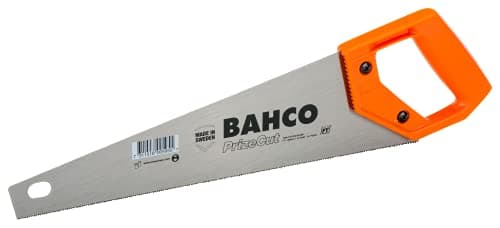
1. Teeth per inch, published. For a veneered face the useful band starts at about 14 TPI and gets better as it rises. Below roughly 12 the teeth are simply bigger than the veneer is thick and will fringe it whatever you do, which is why the 11 TPI Bahco is on this page as the honest general-purpose option and ranked last rather than as a recommendation for a show face. The Rockler dozuki's 106 teeth over 150 mm is the finest here, the GreatNeck publishes 16 TPI, and the HIBINO publishes 14 TPI crosscut. Saw TPI explained has the whole range.
2. Set, which almost nobody publishes. This is the most important specification in the category and not one listing on this page states a figure for it. What we can say is categorical: a flush-cut saw has zero set by definition, which is why it can rest its plate on a veneer and cut something proud of it without scratching the face. Everything else here has some, and fine-toothed saws generally have less.
3. Backed or unbacked. A stiffening spine keeps the plate dead straight in the line you scored, which is what you want when the edge will be visible. It also limits how deep the cut can go to roughly the depth of the blade below the spine, so a backed saw physically cannot cut across a panel. An unbacked kataba or panel saw cuts as deep as its plate is long and wanders more. There is no right answer, only the trade — what is a backsaw and what is a kataba saw cover both patterns.
4. Push or pull, which decides which face you protect. Teeth tear on exit, so the show face goes where the teeth enter. A western push saw cuts on the downstroke and exits underneath: good face up. A Japanese pull saw cuts on the pull and exits on the upper side: good face down. Getting this backwards fringes the one surface you cared about, and it is free to get right. Japanese vs western saws has the full comparison.
5. Can you buy the cutting part again? Every saw on this page except two has teeth hardened past what a file can cut, so the buy-it-for-life question is whether a replacement blade exists. SUIZAN sells blades directly for its saws and Shark Corp has a US replacement-blade presence; the rest, when the teeth go, are scrap. Given that sheet-goods glue dulls teeth faster than wood does, this column deserves more weight here than on a page about hardwood joinery.
What the makers publish
| Saw | Teeth as published | Pattern | Replacement blade? |
|---|
| Rockler mini dozuki panel saw | 106 teeth on 150 mm (approx 18 TPI) | Backed, pull | No listing found |
| SUIZAN dozuki, 6 in | Crosscut; TPI not published | Backed, pull | Yes — sold direct by SUIZAN |
| SUIZAN flush cut saw, 6 in | TPI not published; zero set | Unbacked, pull, flush | Yes — sold direct by SUIZAN |
| Shark Corp 10-2440 fine cut | Fine crosscut; TPI not published | Unbacked, pull | Yes — 01-2440 blade |
| HIBINO kataba, 7.5 in | 14 TPI crosscut | Unbacked, pull | No listing found |
| GreatNeck laminate saw, 12 in | 16 TPI | Unbacked, push | No — warranty excludes blades |
| Bahco Prizecut, 15 in | 11 TPI, hardpoint | Unbacked, push | No |
The GreatNeck row is the most instructive thing on the page. It is the only saw here whose maker names the material it is for, it publishes a tooth count, and it carries a limited lifetime warranty — which excludes blades by name. On a one-piece handsaw that leaves the warranty covering the handle. We have not ranked it down for that because it is honest and cheap; we have ranked it down because nothing about it can be renewed.
The techniques that beat the saw choice
More of the result on sheet goods comes from preparation than from which saw you bought, and two habits matter more than the other five combined.
Score the line with a knife first. A marking knife drawn firmly along a straightedge severs the face veneer before any tooth touches it. The saw then works below a surface that is already cut, and there is nothing left to tear. This single step is the difference between an edge that needs sanding and one that does not, and it is worth more than the price gap between the cheapest and dearest saw here.
Back the exit side up. Clamp a sacrificial scrap tight against the face the teeth exit, and the veneer has something to push against instead of air. On a cut you cannot back up — a notch in an installed panel, say — run a strip of masking tape along both sides of the line and saw through the tape, which holds short fibers down well enough to matter.
What is not on this page
A dedicated veneer saw. The right tool for cutting veneer and inlay is a small two-handled veneer saw with a curved 15 or 16 TPI edge and no set. We looked, and the live Amazon listings are a reseller title stacking four different brand names into one product name, and an unbranded item called simply “Veneer Saw.” Neither can be verified against a maker, so neither is featured. If you need one, Kunz sells them and the replacement blades through specialist retailers.
Panel saws in the traditional sense. A filed 22 or 24 in panel saw at 10 to 12 TPI is what a joiner would have cut sheet goods with, and its teeth can be put back forever. What is a panel sawcovers the pattern. We have not ranked one because the saws sold new under that name are almost all hardpoint, and the genuinely renewable route is a secondhand plate — how to restore a hand saw is the honest buy-it-for-life answer for this job.
Coping and fret saws. For internal curves and cutouts in a panel they are the correct tool, and they are already ranked on the best coping saws. This page is about straight cuts.
Hand planes. Worth knowing because the question comes up: a block plane will clean a sawn plywood edge, and it will also chew through the face veneer at the ends if you plane toward them. Work inward from both ends, take fine shavings, and accept that plywood edges blunt an iron quickly because of the glue. The best block planes has the tools.