We earn a commission when you buy through our Amazon links, at no extra cost to you. It never decides a ranking, and where the best tool in a class is one we earn nothing on, we say so and link it anyway. How this works.
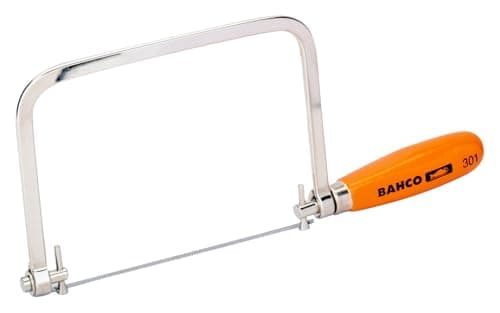
A nickel-plated steel frame, a beech handle and a 14 TPI blade of hardened and tempered carbon steel with the teeth milled and set — and the only coping saw in the ordinary price range whose seller publishes warranty wording at all, as a limited warranty against defects in workmanship and materials. Everything else here is sold with silence or with a returns window.
The one frame in the normal price range with published warranty wording
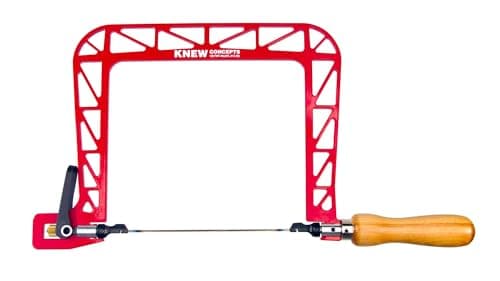
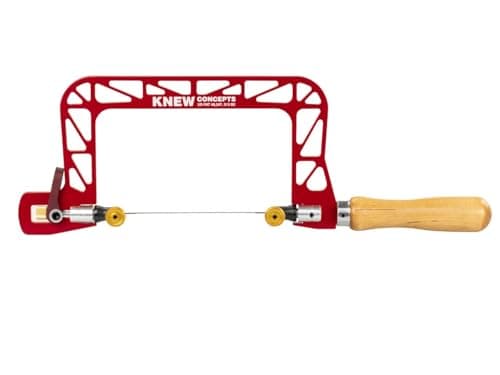
Machined from 3/16 in 6061-T6 aluminum in California, with a cam-lever tensioner, a knurled fine-adjustment screw, a spring-loaded blade carrier that locks in eight 45 degree positions, and a 6-1/2 in throat — at eight ounces. It costs roughly ten times the Bahco and takes the same few-dollar blade. Whether that is absurd or obvious depends entirely on how often you cut curves.
The only frame here built like a machine tool instead of a bent rod
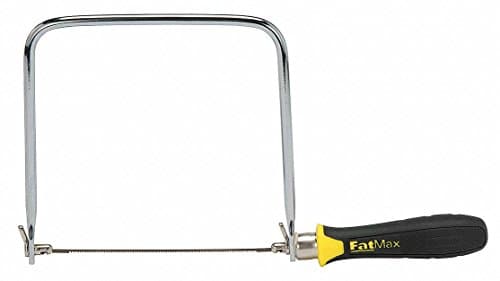
A high-carbon steel frame with a 6-3/4 in deep throat, a hardwood handle and a blade that turns to any angle, under a maker warranty that is limited-lifetime on hand tools and explicitly excludes blades. On most tools that exclusion is fatal. On a coping saw it is the correct exclusion, because the blade was always a consumable.
The deepest published throat at the lowest honest price
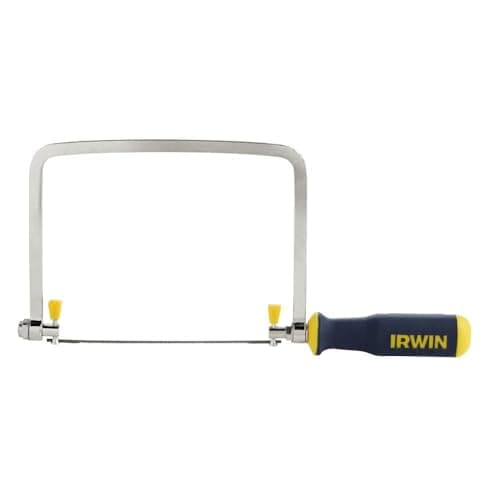
A flat-bar frame, DuraSteel pins, a high-speed steel blade and a triangular ProTouch handle, for single digits at the date checked. The flat bar is a real engineering choice — a flat section resists the twisting that round-rod frames do badly — and IRWIN publishes a limited lifetime warranty on select products at the brand level.
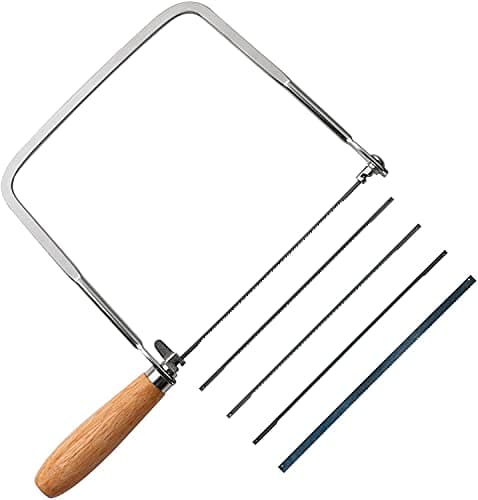
A Japanese frame that ships with five blades covering wood, board, plastic and metal, which is a more useful thing to own than one frame and one unspecified blade. KAKURI publishes almost nothing about the frame itself, and we are not going to pretend otherwise.
A fret saw, not a coping saw: a much thinner, unpinned blade in the same machined aluminum frame, which is what you want for dropping into a saw kerf between dovetails. If you bought a coping saw to remove dovetail waste and found it clumsy, this is why.
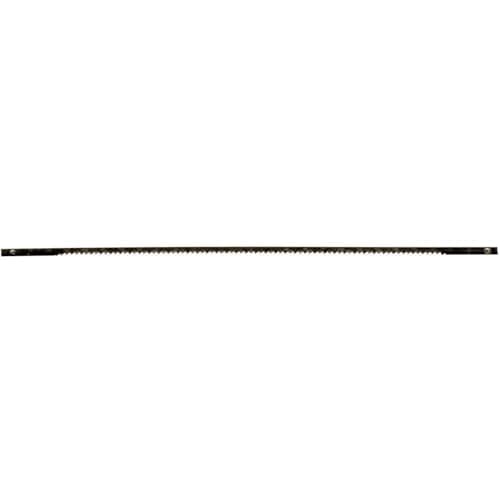
Pin-end coping blades at 15 TPI, five to a pack. This is on the page because it is the only genuinely consumable item in the category, and because a frame judged on a worn blade gets judged unfairly — most people who think their coping saw is bad own a decent frame and a blunt blade.
#ad· Live prices from the Amazon Product API, as of October 16, 2026. Where we have no verified live price we show none, and the cost-per-decade figure is suppressed with it — we would rather leave a gap than print a number that has rotted.
A coping saw is the cheapest tool in the workshop that can do something no other tool can. A thin blade held in tension inside a sprung frame will follow a curve, turn inside its own kerf, and — once the blade is unhooked and threaded through a drilled hole — cut a shape out of the middle of a board without touching its edge. No plane, no chisel and no straight saw will do any of that. It is also, by a wide margin, the tool most people own a bad example of, because it costs so little that nobody researches it.
This page exists to make that research unnecessary, and it starts from one fact that changes the whole exercise. On every other page on this site, the cutting edge is the expensive, consequential, hard-to-replace part: a plane iron, a chisel, a saw plate. On a coping saw it is the opposite. The blade is a 6-1/2 inch pin-end blade, an industry standard that has not moved in a century, sold by Bahco, Olson, Stanley and a dozen generic sellers at a couple of dollars each. It is not sharpenable, it is not supposed to be, and every single frame on this page takes exactly the same one.
So the blade is a commodity, and the frame is the purchase. That inverts the normal question. You are not buying a cutting edge that will last thirty years; you are buying a blade holder that has to keep a two-hundredths-of-an-inch strip of steel in genuine tension, square to a handle, through thirty years of being tightened and released. If you want the mechanism before the shopping, coping saw vs fret saw explains why the two look identical and are not interchangeable, and saw TPI explained covers what the number on the blade packet is telling you.
How we ranked them
We have not cut a cope with any of these saws. What we did is what this whole site does: open every maker's and retailer's own listing, write down only what they are willing to publish, cite it, and rank on that. Every source is at the bottom of the page, and the method is on the methodology page. Five things decided the order.
How deep is the throat? This is the most useful number on a coping saw and the one most listings omit. The throat — the distance from the blade to the back of the frame — is the maximum distance you can cut in from the edge of a board, full stop. The spread here is wider than the price spread suggests: the Stanley publishes 6-3/4 in, the Knew Concepts 6-1/2 in, and the IRWIN 5-1/2 in. Bahco and KAKURI publish no figure at all. An inch and a quarter of reach is the difference between coping a piece of crown molding and not.
How is the blade tensioned, and does the tension stay put? Five of these frames tension the blade by turning the handle, which works and is also the origin of the single most common complaint about coping saws: the handle unwinds as you cut, the blade goes slack, and a slack blade wanders out of the line and then snaps. One frame here replaces that with a cam lever and a knurled fine-adjustment screw, so the tension is set once and arrived at identically every time. That is the difference the money buys, and it is a real one.
Is the frame stiff enough to hold the tension it is given? A coping saw frame is a spring; it has to deflect to accept the blade and then resist deflecting under load. A round steel rod does that adequately. A flat bar does it better in the twisting direction, which is why IRWIN's “Flat-Bar” frame is worth naming. Machined 3/16 in 6061-T6 aluminum, 50 percent thicker than the same maker's jewelers saws, does it in a different league — and does it at eight ounces, because aluminum is about a third the density of steel.
Does the blade rotate, and does it stay where you put it? Rotating the blade relative to the frame is how you cut a long curve without the frame fouling the workpiece. Bahco publishes 360 degree rotation on retaining pins. Stanley says the blade “may be turned to any angle.” The Knew Concepts locks at eight discrete 45 degree positions and is spring-loaded so it cannot creep mid-cut — repeatable positioning rather than approximate positioning.
Does anybody stand behind the frame in writing? This is where the research produced something we did not expect.
The thing the warranties say, for once in our favor
Readers of this site will know the running theme: a maker publishes a lifetime warranty on hand tools and then excludes the part that does the cutting. Stanley's limited lifetime warranty covers hand tools against material and workmanship defects and explicitly excludes consumables including “any blade”. On a plane that guts the cover, because the iron is the tool. On a handsaw it is worse, because the plate is the saw.
On a coping saw, that exclusion is the correct one. The blade was always going to be a two-dollar consumable in a standard size. Excluding it leaves the warranty sitting exactly on the part you want covered: the frame, the tension screw and the handle. For the first time in this category, the fine print and the buyer are pointed the same direction. That is why the Stanley ranks as high as it does on a page where it is also one of the cheapest options, and why its cost per decade horizon is the longest here.
The rest of the field is thinner. Bahco's US retailer publishes a limited warranty against defects in workmanship and materials, which is real wording even if it is brief. IRWIN publishes a limited lifetime warranty on “select products” at the brand level, and the retailer page for this particular saw publishes no warranty statement at all — so we cannot tell you this saw is covered, and we have said so in its cons rather than implying it. KAKURI publishes nothing. And Knew Concepts, the most expensive tool on this page by an order of magnitude, publishes no manufacturer warranty we could find; what exists is Highland Woodworking's 60-day replace-or-refund satisfaction guarantee, which is a returns policy, not a warranty.
Our usual conclusion applies, with a twist. Normally a published parts list beats a warranty, because a warranty is a promise and a parts listing is a standing commitment. Here, the parts list is the entire blade industry: the one consumable is a generic item you can buy from four different companies indefinitely. That is why every frame here carries a twenty-year horizon or better even where the maker says nothing — the wear part cannot be discontinued, because nobody owns it.
What is not on this page, and why
The anonymous frames. A search for “coping saw” returns a wall of near-identical frames from sellers with invented names, usually around fifteen dollars with five blades. We left them off for one reason: there is nothing to publish about them. No throat depth, no frame material, no maker, nobody to ask. They may well cut wood perfectly. They cannot be ranked on evidence, and this site ranks on evidence.
Deep-throat frames from the premium makers. Knew Concepts makes a 5 in and an 8 in Mk.IV in the same machined aluminum, and both were down to between one and three units at the date checked — below the threshold where we are willing to feature a product. The Eclipse 70-FS1R, a long-standing English frame, was showing as “usually ships within 9 to 10 days,” which is not availability we will send a reader into without warning them. They are named here instead.
The Jorgensen Pro coping saw. It is on Amazon, it was in stock, and it looks well made. We left it off because Pony Jorgensen does not list a coping saw in its own catalog at all — a search of the maker's site returns no results for one — which means the company's unusually good published lifetime warranty cannot be shown to apply to it. We are not going to lend a tool a warranty we cannot cite.
Every pick, in full
The write-ups
01The one frame in the normal price range with published warranty wording
Frame
Nickel-plated steel
Blade
6-1/2 in, 14 TPI, hardened and tempered carbon steel
Blade mount
Retaining pins, turnable 360 deg
Handle
Lacquered beech
Warranty
Limited warranty against defects in workmanship and materials
Bahco BAH301 Coping Saw
Bahco
8.0/10
A nickel-plated steel frame, a beech handle and a 14 TPI blade of hardened and tempered carbon steel with the teeth milled and set — and the only coping saw in the ordinary price range whose seller publishes warranty wording at all, as a limited warranty against defects in workmanship and materials. Everything else here is sold with silence or with a returns window.
Cost per decade
$9.92
Horizon · tier C
20 years — No lifetime warranty; parts purchasable and resharpenable
No lifetime warranty published for this frame at the date checked. What sets the horizon instead is that the consumable is a 6-1/2 in pin-end blade — an industry-standard size carried by Bahco, Olson, Stanley and a dozen generic sellers at a few dollars per pack — so the part that wears out can always be bought, from somebody, at a price that does not matter. There is nothing else on the tool to consume: a frame, a tension screw and a handle.
Rebuy risk
High
parts listed
Cut quality
8.0
Blade life
7.5
Control
7.5
Renewability
8.5
Value
8.5
What it gets right
+Published warranty wording, which no other frame in this price range here has
+Blade steel is actually specified — hardened and tempered carbon steel with milled and set teeth — rather than left as 'steel'
+Full 360 degree blade rotation on retaining pins, so the frame can be swung clear of the work mid-cut
+Takes the universal 6-1/2 in pin-end blade, and Bahco sells its own 303 blades in 5-packs
+Wooden handle rather than molded plastic, which can be reshaped or replaced with a dowel if it ever splits
What it costs you
−Neither the maker nor the retailer publishes a throat depth for this frame, which is the single most useful number on a coping saw
−No weight published on the US retailer pages we read
−Tension is set by turning the handle, which is less repeatable than a cam lever and can loosen under hard use
−14 TPI is a compromise pitch — coarse for tight curves in thin stock, fine for ripping a cope in trim
Skip this if…
…you need a deep throat. The Stanley below publishes 6-3/4 in and costs about the same; this frame's case is the warranty and the published blade steel, not reach.
Knew Concepts 6-1/2 in Woodworker's Aluminum Coping Saw
Knew Concepts
8.1/10
Machined from 3/16 in 6061-T6 aluminum in California, with a cam-lever tensioner, a knurled fine-adjustment screw, a spring-loaded blade carrier that locks in eight 45 degree positions, and a 6-1/2 in throat — at eight ounces. It costs roughly ten times the Bahco and takes the same few-dollar blade. Whether that is absurd or obvious depends entirely on how often you cut curves.
Cost per decade
$100.00
Horizon · tier C
20 years — No lifetime warranty; parts purchasable and resharpenable
No lifetime warranty published for this frame at the date checked. What sets the horizon instead is that the consumable is a 6-1/2 in pin-end blade — an industry-standard size carried by Bahco, Olson, Stanley and a dozen generic sellers at a few dollars per pack — so the part that wears out can always be bought, from somebody, at a price that does not matter. There is nothing else on the tool to consume: a frame, a tension screw and a handle.
Rebuy risk
High
parts listed
Cut quality
9.5
Blade life
7.5
Control
9.5
Renewability
9.0
Value
5.0
What it gets right
+Machined 6061-T6 aluminum at 3/16 in thick — the frame holds tension instead of flexing, which is the actual failure mode of every cheap coping saw
+Cam-lever tension plus a knurled fine screw: the same tension, repeatably, every blade change
+Blade rotates a full 360 degrees and locks at eight 45 degree detents, spring-loaded so it cannot creep mid-cut
+Eight ounces, so it can be held out over a fretted cut without your hand shaking
+Made in California by a named small maker, and the frame has no consumable part in it whatsoever
What it costs you
−The price is the headline objection and we are not going to argue it away — it is roughly ten times the Bahco, for a tool that takes the same blade
−No manufacturer warranty published that we could find; what exists is Highland Woodworking's 60-day replace-or-refund guarantee, which is a returns policy
−An aluminum frame will not take the abuse a steel one shrugs off — this is a bench tool, not something to throw in a site bag
−Stock was limited at the date checked, so availability is not guaranteed week to week
−Nobody publishes the TPI of the blade it ships with
Skip this if…
…the coping saw is the tool you reach for twice a year to cope a baseboard. Buy the Bahco, spend the difference on chisels, and do not feel bad about it.
Price as of October 16, 2026. Prices move; Amazon's is the one that counts.
#ad · we may earn a commission from this link to Knew Concepts 6-1/2 in Woodworker's Aluminum Coping Saw
03The deepest published throat at the lowest honest price
Frame
High-carbon steel
Throat
6-3/4 in (deepest published here)
Blade
6-1/2 in pin-end; turns to any angle
Tension
Set by turning the handle
Handle
Hardwood, weatherproof finish
Warranty
Limited lifetime on hand tools; blades excluded
Stanley 15-106 Coping Saw
Stanley
8.1/10
A high-carbon steel frame with a 6-3/4 in deep throat, a hardwood handle and a blade that turns to any angle, under a maker warranty that is limited-lifetime on hand tools and explicitly excludes blades. On most tools that exclusion is fatal. On a coping saw it is the correct exclusion, because the blade was always a consumable.
Cost per decade
$6.47
Horizon · tier A
30 years — Lifetime warranty, cited
The maker publishes a limited lifetime warranty on hand tools against defects in material and workmanship, and explicitly excludes blades from it. On a plane or a handsaw that exclusion guts the cover, because the blade is the tool. On a coping saw it does not: the blade was always a few-dollar consumable in a standard size, so the warranty covers exactly the part that is supposed to last — the frame, the tension screw and the handle.
Rebuy risk
Medium
lifetime warranty, parts listed
Cut quality
7.5
Blade life
7.5
Control
7.0
Renewability
9.5
Value
9.0
What it gets right
+Deepest published throat on this page at 6-3/4 in, which is what decides whether you can reach the middle of a workpiece
+Stanley's limited lifetime warranty covers the frame against material and workmanship defects, and the blade exclusion costs you nothing here
+Hardwood handle, so it can be reshaped or replaced rather than discarded
+Uses the universal 6-1/2 in pin-end blade, including Stanley's own 15-061 15 TPI packs
+Cheap enough that owning two with different blades in them is a reasonable thing to do
What it costs you
−Stanley publishes no TPI for the blade it ships with, and the shipped blade is the weakest part of the package
−Handle-turn tensioning, so the tension is whatever your wrist last decided — the known failure mode is the handle unwinding as you cut
−Build quality in this line has varied noticeably over the years, and we are rating the published specification, not a sample
−Nothing about the frame is adjustable beyond blade angle
Skip this if…
…you want repeatable tension. The handle-turn system is the compromise that buys the price, and no amount of care makes it a cam lever.
Brand-level limited lifetime on select products; not stated for this item
IRWIN ProTouch Coping Saw (2014400)
IRWIN
7.7/10
A flat-bar frame, DuraSteel pins, a high-speed steel blade and a triangular ProTouch handle, for single digits at the date checked. The flat bar is a real engineering choice — a flat section resists the twisting that round-rod frames do badly — and IRWIN publishes a limited lifetime warranty on select products at the brand level.
Cost per decade
$4.50
Horizon · tier C
20 years — No lifetime warranty; parts purchasable and resharpenable
No lifetime warranty published for this frame at the date checked. What sets the horizon instead is that the consumable is a 6-1/2 in pin-end blade — an industry-standard size carried by Bahco, Olson, Stanley and a dozen generic sellers at a few dollars per pack — so the part that wears out can always be bought, from somebody, at a price that does not matter. There is nothing else on the tool to consume: a frame, a tension screw and a handle.
Rebuy risk
High
parts listed
Cut quality
6.5
Blade life
7.5
Control
6.5
Renewability
8.5
Value
9.5
What it gets right
+Cheapest frame here by a wide margin, from a brand with a published warranty program
+Flat-bar frame section resists twist better than the round rod on most budget frames
+High-speed steel blade is a step up from the plain carbon blade most frames ship with
+Takes the universal 6-1/2 in pin-end blade like everything else here
What it costs you
−Shallowest throat on this page at 5-1/2 in — more than an inch less reach than the Stanley at similar money
−IRWIN's warranty applies to 'select products' and the retailer page for this saw publishes no warranty statement at all, so we cannot tell you this specific saw is covered
−Molded plastic handle: comfortable, but not something you can reshape or replace
−IRWIN's warranty language excludes product that 'fails to operate due to normal wear and tear', which on a hand-tensioned frame is most of what goes wrong
Skip this if…
…you expect to cope anything wider than five inches from the edge. The throat is the spec that bites here, and it is the one most listings bury.
A Japanese frame that ships with five blades covering wood, board, plastic and metal, which is a more useful thing to own than one frame and one unspecified blade. KAKURI publishes almost nothing about the frame itself, and we are not going to pretend otherwise.
Cost per decade
$9.40
Horizon · tier C
20 years — No lifetime warranty; parts purchasable and resharpenable
No lifetime warranty published for this frame at the date checked. What sets the horizon instead is that the consumable is a 6-1/2 in pin-end blade — an industry-standard size carried by Bahco, Olson, Stanley and a dozen generic sellers at a few dollars per pack — so the part that wears out can always be bought, from somebody, at a price that does not matter. There is nothing else on the tool to consume: a frame, a tension screw and a handle.
Rebuy risk
High
parts listed
Cut quality
7.0
Blade life
7.5
Control
7.0
Renewability
8.5
Value
8.5
What it gets right
+Ships with five blades for different materials, so the first job does not need a second purchase
+From a named Japanese tool maker with a long catalog rather than an anonymous seller
+Priced below the Bahco while including the blade pack the Bahco does not
What it costs you
−KAKURI publishes no throat depth, no frame material detail and no blade TPI for this set — the thinnest published spec sheet on the page
−No warranty terms published anywhere we looked
−Blade changes are by the handle-turn method, with the same repeatability problem as the Stanley
−The included blades are a mixed assortment, which means some of them are not for woodworking at all
Skip this if…
…you want to know what you are buying before it arrives. This is the one frame here we are recommending partly on the brand's reputation, which is weaker evidence than a spec sheet.
A fret saw, not a coping saw: a much thinner, unpinned blade in the same machined aluminum frame, which is what you want for dropping into a saw kerf between dovetails. If you bought a coping saw to remove dovetail waste and found it clumsy, this is why.
Cost per decade
$81.55
Horizon · tier C
20 years — No lifetime warranty; parts purchasable and resharpenable
No lifetime warranty published for this frame at the date checked. What sets the horizon instead is that the consumable is a 6-1/2 in pin-end blade — an industry-standard size carried by Bahco, Olson, Stanley and a dozen generic sellers at a few dollars per pack — so the part that wears out can always be bought, from somebody, at a price that does not matter. There is nothing else on the tool to consume: a frame, a tension screw and a handle.
Rebuy risk
High
parts listed
Cut quality
9.0
Blade life
7.0
Control
9.0
Renewability
8.5
Value
5.5
What it gets right
+Takes a fret saw blade thin enough to turn inside a dovetail kerf, which no pin-end coping blade will do
+The same machined aluminum frame and lever tension as the coping saw above
+3 in throat is the right depth for dovetail and small fretwork, and keeps the frame out of the way
+Fret blades are cheap and sold by the dozen, so the consumable cost is trivial
What it costs you
−Not interchangeable with coping saw blades — a genuinely different consumable, and buying this by mistake means buying blades twice
−3 in of throat is useless for coping trim or cutting a curve in a panel
−Expensive, and the maker publishes no warranty
−Stock was limited at the date checked
Skip this if…
…you chop the waste out between dovetails with a chisel, which is a completely legitimate way to work. This saw solves a problem you may not have.
Pin-end coping blades at 15 TPI, five to a pack. This is on the page because it is the only genuinely consumable item in the category, and because a frame judged on a worn blade gets judged unfairly — most people who think their coping saw is bad own a decent frame and a blunt blade.
Cost per decade
$12.05
Horizon · tier D
10 years — No warranty and no parts availability found
This is a consumable, not a tool: it is used up. The horizon is the floor value and the rating below is accurate rather than unkind — you will buy this again, and the cost-per-decade figure is only useful for comparing one consumable against another.
Rebuy risk
High
none of the three met
Cut quality
8.0
Blade life
5.0
Control
7.5
Renewability
3.0
Value
9.0
What it gets right
+15 TPI is the most generally useful coping pitch — fine enough for thin stock, coarse enough not to clog in softwood
+Pin-end is an industry-standard mount, so these fit every frame on this page
+Cheap enough that there is no reason to keep sawing with a dull blade, which is the real cause of most bad coping cuts
+Bahco publishes the pitch, which several blade sellers do not
What it costs you
−This is a consumable and the cost-per-decade figure says so — you will buy it again, by design
−Nominal blade length is listed as 6 in on the retailer page against the 6-1/2 in frame standard, so check the fit before buying a dozen packs
−One pitch only; curved work in thin ply wants something finer
Skip this if…
…you only ever cut softwood trim. A coarser 10 or 12 TPI blade clears sawdust faster and cuts a cope in half the strokes.
If you cope trim, cut the occasional curve, and want to stop thinking about it: the Bahco or the Stanley, and the decision between them is whether you value the published blade steel and the 360 degree pin rotation (Bahco) or the extra inch and a quarter of throat and the lifetime warranty on the frame (Stanley). Both sit at the low end of the price range here. Buy a 5-pack of 15 TPI blades at the same time, because the blade that ships in the frame is the cheapest part of the package and the first thing that will make you think the saw is bad.
If you cut curves as a regular part of the work — chair parts, brackets, pierced work, anything laid out with a compass — the Knew Concepts is the one tool on this page we would describe as a genuine upgrade rather than a nicer version of the same thing. A frame that holds its tension, and a lever that returns to the same tension every time, changes how the saw tracks. It also costs roughly ten times the Bahco and takes the identical blade, and we are not going to pretend that is not a strange sentence.
If what you actually wanted was a saw for removing dovetail waste as close to the baseline as possible, consider the fret saw instead. Both tools do that job and most of the confusion in this category comes from assuming they are interchangeable, so it is worth being specific about the difference.
Coping saw, fret saw, and the dovetail problem
A coping saw blade is held between two pins. Those pins need a hole in each end of the blade, which needs the blade to be wide enough to have an end, which means a coping saw blade is roughly an eighth of an inch deep and will not turn inside a narrow kerf. A fret saw blade has no pins: it is clamped flat at each end, so it can be made far thinner and far narrower.
That is what decides how each one removes dovetail waste. A fret saw blade drops straight into the kerf a dovetail saw left — a couple of hundredths of an inch wide — and turns at the baseline, which is why it can cut closer to the line. A coping saw blade is several times that width, so it cannot enter that kerf: the coping-saw method needs an entry it can actually fit, either by widening the top of the kerf or by starting the turn further from the baseline and paring the rest. Plenty of excellent work gets done that way and coping saw vs fret saw lays out the case for each; the short version is that a coping saw is stiffer and faster and a fret saw is more precise. What is not negotiable is that the two take entirely different consumables, which is worth knowing before you buy blades. How to cut dovetails by hand covers where in the sequence that cut belongs, and the best dovetail saws covers the saw that makes the kerf in the first place.
TPI, and the blade you should have in it
Coping blades run from roughly 10 to 24 TPI. The rule is the same as for every saw: you want at least three teeth engaged in the material at all times, which sets the coarse limit, and more teeth cut slower but cleaner, which sets the fine limit. In practice:
10 to 12 TPI— softwood trim, thick stock, coping baseboard. Fast, clears sawdust well, leaves a rough edge that is going against a wall anyway.
15 TPI— the default. Hardwood up to about an inch, general curve cutting, the blade to own if you own one kind.
18 to 24 TPI— thin ply, veneer, plastic, soft non-ferrous metal. Slow in wood and prone to burning, but it is the only thing that will not tear out the back face of quarter-inch ply.
Teeth on a coping saw blade conventionally point toward the handle, so the saw cuts on the pull stroke, which keeps the blade in tension rather than buckling it. You can fit the blade the other way around and cut on the push; some people prefer it for cutting downward into a workpiece held in a vise. There is no wrong answer, only a wrong combination of blade direction and expectation. The rip and crosscut distinction does not apply here — coping blades are filed to one pattern, because a curve is cutting in every direction at once.
Cost per decade on a tool that costs less than a blade pack for a power saw
The arithmetic this site runs on gets strange at this price point, and it is worth being honest about that. Dividing a single-digit price by a two-decade horizon produces a number too small to be interesting. What the figure is still good for is the comparison it was designed for: it shows you, in one number, that the Knew Concepts is not ten times the saw over its life, it is ten times the price over the same life — and that the Stanley's thirty-year warranted horizon costs essentially nothing more than the IRWIN's twenty. On this page the honest advice is that the cheap frames are close enough in cost of ownership that you should choose on throat depth and tension, and the expensive one should be chosen on how much curve work you do, not on durability arithmetic.
The genuine buy-it-for-life argument in this category is not about the frame at all. It is that a coping saw is one of the very few tools where the consumable is standardized across the entire industry, so no manufacturer can strand you. A frame bought today will still be usable in forty years because the blade it needs is a commodity, which is more than can be said for most of the machines in the same shop.
Storage and the one maintenance job
Release the tension when you hang the saw up. A frame left under full tension for years takes a permanent set, and a frame that has lost its spring cannot tension a blade properly ever again — which is the one way to destroy a coping saw without dropping it. Thirty seconds of unwinding the handle after each use is the whole maintenance schedule. How to store hand tools covers the rest of the rack, and rust removal and prevention covers what to do about the inevitable surface rust on a frame that lives in a damp garage.
The job most of these frames are bought for
Coping an inside corner in baseboard or crown molding is the single most common reason a coping saw gets bought, and it is a trim-carpentry job rather than a joinery one. If that is what brought you here, the best saws for trim and molding covers the fine crosscut saw you need alongside the frame, and why a coped joint stays shut when a mitered one opens.
Questions
Frequently asked
Do all coping saw blades fit all coping saws?+
Effectively yes, and it is the best thing about the category. The standard is a 6-1/2 inch pin-end blade — a blade with a small transverse pin through each end that drops into a slot in the frame's rotating carriers. Bahco, Olson, Stanley, IRWIN and the generic sellers all make them to that pattern, and every frame on this page accepts it, including the machined-aluminum one that costs ten times as much. The exception is a fret saw, which uses an unpinned blade clamped flat at both ends; those are not interchangeable in either direction.
Why does my coping saw blade keep snapping?+
Almost always tension, and almost always because the handle has unwound. On a handle-tensioned frame the blade goes slack as you work, a slack blade bows sideways under load, and a bowed blade snaps at the pin. Retighten every few cuts rather than when you notice a problem. The other two causes are forcing a turn tighter than the blade's width will allow — a coping blade needs a radius, it cannot pivot in place — and twisting the frame to steer instead of rotating the blade in its carriers. A cam-lever frame removes the first cause entirely, which is most of what the Knew Concepts is selling.
What throat depth do I need?+
The throat is the maximum distance you can cut in from the edge of the board, and the answer is set by the work rather than by preference. For coping the end of a piece of baseboard or trim, four inches is plenty. For cutting a curve on the end of a rail, or piercing a shape in the middle of a small panel, every inch counts and 6-3/4 in (Stanley, the deepest published here) gets you meaningfully further in than 5-1/2 in (IRWIN, the shallowest). If a listing does not publish the throat depth — and Bahco and KAKURI do not — treat that as a warning rather than a detail.
Should the teeth point toward or away from the handle?+
Conventionally toward the handle, so the saw cuts on the pull stroke. A blade in tension tracks far better than a blade in compression, which is the same reason Japanese saws cut on the pull. Fitting the blade teeth-forward to cut on the push is a legitimate choice for sawing downward into work held in a vise, where gravity and your body weight help. What matters is that you know which way round it is before you start the cut, because the saw behaves completely differently.
Can a coping saw remove dovetail waste?+
Yes, and a great many people do — but not by dropping the blade into the dovetail kerf, because a pin-end coping blade is around an eighth of an inch deep and will not fit it. The coping-saw method widens the entry or starts the turn a little further from the baseline, then the last of the waste is pared out with a chisel. It is fast, the frame is stiff, and it works. A fret saw does it differently: the unpinned blade is thin enough to go straight into the kerf and turn, so it cuts closer to the line. That is why there is a fret saw on this page even though it is not a coping saw. Coping saw vs fret saw compares the two properly. Chopping the waste out with a chisel from both faces is also perfectly traditional and needs no saw at all — just a chisel and a mallet that suits its handle.
Is an expensive coping saw ever worth it?+
It is worth it if you cut curves regularly and it is not worth it if you do not, and we are not going to dress that up. What the money buys is a machined 6061-T6 aluminum frame that does not flex, a cam lever that gives you the same tension every time, eight discrete locking positions for the blade, and eight ounces of total weight. What it does not buy is a better cut from the blade, because the blade is the same commodity strip of steel the cheapest saw here uses. If the coping saw lives in a drawer eleven months a year, buy the Bahco and put the difference into a sharpening stone.
Which coping saw has the best warranty?+
Stanley, and for an unusual reason: its limited lifetime warranty on hand tools explicitly excludes blades, and on this tool that exclusion is harmless. The blade was always a consumable, so what the warranty covers is the frame, the tension screw and the handle — exactly the parts that are supposed to last. Bahco's US retailer publishes a limited warranty against defects in workmanship and materials. IRWIN publishes a brand-level limited lifetime warranty on “select products” and no statement for this saw specifically. KAKURI and Knew Concepts publish none at all — so the most expensive saw on the page has the weakest published cover, which is worth knowing before you spend the money.
How long should a coping saw blade last?+
It is not a question with a published answer, and anybody giving you a number in hours is guessing. What is true is that the teeth are set and hardened rather than filed, so the blade cannot be resharpened — when it stops cutting cleanly it is finished, and the right response is to fit a new one rather than to push harder. At a couple of dollars a blade, the correct mental model is that blades are stationery and the frame is the tool. A 5-pack will outlast most hobby projects; a box of a dozen is a sensible thing to own and costs less than a single chisel.
We have not handled these tools. Nobody here has tested one, owned one, or taken one apart. Specifications come from the manufacturer or the retailer listing; warranty terms come from the maker's own warranty page; the cost-per-decade arithmetic is ours and reproducible. Where we could not verify a figure we say so on the page rather than quietly leaving it out. Read the full method.