We earn a commission when you buy through our Amazon links, at no extra cost to you. It never decides a ranking, and where the best tool in a class is one we earn nothing on, we say so and link it anyway. How this works.
A stiffened back over a very thin crosscut plate. The kerf is narrow enough that the saw goes exactly where the knife line is, which is the whole job of a dovetail saw.
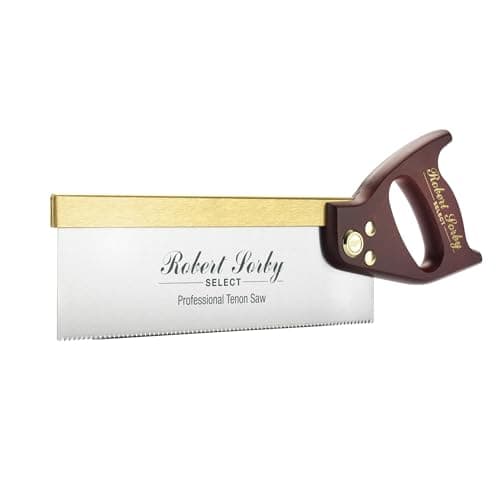
Robert Sorby's own catalog lists this as a solid brass back with brass fasteners, a lacquered high carbon steel blade, and 13 PPI resharpenable precision cross-ground teeth — the fullest spec sheet of any saw on this page, at roughly half what the Sheffield-made premium saws cost. The catch is in the same sentence: the teeth are universal, not rip-filed.
The 12-inch brass-backed saw that publishes the most and costs the least
Sheffield-made, filed teeth, a proper back, and a price that does not assume you are a collector. This is the western answer to the dozuki for anyone who wants to sharpen rather than replace.
A traditional filed gents saw from Sheffield. It does not cut as cleanly out of the box as a dozuki, and unlike a dozuki you can put the teeth back for the rest of your life.
Rip teeth on one edge, crosscut on the other, a plate thin enough to cut with almost no force, and a maker who actually sells replacement blades. That last point is why it rates as well as it does.
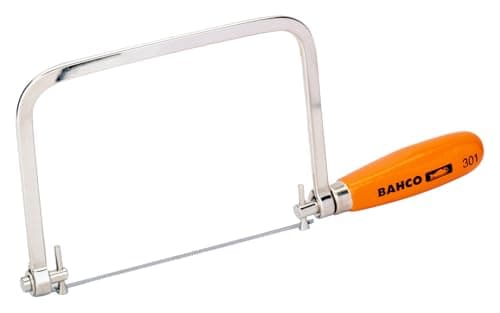
A nickel-plated steel frame, a beech handle and a 14 TPI blade of hardened and tempered carbon steel with the teeth milled and set — and the only coping saw in the ordinary price range whose seller publishes warranty wording at all, as a limited warranty against defects in workmanship and materials. Everything else here is sold with silence or with a returns window.
The one frame in the normal price range with published warranty wording
#ad· Live prices from the Amazon Product API, as of November 22, 2026. Where we have no verified live price we show none, and the cost-per-decade figure is suppressed with it — we would rather leave a gap than print a number that has rotted.
The verdict: buy the SUIZAN 6 in dozuki first, and add a 12 in tenon saw second. The dozuki is the saw that cuts dovetails and small tenon shoulders cleanly with no skill budget at all — a thin, tensioned, pull-stroke plate in a stiffening back tracks the line instead of wandering off it, and SUIZAN sells replacement blades directly, so the handle outlives the teeth. It is for anyone cutting furniture joinery by hand. The budget pick is the Bahco 301 coping saw, the cheapest saw here and the one nobody budgets for: it removes the waste between dovetails in seconds, and without it you are chopping all of it out with a chisel. Prices below are live, with the date they were checked.
This page is organized differently from the best hand saws, which ranks general-purpose saws against each other. Here the question is which saw makes which joinery cut, because joinery is not one operation. It is four: a fine crosscut across the shoulder, a fine rip down the cheek, an angled fine rip for dovetails, and a curved cut to clear waste. One saw can be made to do all four. None does all four well.
The four cuts, and the saw each one wants
Shoulders. A crosscut across the grain that has to be dead square and stop at an exact depth, because the shoulder is the joint line you will be looking at forever. This wants a backed saw: the spine keeps the thin plate from flexing, so the cut goes where the knife line is.
Cheeks. A rip cut down the grain, usually two to three inches deep. This is where a backed saw runs out of depth — the spine bottoms on the work — so either the saw must be big enough (a 12 in tenon saw) or unbacked (a ryoba’s rip edge). Depth of cut, not tooth count, is the specification that matters.
Dovetails. A fine angled rip in thin stock. The narrower the kerf, the less you have to pare afterwards, which is the single biggest reason a Japanese pull saw has taken over this job: putting the plate in tension lets it be thinner than any push saw can be.
Waste. A curved cut between the dovetails or down the middle of a wide mortise. Nothing with a straight back can do it. A coping saw costs almost nothing and saves an hour per drawer.
The honest consequence is a three-saw kit: a dozuki or gents saw, a tenon saw, and a coping saw. Everything else on this page is an alternative to one of those three rather than a fourth tool.
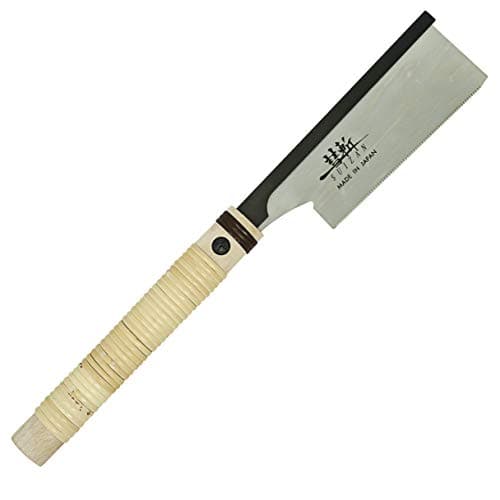
The first saw: SUIZAN 6 in dozuki
A 6 in crosscut dozuki is the saw to buy if you can only buy one. The combination of a tensioned pull stroke, a thin plate and a brass back gives you a cut you can land on a knife line on your first attempt, which is not true of any push saw at any price. SUIZAN publishes a written warranty — a 30-day initial-defect replacement — which is more than almost anyone in the pull-saw market does, and it sells replacement blades for its ryoba, dozuki and kataba saws directly.
The trade is permanent: the teeth are impulse-hardened and cannot be resharpened. You are buying a handle and consuming blades. Whether that is acceptable is a real buy-it-for-life question and it is argued on Japanese vs Western saws. The whole dovetail field is on the best dovetail saws, where this same saw wins on its own merits.
The second saw: a 12 in tenon saw
Twelve inches is the length that cuts a furniture-sized tenon cheek without the spine bottoming out, and it is the reason a dovetail saw cannot be the only backed saw you own. The Robert Sorby Select is the one to buy if you intend to keep it for life: filed teeth you can re-sharpen and re-set indefinitely, from a Sheffield maker that still exists to stand behind it.
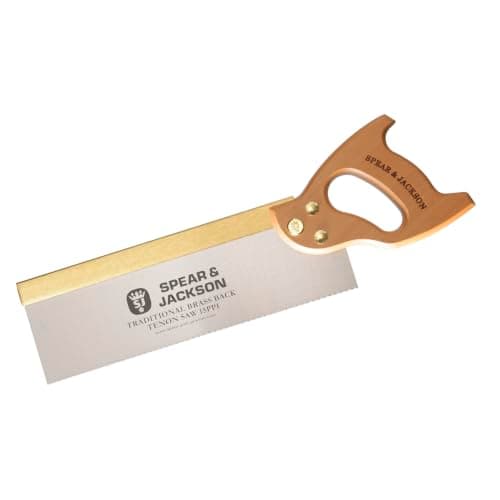
The Spear & Jackson 12 in at 15 PPI is the pragmatic alternative and costs a fraction as much. It cuts well out of the box and is also filed, so it is sharpenable — the difference is fit, finish and the plate. Both are ranked against the rest of the class on the best tenon saws, and the choice between a tenon saw and a dovetail saw is set out on tenon saw vs dovetail saw.
The saw for people who intend to sharpen: Crown 187 gents
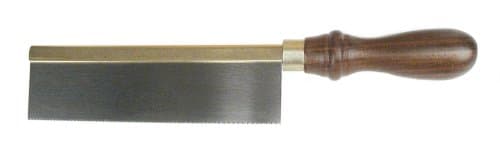
A traditional Sheffield gents saw with filed teeth. Out of the box it does not cut as cleanly as the dozuki and it leaves a wider kerf. What it does instead is last forever: the teeth can be re-filed and re-set by hand for the rest of your life, which makes it the only genuinely lifetime saw in this list rather than a lifetime handle.
Buy it only if you mean it. An unsharpened gents saw is worse than a cheap dozuki permanently, and the skill is a real one — the method is on how to sharpen a dovetail saw.
The one-saw answer, if you insist: the ryoba
A 9.5 in ryoba has rip teeth on one edge and crosscut teeth on the other and no back at all, so it will cut a shoulder, a cheek and a dovetail with the same tool and will cut deeper than any backed saw here. For a toolkit that has to be small, this is the honest single-saw answer.
What it gives up is tracking. Without a spine the plate follows the grain as much as it follows your line, so a ryoba rewards a scored knife line and a slow start. It is the general-purpose Japanese saw rather than the joinery specialist, and the field it belongs to is on the best Japanese saws. If you are deciding between the two Japanese patterns, that argument is on ryoba vs dozuki.
The budget pick: Bahco 301 coping saw
The cheapest tool on this page and the one that changes how long a drawer takes. After the dovetail cuts are made, the waste between the pins has to come out; a coping saw removes nearly all of it in a few seconds per socket and leaves you paring to a line instead of chopping to a depth. Blades are a standard consumable sold in packs.
It is not a precision tool and should not be asked to be — stay a clear sixteenth off the baseline and pare the rest. The whole class, including the aluminium-framed precision saws, is on the best coping saws, and the sequence the saws are used in is on how to cut dovetails by hand.
What is not on this page
Panel saws and toolbox saws. Breaking stock down to length is not joinery and a 15 in toolbox saw is the wrong tool for a shoulder line. Those are on the best hand saws.
Saw guides and jigs. A magnetic guide will make a beginner’s dovetail cuts square and is a legitimate purchase; no guide in our registry has a verified listing, so none is recommended here. The guide question, including how to make one from scrap, is on dovetail saw guides explained.
Every pick, in full
The write-ups
01Best dovetail saw
Length
6 in
Teeth
Fine crosscut
Back
Stiffened spine
Blade
Replaceable
SUIZAN Dozuki Dovetail Saw, 6 in Crosscut
SUIZAN
8.8/10
A stiffened back over a very thin crosscut plate. The kerf is narrow enough that the saw goes exactly where the knife line is, which is the whole job of a dovetail saw.
Cost per decade
$14.74
Horizon · tier C
20 years — No lifetime warranty; parts purchasable and resharpenable
The teeth are impulse-hardened and cannot be filed, so the blade is a consumable — but the maker sells replacement blades directly for this model. The handle and spine are the durable part; the blade is a scheduled purchase, not a failure.
Rebuy risk
High
parts listed
Cut quality
9.5
Blade life
8.0
Control
9.5
Renewability
8.0
Value
9.0
What it gets right
+Kerf narrow enough to split a knife line reliably
+Replacement blades sold by the maker
+6 inch is the right length for drawer-scale dovetails
What it costs you
−The back limits depth of cut absolutely
−Impulse-hardened teeth cannot be filed
−The thin plate is unforgiving of a forced stroke
Skip this if…
…you cut deep tenons. The spine will bottom out and there is no way around it.
02The 12-inch brass-backed saw that publishes the most and costs the least
Size
12 in (300 mm), 13 PPI
Blade
Hardened high carbon steel, protective lacquer
Back
Solid brass back and brass fasteners
Teeth
Universal, resharpenable precision cross-ground
Warranty
Lifetime guarantee published on tool SETS, registration required
Robert Sorby Select Professional Tenon Saw, 12 in 13 PPI
Robert Sorby
8.7/10
Robert Sorby's own catalog lists this as a solid brass back with brass fasteners, a lacquered high carbon steel blade, and 13 PPI resharpenable precision cross-ground teeth — the fullest spec sheet of any saw on this page, at roughly half what the Sheffield-made premium saws cost. The catch is in the same sentence: the teeth are universal, not rip-filed.
Cost per decade
$29.11
Horizon · tier C
20 years — No lifetime warranty; parts purchasable and resharpenable
No lifetime warranty published at the date checked. The teeth are filed rather than impulse-hardened, so they can be resharpened and reset by hand indefinitely — the reason nineteenth-century saw plates are still in working use.
Rebuy risk
Medium
parts listed, resharpenable
Cut quality
8.0
Blade life
9.0
Control
8.0
Renewability
9.5
Value
9.0
What it gets right
+Sorby's catalog states the teeth are resharpenable, which is the one promise that matters on a backsaw
+Solid brass back plus brass fasteners at a price where most saws get a folded steel back
+12 in is the right length for tenon cheeks, and the only 13 PPI saw here in stock without a thin-inventory warning
+The published spec sheet is the most complete of the seven — steel, coating, back, fasteners and tooth type are all stated
What it costs you
−The teeth are filed universal for cutting along and across the grain, so they are a compromise on tenon cheeks rather than the rip filing the job wants
−Sorby's lifetime guarantee is published for tool sets registered from a warranty card; a single saw bought loose is not obviously covered
−The catalog describes a slow, extra fine cut, which is accurate and means it is not the saw for deep tenons in hardwood
−Cross-ground teeth take more work to file back to a clean rip profile than hand-filed teeth do
Skip this if…
…you are cutting tenons all day in hard maple. The universal filing will make you work for every cheek, and a rip-filed 14 in plate is the honest answer.
We earn nothing on this one
The best tenon saw sold in North America is Lie-Nielsen's, it is not sold on Amazon, and we earn nothing on it. Verbatim from its product page: a 16 in long, .032 in thick blade, 21-1/4 in overall, a 3 in depth of cut, a cherry handle, brass fittings and a stout 3/4 x 1/4 in milled brass back, based on a classic Henry Disston model, and every Lie-Nielsen saw is precision set, filed and test cut in hardwood before it leaves the shop. It is filed rip, which is the thing nothing on this page except the thin-stocked Lynx 14 in gets right. Every one of those figures is quoted from the product page at Lie-Nielsen Toolworks.
Price as of November 22, 2026. Prices move; Amazon's is the one that counts.
#ad · we may earn a commission from this link to Robert Sorby Select Professional Tenon Saw, 12 in 13 PPI
03A resharpenable western backsaw at a sane price
Length
12 in
Teeth
15 PPI, filed
Type
Tenon saw, backed
Action
Push stroke
Spear & Jackson Tenon Saw, 12 in 15 PPI
Spear & Jackson
8.7/10
Sheffield-made, filed teeth, a proper back, and a price that does not assume you are a collector. This is the western answer to the dozuki for anyone who wants to sharpen rather than replace.
Cost per decade
$16.52
Horizon · tier C
20 years — No lifetime warranty; parts purchasable and resharpenable
No lifetime warranty published at the date checked. The teeth are filed rather than impulse-hardened, so they can be resharpened and reset by hand indefinitely — the reason nineteenth-century saw plates are still in working use.
Rebuy risk
Medium
parts listed, resharpenable
Cut quality
8.0
Blade life
9.5
Control
8.0
Renewability
9.5
Value
8.5
What it gets right
+Filed teeth mean this saw can be renewed indefinitely
+15 PPI is fine enough for joinery, coarse enough to be efficient
+Substantial back keeps the plate genuinely rigid
What it costs you
−Needs its teeth dressed and set before it does its best work
−Wider kerf than any Japanese equivalent
−Handle finish is rough at the price
Skip this if…
…you will not sharpen it. Everything good about this saw is downstream of that.
A traditional filed gents saw from Sheffield. It does not cut as cleanly out of the box as a dozuki, and unlike a dozuki you can put the teeth back for the rest of your life.
Cost per decade
$20.18
Horizon · tier C
20 years — No lifetime warranty; parts purchasable and resharpenable
No lifetime warranty published at the date checked. The teeth are filed rather than impulse-hardened, so they can be resharpened and reset by hand indefinitely — the reason nineteenth-century saw plates are still in working use.
Rebuy risk
Medium
parts listed, resharpenable
Cut quality
7.5
Blade life
9.5
Control
8.0
Renewability
9.5
Value
8.0
What it gets right
+Filed teeth can be sharpened and set indefinitely by hand
+Genuinely a lifetime tool rather than a lifetime handle
+Straight turned handle suits a light, controlled grip
What it costs you
−Out of the box it needs the teeth dressed to cut at its best
−Cuts a wider kerf than any dozuki
−The straight handle is a preference; some people hate it
Skip this if…
…you have no intention of learning to sharpen a saw. Unsharpened, this is worse than a fifteen-dollar dozuki forever.
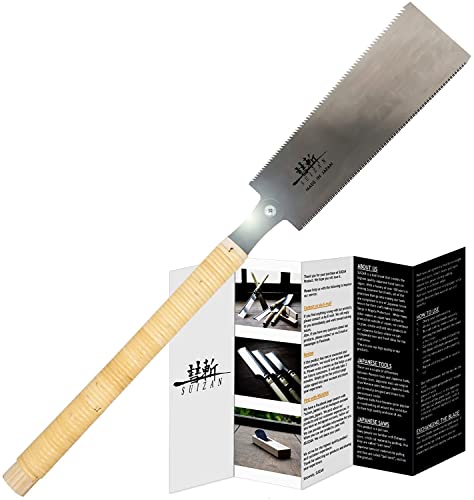
Rip teeth on one edge, crosscut on the other, a plate thin enough to cut with almost no force, and a maker who actually sells replacement blades. That last point is why it rates as well as it does.
Cost per decade
$18.93
Horizon · tier C
20 years — No lifetime warranty; parts purchasable and resharpenable
The teeth are impulse-hardened and cannot be filed, so the blade is a consumable — but the maker sells replacement blades directly for this model. The handle and spine are the durable part; the blade is a scheduled purchase, not a failure.
Rebuy risk
High
parts listed
Cut quality
9.5
Blade life
8.0
Control
8.0
Renewability
8.0
Value
9.0
What it gets right
+Two saws in one, and both edges are good rather than compromised
+SUIZAN sells replacement blades directly, so the handle is the lasting purchase
+Thin kerf means less wood removed and much less effort
What it costs you
−Impulse-hardened teeth cannot be filed; when they go, you buy a blade
−The blade warranty stated on the replacement blades is one month
−A thin plate kinks if you force or twist it
Skip this if…
…your definition of buy-it-for-life excludes consumables. A ryoba is a handle plus a scheduled blade purchase, and no amount of framing changes that.
06The one frame in the normal price range with published warranty wording
Frame
Nickel-plated steel
Blade
6-1/2 in, 14 TPI, hardened and tempered carbon steel
Blade mount
Retaining pins, turnable 360 deg
Handle
Lacquered beech
Warranty
Limited warranty against defects in workmanship and materials
Bahco BAH301 Coping Saw
Bahco
8.0/10
A nickel-plated steel frame, a beech handle and a 14 TPI blade of hardened and tempered carbon steel with the teeth milled and set — and the only coping saw in the ordinary price range whose seller publishes warranty wording at all, as a limited warranty against defects in workmanship and materials. Everything else here is sold with silence or with a returns window.
Cost per decade
$9.86
Horizon · tier C
20 years — No lifetime warranty; parts purchasable and resharpenable
No lifetime warranty published for this frame at the date checked. What sets the horizon instead is that the consumable is a 6-1/2 in pin-end blade — an industry-standard size carried by Bahco, Olson, Stanley and a dozen generic sellers at a few dollars per pack — so the part that wears out can always be bought, from somebody, at a price that does not matter. There is nothing else on the tool to consume: a frame, a tension screw and a handle.
Rebuy risk
High
parts listed
Cut quality
8.0
Blade life
7.5
Control
7.5
Renewability
8.5
Value
8.5
What it gets right
+Published warranty wording, which no other frame in this price range here has
+Blade steel is actually specified — hardened and tempered carbon steel with milled and set teeth — rather than left as 'steel'
+Full 360 degree blade rotation on retaining pins, so the frame can be swung clear of the work mid-cut
+Takes the universal 6-1/2 in pin-end blade, and Bahco sells its own 303 blades in 5-packs
+Wooden handle rather than molded plastic, which can be reshaped or replaced with a dowel if it ever splits
What it costs you
−Neither the maker nor the retailer publishes a throat depth for this frame, which is the single most useful number on a coping saw
−No weight published on the US retailer pages we read
−Tension is set by turning the handle, which is less repeatable than a cam lever and can loosen under hard use
−14 TPI is a compromise pitch — coarse for tight curves in thin stock, fine for ripping a cope in trim
Skip this if…
…you need a deep throat. The Stanley below publishes 6-3/4 in and costs about the same; this frame's case is the warranty and the published blade steel, not reach.
Buy by cut, not by class. A dozuki for dovetails and shoulders, a 12 in tenon saw for cheeks, a coping saw for waste. Three saws cut every joint in a piece of furniture and together cost less than one premium dovetail saw.
Depth of cut is the tenon saw specification that matters. A backed saw stops when the spine hits the work. Measure your deepest likely tenon cheek and buy a saw with more plate below the back than that.
Decide the sharpening question before you spend. Impulse-hardened pull saws cut better out of the box and are consumables. Filed Western saws cut adequately and last forever. Buying the Western saw and never learning to file it is the worst of both.
Do not skip the coping saw. It is the cheapest tool in the kit and the one that removes the most labour. Chopping out dovetail waste with a chisel because you did not buy a twenty-dollar saw is a false economy measured in hours.
Score the line first, whatever you buy. A knife line gives the teeth a wall to start against and is worth more than any upgrade on this page.
Questions
Frequently asked
What hand saws do I need for joinery?+
Three: a dozuki or gents saw for dovetails and shoulders, a 12 in tenon saw for cheeks, and a coping saw to clear waste. Joinery is four different cuts and no single saw makes all of them well, though a ryoba comes closest if the kit has to be small.
Is a dovetail saw the same as a tenon saw?+
No. They are the same pattern at different sizes, and the difference that matters is depth of cut: a dovetail saw’s spine bottoms out long before a furniture tenon cheek is finished. The full comparison is on tenon saw vs dovetail saw.
Japanese or Western saws for joinery?+
Japanese pull saws cut a narrower kerf, track better on the first attempt and cannot be resharpened. Western filed saws need more skill and last indefinitely. If you will never learn to file teeth, buy Japanese; if you will, the Sheffield saws are the cheaper tool over thirty years.
Can I cut dovetails with a coping saw?+
Not the dovetail cuts themselves — the frame will not let you follow a straight line and the kerf is far too wide. A coping saw removes the waste between the pins after the straight cuts are made, which is exactly the job it is here for.
What size tenon saw should I buy?+
Twelve inches for furniture. It has the plate depth to finish a normal tenon cheek without the spine fouling the work, and it is still light enough to control on a shoulder line. Ten inches is a dovetail-plus saw rather than a tenon saw.
We have not handled these tools. Nobody here has tested one, owned one, or taken one apart. Specifications come from the manufacturer or the retailer listing; warranty terms come from the maker's own warranty page; the cost-per-decade arithmetic is ours and reproducible. Where we could not verify a figure we say so on the page rather than quietly leaving it out. Read the full method.