Sharpening
How to Sharpen a Dovetail Saw
A dovetail saw has teeth smaller than the file most people reach for. Get the file size right and the rest is twenty minutes.
We earn a commission when you buy through our Amazon links, at no extra cost to you. It never decides a ranking, and where the best tool in a class is one we earn nothing on, we say so and link it anyway. How this works.
The short answer
Quick picks
| # | Tool | Best for | Per decade | Score | Price |
|---|---|---|---|---|---|
| 01 | 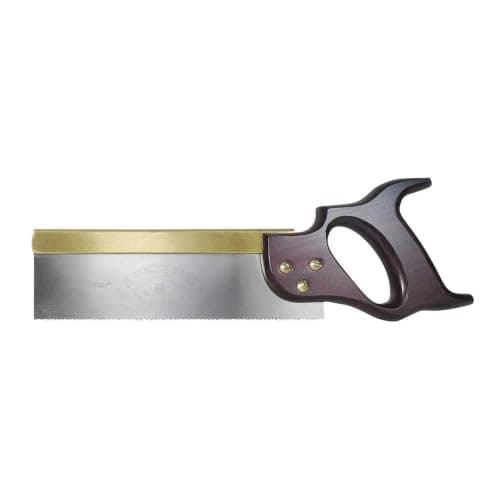 Lynx Tenon Saw, 10 in 15 TPI Crosscut Thomas Flinn is the last traditional saw maker left in Sheffield, and the Lynx line is the reason to care: Sheffield alloy spring steel, a folded brass back that holds the plate under tension, brass button screws, and teeth hand sharpened at the factory. It is also the only saw on this page whose listing states the filing — and what it states is crosscut, which is not what a tenon cheek wants. | The best-made saw here, and the only one that tells you how it is filed | $50.84tier C | 8.6/10 | $101.67Amazon |
| 02 | 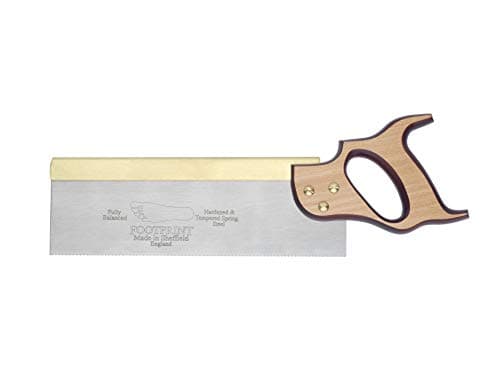 Footprint 256 Tenon Saw, 10 in 15 TPI Brass Back Footprint's own listing for the 256 range says the thing this site exists to look for: a spring alloy steel blade that can be re-sharpened time and time again, a heavy-duty brass back, three brass screws holding a two-tone lacquered beech handle, and Sheffield on the label. At 10 in and 15 TPI it is a carcass-weight saw, and Footprint does not publish the filing either. | Replaceable brass screws and a plate the maker says files forever | $51.09tier C | 8.5/10 | $102.19Amazon |
| 03 | 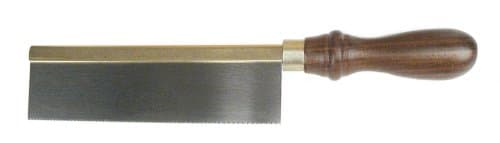 Crown 187 Gents Saw, 8 in A traditional filed gents saw from Sheffield. It does not cut as cleanly out of the box as a dozuki, and unlike a dozuki you can put the teeth back for the rest of your life. | The dovetail saw you can resharpen forever | $20.18tier C | 8.5/10 | $40.37Amazon |
| 04 | 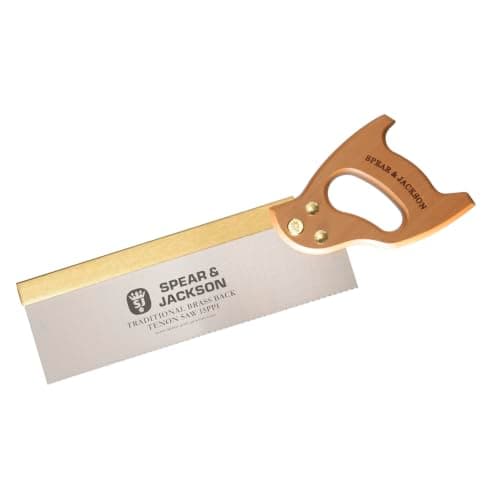 Spear & Jackson Tenon Saw, 12 in 15 PPI Sheffield-made, filed teeth, a proper back, and a price that does not assume you are a collector. This is the western answer to the dozuki for anyone who wants to sharpen rather than replace. | A resharpenable western backsaw at a sane price | $15.66tier C | 8.7/10 | $31.32Amazon |
#ad· Live prices from the Amazon Product API, as of October 16, 2026. Where we have no verified live price we show none, and the cost-per-decade figure is suppressed with it — we would rather leave a gap than print a number that has rotted.
First, find out whether your saw can be sharpened at all. If the teeth are dark blue or black at the tips, they are impulse-hardened and no file will touch them — that saw is a replaceable-blade tool, not a sharpenable one. If the teeth are the same bright steel as the plate, it is filed, and you can keep it cutting for the rest of your life with a 4 in extra-slim taper file, a saw vise and twenty minutes.
This site has the general routine on how to sharpen a hand saw, and if you are sharpening a 10 ppi panel saw that is the page you want. A dovetail saw is a different job in four specific ways, and each of them is a way the general advice goes wrong on a fine backsaw.
The four differences
1. The teeth are much smaller, so the file must be too. A dovetail saw runs somewhere between 15 and 20 points per inch. The 6 in slim taper file that handles a panel saw is physically too large: its corner radius is bigger than the gullet you are trying to file, so it rounds the gullet instead of deepening it and the teeth lose their points. You need a 4 in extra-slim or double-extra-slim taper, and for anything above about 18 ppi a needle file is the realistic option.
2. It is filed rip, not crosscut. A dovetail saw cuts down the grain through the thickness of a board, which is a ripping action, so the teeth are filed straight across at 90 degrees to the plate with no fleam angle at all. That is good news: a rip file is the simplest filing there is, because you hold the file square and push. The rake — how far the front of each tooth leans back — is where the character lives, and we come to that below. Rip vs crosscut teeth has the geometry.
3. It wants almost no set. Set is the alternate bending of teeth left and right that makes the kerf wider than the plate so the saw does not bind. A dovetail saw's whole value is a narrow kerf, and the plate is thin enough that very little set is needed — a few thousandths of an inch per side, which is less than most saw sets will deliver on their lightest setting. Many dovetail saws are sharpened with no new set at all, because the existing set is still there.
4. There is less room for error. On a 10 ppi saw a tooth filed a little too far is cosmetic. On an 18 ppi saw, one heavy stroke takes a tooth below its neighbours and that tooth stops cutting. Light strokes, counted, identical on every tooth.
What you need, and what it costs
An honest note on supply before the list: we have no saw file, saw set or saw vise in our product registry with a listing we can verify, so none is linked on this page and none is recommended by name. The rule here is that we only link to products we have checked are live. The sizes below are what to search for.
A taper file sized to the pitch. For 15 to 16 ppi, a 4 in extra-slim taper. For 17 to 20 ppi, a 4 in double-extra-slim, or a needle file at the top of that range. Buy two or three: a saw file is consumable and a dull one skates and glazes the tooth instead of cutting it. Bahco and Grobet are the names worth looking for.
A saw vise, or a wooden substitute. The plate has to be held rigid with only the teeth and a sliver of plate above the jaws, or it will chatter and the file will skip. A proper saw vise is the comfortable answer. Two pieces of hardwood with a slight bevel on the top inside edges, clamped in a bench vise, is the free answer and works.
Magnification and light. This is not optional at 18 ppi. A cheap head-worn magnifier and a bright raking light are what let you see which tooth you are on, and more sharpening jobs are ruined by not being able to see than by bad technique.
A fine mill file for jointing. Only if the tooth line is uneven. On a saw that has been used rather than abused, you skip this.
A saw set, probably not. Most dovetail saws do not need resetting at a sharpening. If yours genuinely binds after filing, a fine saw set on its lightest setting, applied to every other tooth from each side, is the tool — and be aware most sets are designed for coarser pitches and will overdo it.
The sequence
Step 1 — test the teeth with the file. Before anything else, take a file and draw it once across a few teeth with light pressure. If it bites, the saw is filed and you are in business. If it skates with a glassy feel, the teeth are impulse-hardened, and no amount of technique will change that. Stop, and buy a replacement blade or a filed saw instead.
Step 2 — clamp it low and rigid. Teeth plus about an eighth of an inch of plate above the jaws, no more. If you can hear a ring when you tap the plate, it is not clamped tightly enough.
Step 3 — joint the tooth line, only if it needs it. A mill file held flat on the teeth, run along the length until every tooth shows a tiny flat on its tip. This makes every tooth the same height and it also makes them all temporarily blunt, which is the point: the flats tell you how much to file each one. Skip this if the line is already straight, because jointing removes tooth height you cannot put back.
Step 4 — file every gullet, square across. Place the file in the first gullet, hold it level and at 90 degrees to the plate, and take two or three light strokes on the push only — never drag it back under pressure. Move to the next gullet. Same number of strokes, every time. Work along the whole saw in one direction.
Step 5 — watch the flats disappear. If you jointed, the shiny flat on each tooth tip is your gauge. File until the flat on the tooth in front of the file is gone, and then stop on that tooth. When every flat has gone, every tooth is the same height and sharp.
Step 6 — decide the rake, once. Rake is how far the front face of each tooth leans back from vertical, and it is set by how you tilt the file. Zero rake — the front face dead vertical — is the most aggressive and the hardest to start. Relaxing the rake to about 10 to 15 degrees makes the saw dramatically easier to start and a little slower, which on a joinery saw is almost always the right trade. Pick one and keep it consistent along the whole plate.
Step 7 — stone the sides lightly. One light pass of a fine stone flat along each side of the tooth line removes any burr and evens out set irregularities. It also takes the saw from cutting a slightly ragged kerf to cutting a clean one.
Step 8 — test in scrap and wipe it down. Cut a kerf in softwood end grain. It should start without jumping and track straight. Then oil the plate, because a plate you have just filed is bare steel — cleaning and waxing hand tools covers what to use, and rust removal and prevention is the fix if you have left it too long already.
Which saws can be sharpened at all
This is the buying decision the topic forces, and it is why the four saws in the table above are the ones on this page: every one of them is filed rather than impulse-hardened, so every one of them can be sharpened by the routine on this page indefinitely.
Lynx 10 in tenon saw, 15 TPI— made by Thomas Flinn in Sheffield, and the only saw here whose maker publishes how it is filed. Sheffield spring steel, folded brass back, beech handle on brass button screws. The best-made saw on the page.
Footprint 256 10 in, 15 TPI— a brass-backed Sheffield saw whose listing says the plate is re-sharpenable repeatedly, with three brass handle screws you can replace. The most explicitly renewable saw here.
Crown 187 Gents Saw 8 in— the small filed backsaw most people actually use for dovetails, and the cheapest route on this page to a saw you can keep forever. Straight handle rather than a pistol grip.
Spear & Jackson 12 in, 15 PPI— a filed western backsaw at a sane price, and the longest here, so it covers tenon shoulders as well as dovetails.
Everything else — the dozukis, the razor saws, every impulse-hardened pull saw — is a replaceable-blade tool and belongs on how to replace a Japanese saw blade instead. That is not a criticism of them; it is a different ownership model, and Japanese saw types explained sets out which is which.
What actually decides it
Buying guide
File size by tooth pitch
| Teeth per inch | File | Typical saw |
|---|---|---|
| 10 to 12 | 5 to 6 in slim taper | Panel saw, carcass saw |
| 13 to 14 | 4-1/2 to 5 in extra-slim taper | Large tenon saw |
| 15 to 16 | 4 in extra-slim taper | Tenon saw, large dovetail saw |
| 17 to 20 | 4 in double-extra-slim taper | Dovetail saw, gents saw |
| Above 20 | Needle file, or send it out | Fine gents saw, jeweller's saw |
The rule behind the table is that the file's face should be a little more than twice the depth of the gullet, so that one corner of the file does the work and you can rotate to a fresh corner as it dulls. A file that is too big rounds the gullet and ruins the points; a file that is too small dulls in one saw.
The honest case for a sharpening service
There is a real argument for not doing this yourself, and it is worth making rather than pretending otherwise.
A professional saw sharpener will joint, set and file a backsaw properly, and for a saw at 18 or 20 ppi they will do it better than a first-timer with a magnifier. The cost is usually a fraction of the saw's price. If you own one good backsaw, use it occasionally and want it cutting perfectly, sending it out once every few years is a rational choice and costs you nothing but postage.
The case for learning it is different and it is about independence rather than money. A filed saw you can sharpen is the only saw that genuinely never needs replacing, which is the argument this whole site is built on — see tools that last a lifetime. Once you can file a saw, a rusty flea-market backsaw with a sound plate becomes a twenty-minute project rather than scrap, and that changes what you can buy. How to restore a hand saw is the other half of that, and buying used hand tools is how you find one worth the effort.
Our suggestion: learn on a cheap flea-market backsaw where mistakes cost nothing, and send your good one out until you are confident. A ruined saw teaches you more than a perfect one and costs five dollars.
Common mistakes
- Using a file that is too big. The most common error by a distance, and the one that does permanent damage. A 6 in slim taper in an 18 ppi saw rounds every gullet.
- Dragging the file back under pressure. A file cuts on the push. Dragging it back dulls the file and burnishes the tooth.
- Jointing when you did not need to. Every jointing pass costs tooth height permanently. If the tooth line is straight, go straight to filing.
- Adding set. A dovetail saw almost never needs it, and a set applied with a tool designed for coarse saws will widen the kerf enough to lose the saw's whole advantage.
- Varying the stroke count. Two strokes on one tooth and three on the next makes them different heights. Count, every time.
- Working without magnification. You cannot file what you cannot see, and at 18 ppi you cannot see it.
- Trying to file hardened teeth. Test first. It wastes a file and achieves nothing — and a file is not cheap.
Cost per decade of a saw you can file
Here is the arithmetic that makes this page worth reading. An impulse-hardened dovetail saw lasts until its teeth dull, and then costs either a replacement blade or a replacement saw. Call that a purchase every few years for regular use.
A filed Sheffield backsaw costs more up front and then costs a file every few sharpenings and twenty minutes of your time. The plate loses a few thousandths of an inch of tooth height per sharpening, which means it can be filed dozens of times, which means it outlives you. In the tenth year, the twentieth and the fortieth it costs nothing but the file.
That is the only place in sawing where the buy-it-for-life argument reaches a genuinely permanent answer, and it is why this site weights a filed plate so heavily on the best tenon saws and the best dovetail saws. The condition is that you have to be able to do the filing — which is this page. Cost per decade has the method we use for that comparison everywhere else.
Questions
Frequently asked
Can you sharpen a dovetail saw?
Only if its teeth are filed rather than impulse-hardened. Draw a file across a few teeth: if it bites, you can sharpen it; if it skates with a glassy feel, the teeth are hardened past what a file can cut and the saw is designed around a replaceable blade. Most Japanese pull saws and most hardpoint western saws fall in the second group; Sheffield brass-backed saws fall in the first.
What file do I need to sharpen a dovetail saw?
A 4 in extra-slim taper for 15 to 16 ppi, and a 4 in double-extra-slim for 17 to 20 ppi. Above about 20 ppi you are into needle files. The usual mistake is using the 6 in slim taper that handles a panel saw: it is too big for a fine gullet and it rounds the gullet instead of deepening it, which costs you the tooth points permanently.
Is a dovetail saw filed rip or crosscut?
Rip — filed straight across at 90 degrees to the plate with no fleam. A dovetail cut runs down the grain through the thickness of a board, which is a ripping action. That makes it the easiest filing there is, because you hold the file square rather than at a compound angle.
Does a dovetail saw need set?
Very little, and usually none at a resharpening. The narrow kerf is the saw's whole advantage and set widens the kerf, so a few thousandths of an inch per side is all it wants — which is less than most saw sets deliver on their lightest setting. Only add set if the saw genuinely binds in the cut after filing.
How often should a dovetail saw be sharpened?
When it stops starting easily or stops tracking straight, which for a hobbyist cutting joinery is likely to be years rather than months. A backsaw cuts clean dry hardwood and meets no grit, so it leads an easy life compared with a panel saw. Filing it before it needs it costs tooth height you cannot replace.
Is it worth paying someone to sharpen a dovetail saw?
For one good saw at a fine pitch, often yes — a professional will do it better than a first attempt and the cost is a fraction of the saw. The reason to learn it anyway is that it makes a rusty flea-market backsaw with a sound plate into a twenty-minute project, which changes what is worth buying secondhand.
Receipts
Sources
- Popular Woodworking — The Last Sheffield Sawmaker (Thomas Flinn & Co: the oldest remaining traditional hand saw maker in Sheffield, England, started 1923; produces saws under the Pax, Lynx, William Greaves and Dorchester brands; saws are made from Sheffield alloy spring steel, the plate is held straight and true by a thick solid brass spine, the folded brass back holds the blade under tension, and the saws are hand sharpened before leaving the factory and can be resharpened). Retrieved 2026-09-30.
- Hardwick & Sons — Lynx 14" Tenon Saw, Rip Tooth (model LTB14R; "14\" (355 mm)" blade, "3\"" depth of cut, "19\"" overall length, "Solid brass backing & screws", "Lacquered & stained Beech handle", "Made in Sheffield, England"; filed rip for cutting with the grain). Retrieved 2026-09-30.
- Footprint 256 Brass Back Tenon Saw ("Made from high quality spring alloy steel, the blade can be re-sharpened time and time again."; "A heavy-duty brass back provides rigidity and support to the blade."; "The handle is made from an attractive two tone lacquered beechwood."; "Three brass screws securely fit the handle to the saw blade."; "Made in Sheffield, England." No warranty terms published; no tooth filing stated). Retrieved 2026-09-30.
- Spear & Jackson — 12" (305mm) x 15pts Traditional Tenon Saw, part 9550B ("harden and tempered carbon steel" blade; "Brass Back"; "15 PPI"; "Resharpenable teeth"; "Comfortable wooden handle incorporating 3 bifurcated rivets". No depth of cut, country of manufacture or warranty terms published on the page). Retrieved 2026-09-30.
- Amazon listing for Lynx Tenon Saw, 10 in 15 TPI Crosscut — specifications and price basis, retrieved via the Amazon Product API on 2026-07-24 and refreshed on the daily price check.
- Amazon listing for Footprint 256 Tenon Saw, 10 in 15 TPI Brass Back — specifications and price basis, retrieved via the Amazon Product API on 2026-07-24 and refreshed on the daily price check.
- Amazon listing for Crown 187 Gents Saw, 8 in — specifications and price basis, retrieved via the Amazon Product API on 2026-07-24 and refreshed on the daily price check.
- Amazon listing for Spear & Jackson Tenon Saw, 12 in 15 PPI — specifications and price basis, retrieved via the Amazon Product API on 2026-07-24 and refreshed on the daily price check.
We have not handled these tools. Nobody here has tested one, owned one, or taken one apart. Specifications come from the manufacturer or the retailer listing; warranty terms come from the maker's own warranty page; the cost-per-decade arithmetic is ours and reproducible. Where we could not verify a figure we say so on the page rather than quietly leaving it out. Read the full method.
Keep reading
Related
- How to sharpen a hand sawThe coarser panel-saw routine this page diverges from.
- The best dovetail sawsWhich saws arrive filed and which arrive hardened.
- Saw TPI explainedThe pitch that decides which file you need.
- How to restore a hand sawThe flea-market plate this skill makes worth buying.
- Rip vs crosscut teethWhy a dovetail saw is filed square across.
Back to Sharpening · how we pick · editorial policy