A mallet is the only tool in the kit designed to be damaged in use. That makes the buy-it-for-life question unusually simple, and the answer is not the most expensive one.
We earn a commission when you buy through our Amazon links, at no extra cost to you. It never decides a ranking, and where the best tool in a class is one we earn nothing on, we say so and link it anyway. How this works.
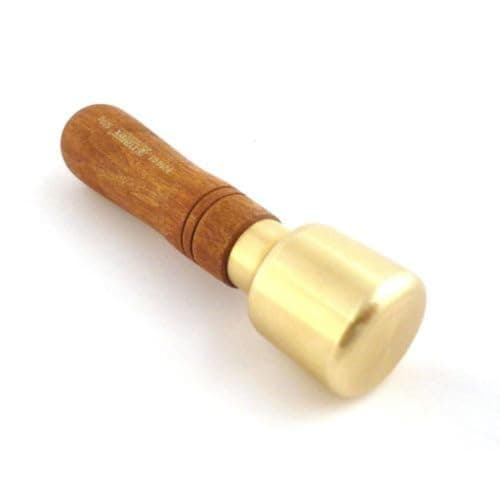
A solid brass striking head 40 mm across and 52 mm long on a stained hornbeam handle, 500 g in 170 mm overall. Brass is the right material for a chisel mallet for an unglamorous reason: it is dense enough to deliver the blow from a short wrist flick, and soft enough not to mushroom a chisel hoop or a ferrule.
Chisel work, where mass in a small head is the whole point
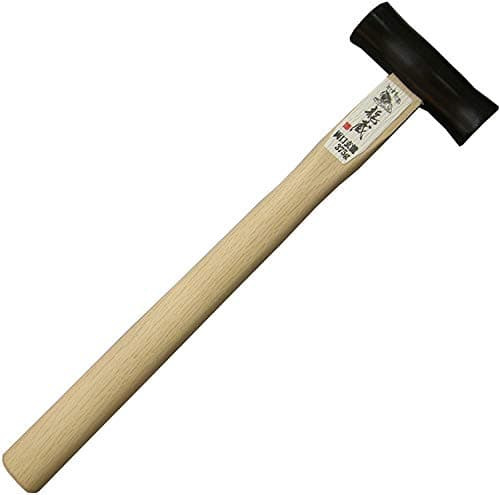
A 375 g bronze-plated Japanese carbon steel head, 29 mm thick, on a natural oak handle, with one flat face and one slightly domed face. If you own hooped Japanese chisels or a wooden plane, this is not a style preference — a genno is the tool those are designed to be struck with, and a wooden mallet does the job badly.
Japanese chisels and setting a kanna, where a wooden mallet is wrong
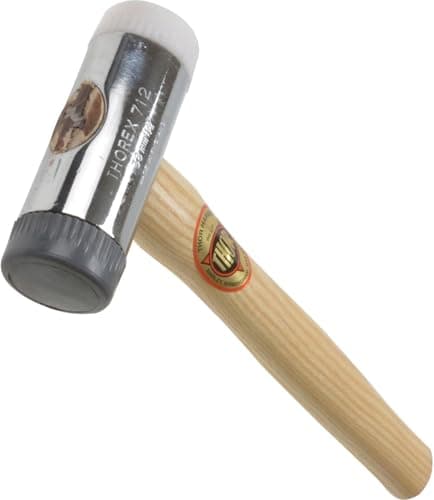
Two screw-in faces, 38 mm across, one soft grey and one hard white, on a chrome-plated zinc head and a wooden handle at 650 g — and the faces are explicitly 'designed to be replaced when worn', with color-coded alternatives in different hardnesses. Every other mallet on this page wears out. This one has a service part.
The only mallet here whose wear part is a published, replaceable component
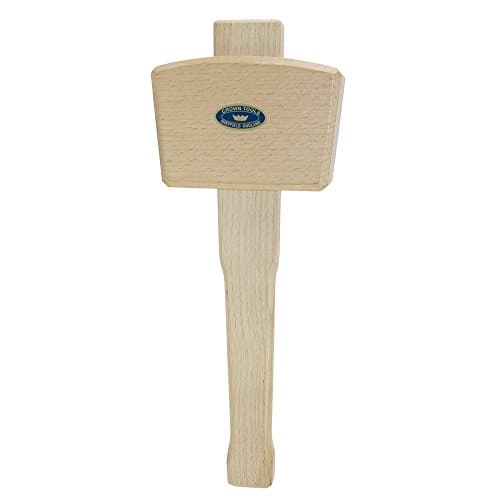
A 4-1/2 in kiln-dried beech head with a 1-7/8 by 2-7/8 in face, 17 oz overall on a 12 in unlacquered handle, made in Sheffield. The angled faces of a joiner's mallet exist so the face meets the chisel square when your arm swings in an arc — the one piece of geometry a round carving mallet gives up.
The traditional joiner's mallet, from a maker who still names the town
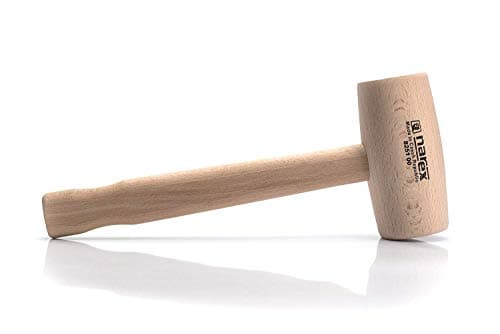
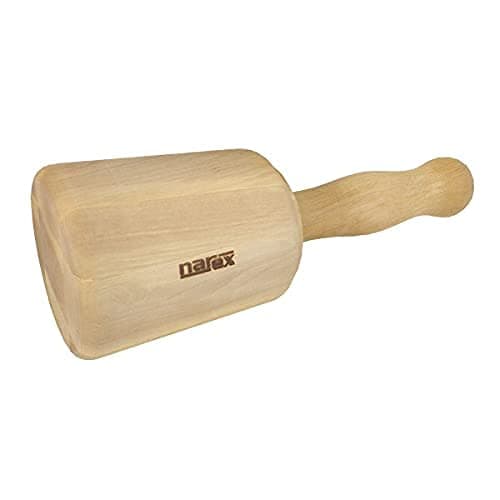
A round unfinished European beech mallet at 300 g, with two details the price does not suggest: the head is cut at a 5 degree angle so it strikes square, and the edges are chamfered so the end grain does not splinter. Narex publishes both across this series. Most mallets at this money publish nothing at all.
The cheapest mallet here that is designed rather than just turned
900 g of round-turned hornbeam. Hornbeam rather than beech is the point: it is one of the densest European hardwoods, and it is what mallet heads were made from before beech became the default. At this weight the chisel goes where it is pointed and you stop fighting it.
Mortising, where mass does the work so technique does not have to
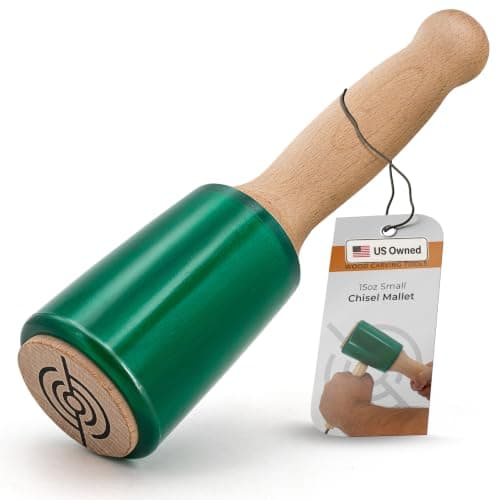
A 15 oz urethane striking head on a wooden handle, sold on the claim that the urethane absorbs punishment to protect your tools and cuts noise. For carving gouges — struck hundreds of times an hour on a small handle — a dead, non-marring face is a genuine functional advantage rather than a nicety.
Gouges and carving tools, where a hard face is the enemy
#ad· Live prices from the Amazon Product API, as of October 16, 2026. Where we have no verified live price we show none, and the cost-per-decade figure is suppressed with it — we would rather leave a gap than print a number that has rotted.
Every page on this site that tells you how to chop a mortise, pare a dovetail or seat a chisel in a baseline says “strike it with a mallet” and then moves on. That is a gap, because the mallet is not a neutral accessory. The wrong one will split the handle of a chisel that cost five times as much, and the right one makes the difference between a mortise cut in forty blows and one cut in a hundred.
A mallet is also the strangest tool in the workshop to apply this site's method to, because it is the only one designed to be damaged. A plane sole gets flatter with use. A chisel gets sharper every time you touch it to a stone. A mallet face gets worse every single time you use it, for its entire working life, by design — it is absorbing a blow that would otherwise go into your tool. So the buy-it-for-life question here has only three possible answers, and every mallet ever made gives one of them:
The face is a replaceable part. One mallet on this page is in this category, and exactly one. Thor's faces screw in and are published as replacements in several hardnesses.
The head cannot meaningfully wear out. Solid brass and forged steel are in this category. There is no face to go through; the consumable becomes the wooden handle, which is a shaped stick you can make yourself.
You are buying a wear item. Every wooden and urethane mallet here, honestly. A beech head mushrooms, checks and eventually splits, nobody sells a replacement, and the tool's life is the face's life. That is not a criticism — it is a long life and a cheap tool — but it is what the cost per decade horizon on those four is telling you.
How we ranked them
We have not chopped a mortise with any of these. What we did is open every maker's and retailer's own listing, write down only what they publish, cite it, and rank on that. Sources are at the bottom; the method is on the methodology page. Five things decided the order.
What is the head made of, and what does that do to your chisels? This is the first question and most people get it backwards. A mallet face has to be softer than the thing it strikes, or it damages it. Beech on a wooden chisel handle is correct. Brass on a steel hoop is correct, because brass is softer than the hoop. Steel on a wooden handle is a disaster, and steel on a hooped Japanese chisel is correct and traditional. The mistake that destroys tools is not buying a cheap mallet; it is buying the right mallet for the wrong chisels.
Is there a replaceable part, and is it published? Only the Thor passes this outright. The two metal-headed mallets pass on a technicality that happens to be the strongest position available: a handle is a stick, and you do not need anybody's part number to make one. The four wooden and urethane heads fail it, and we have said so in every one of their cons.
How much mass, and where? Mass is what does the work. These run from 300 g to 900 g of head, a factor of three, and the right figure depends entirely on the job: 300 g for carving and light paring taps, 450 to 650 g for general bench joinery, 900 g and up for chopping mortises in hardwood. Equally important is where the mass sits. The Narex brass mallet puts 500 g into 170 mm overall, so the blow comes from a wrist flick with the chisel held close; the Crown puts 17 oz into 12 inches, which needs a swing. Neither is better. They are different tools that look like the same tool.
Does the geometry do anything, or is it just turned? Two details separate a designed mallet from a lump on a stick, and both are published here. A traditional joiner's mallet — the Crown — has its faces cut at an angle so that the face arrives square on the chisel at the bottom of the arc your arm swings in. Narex applies the same thinking to a round mallet: the head is cut at a 5 degree angle for the same reason, with chamfered edges so the end grain does not splinter. Those are real decisions, published, at a price where most sellers publish nothing.
Does anybody publish anything at all? This is where the category falls apart, and it is worth saying plainly.
What nobody in this category publishes
Not one maker on this page publishes a defect warranty on a mallet. Not one. Narex, Crown, KAKURI and Thor publish none; the two guarantees that exist are a retailer's satisfaction policy (Infinity Tools, on the brass mallet) and a seller's money-back or replacement promise (Schaaf). Both are returns policies, which tell you what happens in the first month and nothing about year twenty.
That is more defensible here than it is in most categories. A mallet is supposed to wear out; a warranty against wear would be a warranty against the tool working. What would be genuinely valuable is the thing almost nobody offers: a replacement face or a replacement handle as a catalog item. Thor offers faces. Nobody on this page offers a handle. On the two metal-headed mallets that does not matter, because a handle is a stick. On the four wooden ones it is the whole lifespan of the tool.
The published spec sheets are similarly thin, with two honorable exceptions. Narex publishes head diameter, head length, handle length, overall length and total weight for the brass mallet, and the 5 degree head angle and chamfers across the beech series. KAKURI publishes head weight, head thickness, total weight, head material, plating and handle species. Crown publishes head size, face dimensions, overall weight, overall length, the wood and the fact that it is kiln dried — and the town it is made in. Against that, Schaaf's own retailer page states both 12 oz and 15 oz for the same mallet in different places and publishes no handle material or overall length at all, and Narex publishes nothing for the 900 g hornbeam beyond its weight and species.
The Japanese chisel problem, which is not optional
If you own Japanese chisels, this section is the reason this page exists. A Japanese bench chisel has a laminated blade, a wooden handle, and a steel hoop (katsura) driven onto the end of that handle. The hoop is there specifically so the handle can be struck by steel. The tool is designed around a genno — a Japanese carpenter's hammer with a flat face and a slightly domed face — and striking it with a wide wooden mallet instead is not merely traditionalism, it is less accurate and it fails to seat the hoop properly over time.
The reverse is the expensive mistake. A Western bench chisel with a plain wooden handle and no ferrule, struck with a steel hammer, splits. Not eventually — reliably. If your chisels came with a wooden handle and a brass or steel ferrule only at the blade end, they are mallet chisels and a steel hammer is the fastest way to destroy them. Chisel handle materials goes through which is which, and Japanese vs Western chisels covers why the two traditions arrived at different answers. The short version: buy the mallet that matches the chisels you own, not the one with the best reviews.
What is not on this page, and why
The anonymous beech mallets. There are dozens, mostly around ten dollars, often sold as bartending or ice mallets with woodworking as a secondary use. The Big Horn 26016 16 oz beech mallet was in stock at the date checked and is a perfectly reasonable thing to own; it is off the list because nothing is published about it beyond its weight, which gives us nothing to rank. The ones sold with no maker at all we will not feature on principle.
Dead-blow mallets with shot-filled heads. They are excellent at assembly and bad at chisel work: the delayed, mushy blow that stops a joint from rebounding is exactly the wrong feel for a chisel, where you want the energy to arrive all at once and stop. If you want one, buy it as an assembly tool and not as a chisel mallet.
The heavier brass and hornbeam Narex sizes, and the carver's mallets. Several were down to single-digit stock at the date checked. We would rather name them than send a reader to a dead listing: the Narex 825300 650 g beech and the 825701 250 g round-turned are the two most useful sizes we could not feature on availability.
Every pick, in full
The write-ups
01Chisel work, where mass in a small head is the whole point
Head
Solid brass, 40 mm dia x 52 mm
Handle
Stained hornbeam, 118 mm
Overall
170 mm, 500 g
Maker
Narex, Czech Republic
Warranty
None published; retailer guarantee only
Narex 500 g Brass Carving Mallet
Narex
8.3/10
A solid brass striking head 40 mm across and 52 mm long on a stained hornbeam handle, 500 g in 170 mm overall. Brass is the right material for a chisel mallet for an unglamorous reason: it is dense enough to deliver the blow from a short wrist flick, and soft enough not to mushroom a chisel hoop or a ferrule.
Cost per decade
$23.84
Horizon · tier C
20 years — No lifetime warranty; parts purchasable and resharpenable
No warranty published for this tool at the date checked. The horizon rests on construction instead: the head is forged steel or solid brass with no face to wear through, and the consumable is the wooden handle, which is a shaped stick — replaceable from a hardware store or a scrap of hickory, with no part number required from anybody. On a struck tool that is the strongest position available, because it is the only one that does not depend on a company still existing.
Rebuy risk
High
parts listed
Head & face
9.5
Handle & fit
8.0
Balance
9.0
Parts & repair
7.5
Value
7.5
What it gets right
+Solid brass head: no face to wear through, no grain to split, and soft enough that it will not mushroom a chisel hoop
+500 g in 170 mm means the mass is where you want it, so the blow comes from the wrist rather than the shoulder
+Published spec sheet — head diameter, head length, handle length, overall length and weight — which almost no mallet gets
+Short enough to use with a chisel held close to the work, which a 12 in beech mallet is not
+Brass and hornbeam are both renewable in principle: the head can be re-drilled and the handle is a shaped stick
What it costs you
−Brass marks a wooden chisel handle faster than wood does — this is a mallet for hooped or ferruled chisels, not for bare boxwood
−Narex publishes no warranty for it; the guarantees on the retailer page are the retailer's
−The head sits in a blind hole with a safety pin rather than through-wedged, so re-handling it is not the five-minute job it is on a through-fitted mallet
−Dead weight at 500 g gets tiring on a long session, where a lighter wooden mallet is kinder
−One of the more expensive mallets here
Skip this if…
…your chisels have plain wooden handles with no ferrule or hoop. Brass on bare wood is a short conversation that the wood loses.
02Japanese chisels and setting a kanna, where a wooden mallet is wrong
Head
375 g, Japanese carbon steel, bronze plated, 29 mm thick
Handle
Natural oak
Faces
One flat, one slightly domed
Total weight
16.7 oz
Made in
Japan
KAKURI Japanese Carpenter Hammer (Genno), 375 g
KAKURI
8.3/10
A 375 g bronze-plated Japanese carbon steel head, 29 mm thick, on a natural oak handle, with one flat face and one slightly domed face. If you own hooped Japanese chisels or a wooden plane, this is not a style preference — a genno is the tool those are designed to be struck with, and a wooden mallet does the job badly.
Cost per decade
$17.90
Horizon · tier C
20 years — No lifetime warranty; parts purchasable and resharpenable
No warranty published for this tool at the date checked. The horizon rests on construction instead: the head is forged steel or solid brass with no face to wear through, and the consumable is the wooden handle, which is a shaped stick — replaceable from a hardware store or a scrap of hickory, with no part number required from anybody. On a struck tool that is the strongest position available, because it is the only one that does not depend on a company still existing.
Rebuy risk
High
parts listed
Head & face
9.5
Handle & fit
8.5
Balance
8.5
Parts & repair
7.0
Value
8.0
What it gets right
+Steel head with no face to consume: the one construction here that genuinely does not wear out in normal use
+Two faces with different jobs — the flat one for chisels and plane blades, the domed one for setting a nail below the surface without bruising the wood
+Oak handle is friction-fitted in the Japanese way, so re-handling it is a maintenance task rather than a repair
+375 g is the standard head weight for bench chisel work, and KAKURI publishes head weight, head thickness, total weight and material
+Made in Japan by a named maker with a real spec sheet
What it costs you
−Steel on a wooden chisel handle will destroy it — this is for hooped Japanese chisels, plane adjustment and nails, and nothing else
−No warranty published, and no replacement handle offered as a part
−A 29 mm hammer face is unforgiving of a mis-hit in a way a wide wooden mallet is not
−The bronze plating is cosmetic and will wear off the striking face early, which looks worse than it is
Skip this if…
…all your chisels are Western with wooden handles and no hoops. You would be buying the fastest way to split them.
Price as of October 16, 2026. Prices move; Amazon's is the one that counts.
#ad · we may earn a commission from this link to KAKURI Japanese Carpenter Hammer (Genno), 375 g
03The only mallet here whose wear part is a published, replaceable component
Faces
38 mm, screw-in, one soft grey and one hard white
Weight
650 g (1-1/2 lb)
Head
Chrome-plated zinc
Handle
Wood
Spares
Replacement faces published in several color-coded hardnesses
Thor 712R Thorex Soft and Hard Faced Hammer
Thor
8.2/10
Two screw-in faces, 38 mm across, one soft grey and one hard white, on a chrome-plated zinc head and a wooden handle at 650 g — and the faces are explicitly 'designed to be replaced when worn', with color-coded alternatives in different hardnesses. Every other mallet on this page wears out. This one has a service part.
Cost per decade
$19.89
Horizon · tier C
20 years — No lifetime warranty; parts purchasable and resharpenable
No lifetime warranty published for this item at the date checked. The striking face is the wear part; on this pattern it is replaceable, and the head and handle are not consumables.
Rebuy risk
High
parts listed
Head & face
7.5
Handle & fit
8.0
Balance
8.0
Parts & repair
9.5
Value
8.0
What it gets right
+The faces screw in and are sold as replacements, so the part that wears is the part you can buy — the strongest buy-it-for-life position on this page
+Face hardness becomes a choice rather than a fixed property: Thor publishes faces from soft PVC through hard nylon
+Two different faces on one tool, so a non-marring blow and a firm blow do not need two mallets
+Nylon will not mark a finished surface, which matters when tapping a fitted joint home
+Wooden handle, so the second consumable is also replaceable
What it costs you
−The head is chrome-plated zinc, the cheapest material in this group and the one most likely to be damaged by a hard mis-hit on steel
−Spare 38 mm faces were thin on the ground on US Amazon at the date checked — one listing, one unit — so sourcing them may mean an industrial supplier rather than a click
−A nylon face is the wrong feel for chopping a mortise; this is an assembly and adjustment tool first
−No warranty terms published
−Nobody publishes the thread spec for the faces, so it is the maker's faces or nothing
Skip this if…
…you are buying one mallet for mortising. A 650 g nylon-faced hammer will drive a chisel, but a heavier wooden or brass head does it with less effort.
04The traditional joiner's mallet, from a maker who still names the town
Head
4-1/2 in (114 mm), face 1-7/8 x 2-7/8 in
Weight
17 oz overall
Overall
12 in
Wood
Kiln-dried beech; handle not lacquered
Made in
Sheffield, England
Crown 106 Beechwood Mallet, 4-1/2 in
Crown Hand Tools
7.7/10
A 4-1/2 in kiln-dried beech head with a 1-7/8 by 2-7/8 in face, 17 oz overall on a 12 in unlacquered handle, made in Sheffield. The angled faces of a joiner's mallet exist so the face meets the chisel square when your arm swings in an arc — the one piece of geometry a round carving mallet gives up.
Cost per decade
$12.47
Horizon · tier C
20 years — No lifetime warranty; parts purchasable and resharpenable
No warranty published for this mallet at the date checked, and no replacement part exists for it — the head and the handle are the same piece of wood, or are fitted to each other at the factory. The striking face IS the tool, and when it finally mushrooms, splits along the grain or wears below the chamfer, there is nothing to buy. The horizon is honest rather than generous: beech takes a very long time to get there in light chisel work, and almost no time at all if the mallet is used on steel.
Rebuy risk
High
none of the three met
Head & face
8.0
Handle & fit
8.5
Balance
8.5
Parts & repair
5.0
Value
8.5
What it gets right
+Angled striking faces meet the chisel square at the bottom of an arc, which is the entire reason this shape exists
+Kiln-dried beech is published, not implied — moisture content is what decides whether a mallet head checks in a dry shop
+Unlacquered handle, so it can be sanded and oiled rather than peeling
+Made in Sheffield by a named maker with a published spec sheet
+Wide face is forgiving of a mis-hit in a way a hammer never is, and will not mark a wooden chisel handle
What it costs you
−17 oz overall is light for heavy mortising — this is a bench joinery mallet, not a framing one
−The head is a wear part with no replacement sold: when it mushrooms past the chamfer, the tool is done
−No warranty published
−12 in overall is long for close work on small parts, where a short brass mallet is easier to control
−Beech on a hooped Japanese chisel is the wrong pairing — those want a steel genno
Skip this if…
…you chop deep mortises in oak all day. Buy twice the mass; this mallet will do the job and will wear out doing it.
05The cheapest mallet here that is designed rather than just turned
Weight
300 g / 11 oz (listing)
Overall
12 in (listing)
Head
5 degree angle, chamfered edges (series spec)
Wood
Unfinished European beech, head and handle
Maker
Narex, Czech Republic
Narex Beech Carving Mallet, 300 g
Narex
7.6/10
A round unfinished European beech mallet at 300 g, with two details the price does not suggest: the head is cut at a 5 degree angle so it strikes square, and the edges are chamfered so the end grain does not splinter. Narex publishes both across this series. Most mallets at this money publish nothing at all.
Cost per decade
$11.02
Horizon · tier C
20 years — No lifetime warranty; parts purchasable and resharpenable
No warranty published for this mallet at the date checked, and no replacement part exists for it — the head and the handle are the same piece of wood, or are fitted to each other at the factory. The striking face IS the tool, and when it finally mushrooms, splits along the grain or wears below the chamfer, there is nothing to buy. The horizon is honest rather than generous: beech takes a very long time to get there in light chisel work, and almost no time at all if the mallet is used on steel.
Rebuy risk
High
none of the three met
Head & face
7.5
Handle & fit
8.0
Balance
8.0
Parts & repair
5.0
Value
9.5
What it gets right
+A 5 degree head angle on a round mallet is a real design decision — it makes the face arrive square on the arc of your swing
+Chamfered head edges, published, which is what stops the end grain splintering after a year
+Unfinished beech can be oiled, waxed or left alone, and will not peel like a lacquered handle
+A round head means you never have to think about which face you are presenting
+Cheapest mallet on this page, and from a maker whose chisels we already rate
What it costs you
−300 g is light. It is a carving and light-joinery weight, and it will not chop a mortise in hardwood without a lot of swings
−One piece of beech: nothing on it is a replaceable part, so the face is the lifespan
−This model's own weight and length come from the Amazon listing; the 5 degree angle and the chamfers are published for the series rather than for this size
−No warranty published
Skip this if…
…this is your only mallet and you intend to cut mortises. Go up to 650 g or more, or buy the brass.
06Mortising, where mass does the work so technique does not have to
Weight
900 g / 32 oz
Wood
Hornbeam, round turned
Pattern
Heavy duty carving / mortising
Maker
Narex, Czech Republic
Warranty
None published
Narex 825802 Hornbeam Mallet, 900 g
Narex
7.2/10
900 g of round-turned hornbeam. Hornbeam rather than beech is the point: it is one of the densest European hardwoods, and it is what mallet heads were made from before beech became the default. At this weight the chisel goes where it is pointed and you stop fighting it.
Cost per decade
$31.84
Horizon · tier C
20 years — No lifetime warranty; parts purchasable and resharpenable
No warranty published for this mallet at the date checked, and no replacement part exists for it — the head and the handle are the same piece of wood, or are fitted to each other at the factory. The striking face IS the tool, and when it finally mushrooms, splits along the grain or wears below the chamfer, there is nothing to buy. The horizon is honest rather than generous: beech takes a very long time to get there in light chisel work, and almost no time at all if the mallet is used on steel.
Rebuy risk
High
none of the three met
Head & face
8.5
Handle & fit
8.0
Balance
7.0
Parts & repair
5.0
Value
7.5
What it gets right
+900 g is genuinely enough mass to chop a mortise in hardwood without swinging from the shoulder
+Hornbeam is denser and harder-wearing than the beech used on most mallets, including Narex's own cheaper ones
+Round turned, so any part of the circumference is a striking face and wear spreads evenly
+A wide wooden face is safe on wooden chisel handles that a steel hammer would split
What it costs you
−Too heavy for paring or any delicate work, and heavy enough to be tiring held out at arm's length
−Narex publishes no dimensions for this model that we could find — only the weight and the material
−One piece of wood with no replaceable part, the same as every wooden mallet here
−Stock was limited at the date checked
−No warranty published
Skip this if…
…you mostly pare and tap. This is a mortising mallet and it will feel like one every time you pick it up.
07Gouges and carving tools, where a hard face is the enemy
Head
Urethane, non-marring
Weight
15 oz
Handle
Wood; material not published
Guarantee
Seller publishes a 100% money-back or replacement guarantee
Schaaf 15 oz Urethane-Head Woodworking Mallet
Schaaf
6.9/10
A 15 oz urethane striking head on a wooden handle, sold on the claim that the urethane absorbs punishment to protect your tools and cuts noise. For carving gouges — struck hundreds of times an hour on a small handle — a dead, non-marring face is a genuine functional advantage rather than a nicety.
Cost per decade
$17.50
Horizon · tier C
20 years — No lifetime warranty; parts purchasable and resharpenable
No warranty published for this mallet at the date checked, and no replacement part exists for it — the head and the handle are the same piece of wood, or are fitted to each other at the factory. The striking face IS the tool, and when it finally mushrooms, splits along the grain or wears below the chamfer, there is nothing to buy. The horizon is honest rather than generous: beech takes a very long time to get there in light chisel work, and almost no time at all if the mallet is used on steel.
Rebuy risk
High
none of the three met
Head & face
7.0
Handle & fit
6.5
Balance
8.0
Parts & repair
5.0
Value
8.0
What it gets right
+A urethane face will not mark or bruise a wooden gouge handle, which is the point of the tool
+Dead-blow behavior: less rebound means more of the swing ends up in the cut and less in your wrist
+Noticeably quieter than wood on wood, which matters more than it sounds over a long carving session
+The seller publishes a money-back or replacement guarantee, which is more than most mallet makers here manage
What it costs you
−The published spec sheet contradicts itself — the same retailer page states both 12 oz and 15 oz — and no handle material or overall length is published at all
−Urethane is a wear part with no replacement face offered, so when it degrades the mallet is done
−15 oz is a carving weight, not a joinery one
−A soft face is the wrong tool for a mortise chisel and will feel vague doing it
Skip this if…
…you do not carve. For bench joinery the beech, brass and nylon-faced options above all do more.
Western chisels, general bench joinery, one mallet: the Crown 106 beech, or the Narex 300 g beech if you want to spend less and your work is light. A wooden face will not mark a wooden handle, the angled faces of the Crown arrive square, and 17 oz is enough for furniture-scale joinery. Accept that it is a wear item and that you will replace it in a decade or two.
Western chisels, and you chop real mortises: the Narex 900 g hornbeam. Mass is the whole answer to mortising and no amount of technique substitutes for it. Pair it with a proper mortise chisel, because a bench chisel struck that hard is being misused.
Hooped or ferruled chisels, and you want one mallet for twenty years: the Narex brass. A solid brass head has nothing to wear through, it is soft enough not to mushroom a hoop, and 500 g in 170 mm is the most controllable combination here. This is our top pick overall, and the reason is durability rather than performance.
Japanese chisels or a wooden plane: the KAKURI genno, and it is not really a preference. You need a flat steel face for chisel hoops and blade adjustment, and a domed face for setting nails; the tool is designed for it and a mallet is not. If you own a kanna, this is also the tool for tapping the blade in and out — see the Japanese plane roundup for why that is a daily job rather than an occasional one.
Assembly, knockdown, fitting joints, not marking anything: the Thor 712R. Two faces of different hardness, both replaceable, neither of which will mark a finished surface. It is the one tool here with a published service part, and if the buy-it-for-life argument on this site were applied mechanically it would win the page. It does not win because a nylon face is a vague, slightly dead blow for chopping, and because the head underneath it is plated zinc.
Carving gouges: the Schaaf urethane, or a round beech carver's mallet. A gouge handle is struck hundreds of times an hour on a small area, and a dead non-marring face genuinely extends the handle's life.
Weight, in numbers rather than adjectives
300 g (11 oz)— carving, paring taps, light dovetail work. Too light to chop with, and that is the point: a light mallet lets you tap a chisel a controlled fraction of a millimeter.
375 to 500 g (13 to 18 oz)— the general bench weight, and where most people should start if they are buying one mallet. Enough to drive a chisel through hardwood end grain; light enough to use for an hour.
650 to 900 g (23 to 32 oz)— mortising and heavy chopping. Notably less tiring than a lighter mallet for the same job, because you are swinging it less hard.
Over 900 g— timber framing and joinery in oak, where the chisel is a framing chisel and the mallet is effectively a small sledge. Nothing on this page is in that class.
One practical note that the weight numbers hide: published mallet weights sometimes mean the head and sometimes the whole tool, and the two differ by a lot. KAKURI publishes both for the genno — 375 g head, 16.7 oz total — which is the honest way to do it. Where a listing gives one number without saying which, assume it is the total.
Cost per decade, and the mallet that breaks the arithmetic
The horizons on this page split cleanly three ways and the arithmetic follows. The brass mallet and the genno carry twenty-year horizons because their heads do not wear out and their handles are replaceable without anybody's cooperation. The Thor carries the same twenty on the strength of its published faces. The four wooden and urethane heads carry twenty as well — but for a different reason, which is that beech in light chisel work genuinely does last that long, not because anything about them can be renewed.
Which means the honest conclusion on this page is unusual for this site: cost per decade does not separate these tools much, because they all last a long time and none of them costs very much. What separates them is fit to the job and fit to your chisels. Buy the one that matches the handles you own, at the weight the work needs, and you will not think about it again. Buy the beautiful brass one for a set of bare-handled bench chisels and you will have bought a tool that slowly ruins them.
Looking after a wooden mallet
Three things, all cheap. Keep it out of direct sun and off a heat source — a beech head that dries unevenly checks along the grain, which is the usual way a good mallet dies young. Keep the chamfers on the striking faces crisp with a block plane or a rasp; a chamfer stops the end grain from spalling, and a mallet whose edges have mushroomed is one that lost its chamfer a year ago. And oil an unfinished handle occasionally with anything you have — boiled linseed, a wax paste, the same wax you use on tool bodies — because a dry handle is a handle that raises blisters.
A steel-headed genno needs less: wipe the head, keep it dry, and re-seat the handle by tapping the butt on the bench if it ever loosens, which is how a friction-fitted Japanese handle is designed to be maintained. If you are new to striking chisels at all, how to use a chisel covers the grip and the blow, and the bench chisel roundup covers what should be on the other end of it.
Questions
Frequently asked
Can I use a hammer instead of a mallet on a chisel?+
It depends entirely on the chisel. A Japanese chisel with a steel hoop on the handle is built to be struck by a steel hammer and a genno is the correct tool. A Western chisel with a hooped or heavily ferruled striking end will tolerate it. A chisel with a plain wooden handle and no reinforcement at the struck end will split, reliably, and a plastic or composite handle will mushroom and eventually break. If you are not sure which you own, use wood or brass — neither will hurt anything.
What weight mallet should I buy for chisel work?+
For one mallet covering general bench joinery, somewhere between 375 g and 650 g (13 to 23 oz). Lighter than that is a carving and paring weight; heavier is a mortising weight. Check whether the number quoted is head weight or total weight — the two can differ by a third, and most listings do not say which they mean.
Brass, wood or nylon?+
Wood for wooden chisel handles and anything you do not want marked. Brass for hooped or ferruled chisels, where you want more mass in a smaller head and a face that cannot wear through. Nylon for assembly work and anything with a finish on it. Steel only for hooped Japanese chisels and plane adjustment. The material is a function of what you are hitting, not a question of quality.
Why are joiner's mallets wedge-shaped?+
Because your arm swings in an arc. The faces of a traditional joiner's mallet are cut at an angle so that at the bottom of that arc, the face is parallel to the chisel handle and the blow lands square rather than glancing. Narex applies the same idea to a round mallet by cutting the head at a published 5 degree angle. A perfectly cylindrical mallet with square faces works, but it asks your wrist to do the correcting.
Which mallet has the best warranty?+
None of them has one. Not a single maker on this page publishes a defect warranty on a mallet that we could find. What exists is retailer policy: Infinity Tools publishes satisfaction and quality guarantees on the Narex brass mallet, and Schaaf's seller publishes a 100 percent money-back or replacement guarantee. Both are returns policies. On a tool designed to wear out, what you actually want is a replaceable part, and Thor is the only maker here that publishes one.
Do mallet faces wear out, and can they be replaced?+
Yes, and almost never. A wooden face mushrooms and eventually splits; a urethane face degrades; neither is sold as a spare by anybody on this page. The Thor 712R is the exception and the reason it is on the list: its two faces screw in, are explicitly “designed to be replaced when worn,” and are published in several color-coded hardnesses from soft PVC to hard nylon. Worth knowing that US stock of the 38 mm spare faces was thin at the date checked — the faces exist as a product line, but sourcing them may mean an industrial supplier rather than a click.
Is a brass mallet going to damage my chisels?+
Not if the chisel has a hoop or a ferrule at the struck end, because brass is softer than either. It will mark a bare wooden handle faster than a wooden mallet does, which is the one real objection to it. The general rule for struck tools: the striking face should be softer than what it strikes. Brass on steel is fine; brass on bare boxwood is a slow argument the boxwood loses.
Can I just make a mallet?+
Yes, and it is one of the best first projects there is — a mallet is a block of hardwood and a tapered handle through a tapered mortise, and making one teaches you mortising on a workpiece where a sloppy fit does not matter. Beech, hornbeam, maple, ash and oak all work; the traditional detail is to taper the mortise so the handle wedges tighter the more you use it. The reason to buy one anyway is that you need a mallet before you can cut the mortise for a mallet, which is a circle worth about twenty dollars to break.
We have not handled these tools. Nobody here has tested one, owned one, or taken one apart. Specifications come from the manufacturer or the retailer listing; warranty terms come from the maker's own warranty page; the cost-per-decade arithmetic is ours and reproducible. Where we could not verify a figure we say so on the page rather than quietly leaving it out. Read the full method.