Two completely different tools are sold as corner clamps. One squeezes a joint shut; the other just holds a right angle. Buy the wrong one and the joint opens.
We earn a commission when you buy through our Amazon links, at no extra cost to you. It never decides a ranking, and where the best tool in a class is one we earn nothing on, we say so and link it anyway. How this works.
Our top pick
BESSEY WS-6 Angle Clamp
The corner clamp that actually clamps full-size carcass stock
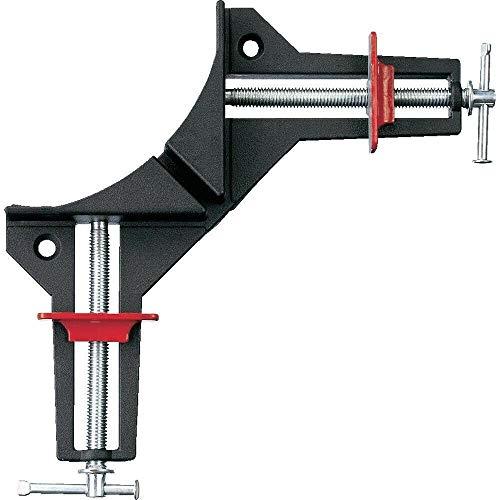
A two-spindle angle clamp with an 8 in capacity on both sides and plastic-coated die-cast jaws, under BESSEY's lifetime clamping warranty. It is the only clamp here that will close on real cabinet stock rather than picture-frame molding.
The corner clamp that actually clamps full-size carcass stock
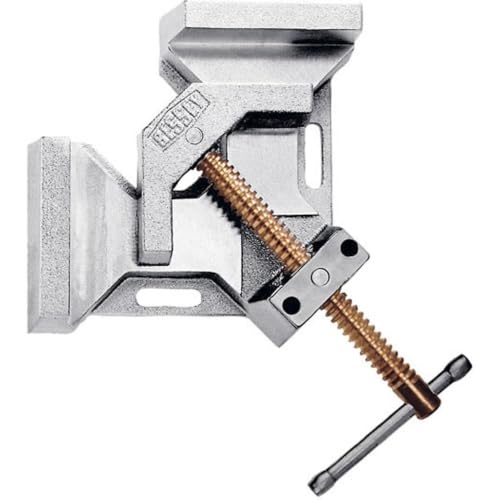
The welders' angle clamp, bought by woodworkers for exactly one reason: the angle is machined into a heavy body rather than set by two independent screws, so it cannot drift. A 9-1/2 in capacity and the weight to match.
A fixed 90 degrees that nothing you do will ever move
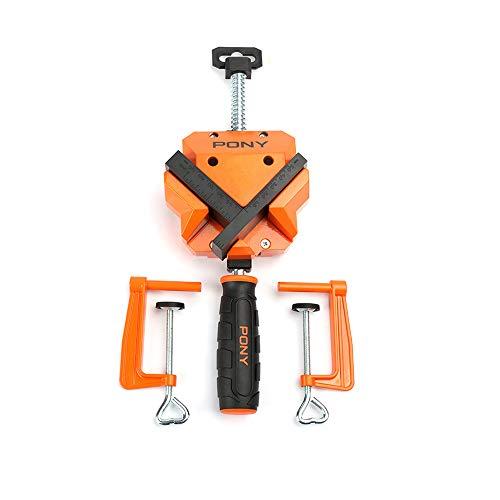
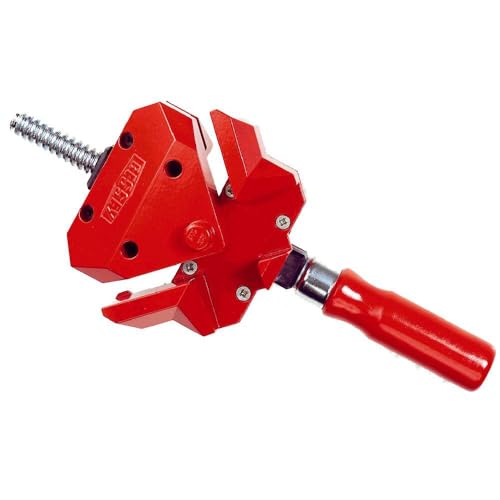
A cast miter clamp that pulls two 45-degree ends together at a published 150 lb, from the one maker on this page whose lifetime warranty needs no receipt. The clamp for frames, not for carcasses.
Mitered corners, and the warranty you can still claim in 2055
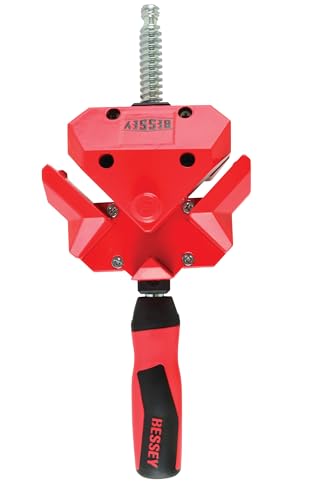
A die-cast aluminum angle clamp with a published 1-1/8 in capacity and a 1-1/8 in throat, and a two-component handle you can actually tighten by hand. The one in this field that tells you its throat depth before you buy it.
Small cabinet and box work with the specs actually printed on the box
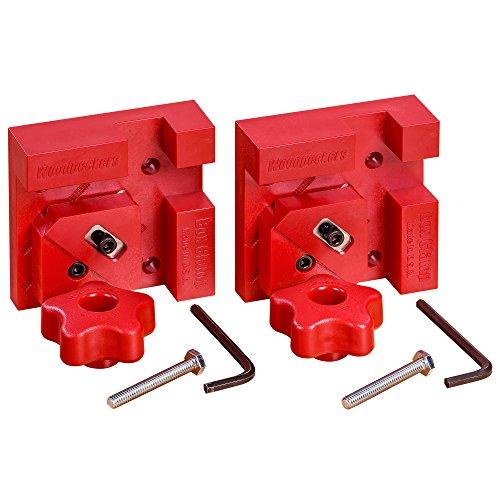
A molded clamp that holds two boards from 1/4 in to 1 in thick at 90 degrees and leaves the whole joint line open, so you can drive fasteners along it while it is clamped. Sold in pairs, which is how they are used.
Box and carcass joints you still need to screw or nail through
A steel corner clamp with a published 200 lb of clamping force and a 3 in capacity, for less than the price of a bag of sanding discs. The throat is half an inch deep, and that is the whole catch.
The cheapest clamp here that publishes a force figure
#ad· Live prices from the Amazon Product API, as of November 24, 2026. Where we have no verified live price we show none, and the cost-per-decade figure is suppressed with it — we would rather leave a gap than print a number that has rotted.
The verdict: buy the BESSEY WS-6. It is the only clamp in this field with a capacity measured in inches rather than fractions — 8 in on both sides, per the distributor listing — plastic-coated die-cast jaws so it does not print its marks into the work, and a galvanized spindle doing real work rather than a plastic cam holding a shape. The budget pick is the BESSEY WS-1, which publishes 200 lb of clamping force for pocket money and whose only serious flaw is a half-inch throat. Prices below are live from the Amazon Product API with the date they were checked.
Read the next section before you buy anything in this category, because the single commonest way to waste money here is not buying the wrong brand. It is buying a tool that was never a clamp.
Two tools, one name
Search for corner clamps and you get two populations of product mixed together on the same results page.
Angle clamps. A body with two jaws and one or two screws. You put two pieces in, wind the spindle down, and the clamp pulls the joint closed and holds it at 90 degrees while the glue sets. This is a clamp in the ordinary sense: it generates force.
Positioning squares, clamping squares, assembly squares. An aluminum or polycarbonate right-angle block, usually sold eight or twelve to a box. You hold the work against it, often with your own clamps, and it keeps the corner at 90 degrees. It applies no force at all.
Both are useful. They are not substitutes, and the second kind is what the bargain multi-packs are. If your joint is fitting badly and needs pulling shut, a positioning square will hold it crooked and open; if you are dry-assembling a cabinet and want the carcass square while your bar clamps do the pulling, a stack of squares is the right purchase and an angle clamp is in the way.
This page ranks only the first kind. Every pick below has a screw. The aluminum clamping-square sets, the polycarbonate assembly squares and the molded quick-grip corner clips are deliberately not ranked: they are jigs, we have no verified listing for them in the registry, and a page that mixed them in would be comparing a vise with a set square.
What this page is ranked on
A corner clamp is a simple object, and the criteria follow in the order they will actually bite on you.
Published clamping force, and failing that, capacity. Most of this category publishes neither. Two of the six picks publish a force figure in pounds, and where no force is published, capacity is what you are buying: a clamp that will not close on 3/4 in ply cannot help you build a cabinet, whatever it claims.
Throat depth, which is the criterion nobody checks. The throat is how far from the edge the screw sits. A shallow throat puts the clamp exactly where the screws, nails or dominoes go, and where the glue squeezes out. This single dimension is the difference between a clamp you reach for and one that lives in a drawer, and it is the reason the cheapest pick here is not the first pick.
Body and jaws: what it is made of, and whether it marks. Cast iron is permanent and will dent your work. Die-cast aluminum is lighter and more brittle. Plastic-coated jaws are the compromise and are worth more than the material upgrade on a tool this small. Molded bodies cannot mark anything and cannot pull hard either.
Whether the right angle is built in or set by you. On most angle clamps the 90 degrees is produced by two independent screws, which means it is only as square as your setup. On a fixed-angle body it is machined in and cannot drift. That is a real difference in a glue-up you only get one go at.
Warranty position and parts. Reported honestly below, including the part most pages skip.
The warranty finding worth knowing before you spend
BESSEY is the dominant name here and its warranty is the usual reason people pay for it. What BESSEY’s own warranty page says is that clamping productsare covered by a Limited Lifetime program — and that “other tools including but not limited to snips, knives, c-clamps, some specialty clamps, magnets, bearing heaters and pyrometers are guaranteed for 1 year.” It does not say which specialty clamps. An angle clamp is plausibly in either bucket.
So we do not claim the lifetime warranty on the four BESSEY clamps below, and our durability rating for them reflects an unconfirmed term rather than a lifetime one. What is not in doubt is the parts position: BESSEY publishes replacement pads and wear parts by part number across its clamp ranges, which is more than any other maker in this category does, and the body of an angle clamp has no consumable in it to begin with. The one unambiguous lifetime term in this field belongs to Pony Jorgensen, whose warranty has no time limit and needs no receipt — the thing that actually matters on a tool you may still own in 2055.
The picks
BESSEY WS-6, the one that clamps cabinet stock. Everything else in this field is built around frame molding; this is built around boards. The capacity is 8 in on both sides and the jaws are plastic coated, which on a show face matters more than the material they are cast from. BESSEY does not publish a clamping force for it, so what you are buying is capacity and jaw quality rather than a number. At roughly 5 lb it is heavy enough to drag a light assembly out of position if you let go of it, and it is by a wide margin the most expensive way on this page to hold two boards at right angles. For carcass work it is still the one.
BESSEY WSM-12, the fixed angle that cannot drift. A welders’ angle clamp from BESSEY’s WSM cast-iron family, bought by woodworkers for exactly one property: the 90 degrees is in the body, not in your setup, so the joint cannot be clamped out of square. The capacity is the largest here at 9-1/2 in. The costs are real — most expensive clamp on the page, bare cast iron that will mark anything it touches unless you use cauls, and far too heavy and slow for an assembly where you are juggling six joints. Buy it as a fixture, not as a set.
Pony Jorgensen 9180, the miter answer. A mitered corner is a different geometry from a butt joint and a square-jawed clamp cannot pull one closed properly. This one is built around the miter, publishes 150 lb of clamping force, has a 2 in throat and a 1-1/8 in maximum opening, and carries the only no-receipt lifetime warranty in this field. That opening is the limit: frame stock yes, carcass stock no. If you make picture frames, this is the first thing to buy on this page and the WS-6 is irrelevant to you.
BESSEY WS-3+2K, the small clamp that tells you its throat. Die-cast aluminum, a published 1-1/8 in capacity and — unusually for this whole category — a published 1-1/8 in throat depth, with a two-component handle you can genuinely tighten by hand. It is the lighter-duty half of the BESSEY range and it is made in China rather than Germany, both of which the listing says plainly. For small boxes and frames it is the sensible middle of this page.
Woodpeckers M2 box clamp, for joints you have to fasten through. A molded clamp, sold in pairs, that holds stock from 1/4 in to 1 in thick at 90 degrees and leaves the entire joint line open so you can nail or screw along it while it is still clamped. That open design is the whole point and nothing else here offers it. Be clear about what it is: it holds a joint square, it does not pull a gappy one shut, there is no published warranty or replacement part for it, and two clamps hold one corner — so a four-sided box wants four to eight of them.
BESSEY WS-1, the budget pick with one real flaw. A steel corner clamp publishing 200 lb of clamping force and a 3 in capacity for less than the price of a bag of sanding discs — more published force than the Pony miter clamp, at a fraction of the WS-6’s money. The flaw is the throat: half an inch, which puts the spindle right at the joint line where the fasteners and the glue squeeze-out are. If you are gluing and screwing through the corner you are clamping, this is the wrong tool and the WS-3 is where the extra money should go. If you are gluing only, it is the best value on the page.
How many you actually need
One corner clamp holds one corner. A box, a drawer or a face frame has four, and the clamp has to stay on each one until the glue grabs — so for assembly work the honest answer is four, or two pairs of the box clamps, and for a one-off repair or a test fit it is one. This is the arithmetic that sends most people to the twelve-piece aluminum square sets, and for dry-assembly and squaring that is a defensible purchase. It is just not a clamp.
It is also worth saying that corner clamps are not how cabinets get glued up. A carcass is pulled together by bar or parallel clamps across its width, with squares or corner clamps keeping it honest while they do it. If you do not own that, start there rather than here: the field is ranked on the best bar clamps, the quantity-first argument for carcass work is on the best clamps for cabinet making, and the whole clamp field including handscrews and pipe clamps is on the best woodworking clamps.
Squareness comes from checking, not from the clamp
Every clamp on this page will hold something near enough 90 degrees. None of them will tell you whether your assembly is actually square, because a carcass can be square at every corner and still racked across the diagonals. The clamp holds; the square and the diagonal measurement verify. If the tool doing your verifying is a hardware-store try square of unknown accuracy, that is the weak link in the whole operation, and the ones that publish a tolerance are ranked on the best woodworking squares.
Last thing: these are cast and steel tools that live on a shelf in a shop with humidity swings, and the spindle threads are where rust actually stops a clamp from working. A wipe of protectant on the screw once a year is the entire maintenance schedule — the products are compared on the best rust prevention for hand tools, and if you are buying secondhand cast clamps that are already rusty, the cheap ways to deal with that are on Evapo-Rust alternatives.
Every pick, in full
The write-ups
01The corner clamp that actually clamps full-size carcass stock
Capacity
8 in on both sides (distributor listing)
Jaw height / miter passage
2-7/16 in (sources differ on which)
Jaws
Die cast, plastic coated
Spindle
Galvanized steel
Weight
Approx 5 lb
BESSEY WS-6 Angle Clamp
BESSEY
8.4/10
A two-spindle angle clamp with an 8 in capacity on both sides and plastic-coated die-cast jaws, under BESSEY's lifetime clamping warranty. It is the only clamp here that will close on real cabinet stock rather than picture-frame molding.
Cost per decade
$78.43
Horizon · tier C
15 years — No lifetime warranty; parts purchasable and resharpenable
BESSEY warrants clamping products under a Limited Lifetime program, but the same warranty page carves out 'some specialty clamps' at 1 year and does not list which models those are - so on an angle clamp the cover is between one year and a lifetime and BESSEY does not say. What is not in doubt is the parts position: BESSEY publishes replacement pads and wear parts by part number across its clamp ranges, and the body of an angle clamp has no consumable in it at all.
Rebuy risk
High
parts listed
Clamping force
8.5
Body & jaws
9.0
Squareness
8.5
Rebuildability
9.0
Value
7.0
What it gets right
+8 in capacity on both sides is far beyond anything else in this field
+Plastic-coated jaws, so the clamp does not print its own marks into the work
+BESSEY publishes replacement wear parts by part number across its clamp range, which nothing else in this category does
What it costs you
−BESSEY does not publish a clamping force figure for it; what you are buying is capacity
−At roughly 5 lb it is heavy enough to pull a light assembly out of true if you let go of it
−BESSEY's warranty page carves 'some specialty clamps' out of its lifetime program at 1 year and does not say which, so the lifetime cover on an angle clamp is unconfirmed
Skip this if…
…the job is picture frames and small boxes. The capacity you are paying for is wasted and a 3 in clamp costs a fraction as much.
02A fixed 90 degrees that nothing you do will ever move
Capacity
9-1/2 in
Angle
Fixed 90 deg
Body
Cast iron (BESSEY's WSM welders' angle clamp family)
Clamping force
Not published
Warranty
Lifetime or 1 year: BESSEY carves out 'some specialty clamps'
BESSEY WSM-12 Angle Clamp, 90 Degree
BESSEY
8.4/10
The welders' angle clamp, bought by woodworkers for exactly one reason: the angle is machined into a heavy body rather than set by two independent screws, so it cannot drift. A 9-1/2 in capacity and the weight to match.
Cost per decade
$123.33
Horizon · tier C
15 years — No lifetime warranty; parts purchasable and resharpenable
BESSEY warrants clamping products under a Limited Lifetime program, but the same warranty page carves out 'some specialty clamps' at 1 year and does not list which models those are - so on an angle clamp the cover is between one year and a lifetime and BESSEY does not say. What is not in doubt is the parts position: BESSEY publishes replacement pads and wear parts by part number across its clamp ranges, and the body of an angle clamp has no consumable in it at all.
Rebuy risk
High
parts listed
Clamping force
9.0
Body & jaws
9.5
Squareness
9.5
Rebuildability
8.5
Value
5.5
What it gets right
+The right angle is built into the body, not set by the user, so it cannot be clamped out of square
+The largest capacity on this page at 9-1/2 in
+Built for welding fixtures, which means it is heavier and stiffer than anything woodworking asks of it
What it costs you
−Most expensive clamp here, and it is a welding tool being used for joinery
−Bare cast iron against bare wood will mark; it needs cauls on show faces
−Too heavy and too slow for assembly work where you are holding six joints at once
Skip this if…
…you need several clamps. Buying six of these is a car payment; this is the one-off fixture, not the set.
03Mitered corners, and the warranty you can still claim in 2055
Clamping force
150 lb (listing)
Max opening
1-1/8 in
Throat depth
2 in
Use
Mitered corners, cabinetmaking
Warranty
Limited lifetime, no receipt required
Pony Jorgensen 9180 Adjustable Angle Clamp
Pony Jorgensen
8.3/10
A cast miter clamp that pulls two 45-degree ends together at a published 150 lb, from the one maker on this page whose lifetime warranty needs no receipt. The clamp for frames, not for carcasses.
Cost per decade
$10.00
Horizon · tier A
30 years — Lifetime warranty, cited
Pony Jorgensen publishes a limited lifetime warranty against deficiencies in material and workmanship with no time limit on when the tool was bought, no receipt required, and replacement shipping paid by the maker; it excludes improper use, abuse, alteration and damage from improper repair. The no-receipt clause is the part that matters — a lifetime warranty you cannot claim on a clamp bought in 1994 is not a lifetime warranty, and this is the only maker on the page that says so in writing.
Rebuy risk
Medium
lifetime warranty, parts listed
Clamping force
8.0
Body & jaws
8.0
Squareness
8.0
Rebuildability
9.0
Value
8.5
What it gets right
+Publishes its clamping force (150 lb), which most of this category does not
+Pony Jorgensen's lifetime warranty has no time limit and needs no receipt
+Pulls a miter closed, which a square-jawed corner clamp cannot do properly
What it costs you
−1-1/8 in maximum opening rules out anything thicker than frame stock
−It is set up for miters; butt joints need a square-jawed clamp instead
−A 2 in throat is shallow, so the screw sits close to the joint line
Skip this if…
…you are assembling cabinet carcasses from 3/4 in ply. The opening is not the problem — the geometry is, since this clamp is built around the miter.
04Small cabinet and box work with the specs actually printed on the box
Capacity
1-1/8 in
Throat depth
1-1/8 in
Material
Die cast aluminum
Handle
2K two-component grip
Origin
Made in China (listing)
BESSEY WS-3+2K Angle Clamp
BESSEY
8.0/10
A die-cast aluminum angle clamp with a published 1-1/8 in capacity and a 1-1/8 in throat, and a two-component handle you can actually tighten by hand. The one in this field that tells you its throat depth before you buy it.
Cost per decade
$22.65
Horizon · tier C
15 years — No lifetime warranty; parts purchasable and resharpenable
BESSEY warrants clamping products under a Limited Lifetime program, but the same warranty page carves out 'some specialty clamps' at 1 year and does not list which models those are - so on an angle clamp the cover is between one year and a lifetime and BESSEY does not say. What is not in doubt is the parts position: BESSEY publishes replacement pads and wear parts by part number across its clamp ranges, and the body of an angle clamp has no consumable in it at all.
Rebuy risk
High
parts listed
Clamping force
7.5
Body & jaws
7.5
Squareness
8.0
Rebuildability
8.5
Value
8.5
What it gets right
+Publishes both capacity and throat depth, which the rest of this category treats as optional
+A 2K handle tightens harder by hand than a bare steel wing does
+Light enough to hold a small assembly without dragging it out of position
What it costs you
−Die-cast aluminum, not cast iron: this is the lighter-duty half of the BESSEY range
−1-1/8 in capacity is frame and small-box work only
−Made in China, unlike the German-made clamps BESSEY is known for
Skip this if…
…you are clamping anything thicker than nominal 1 in stock. It will not close on it.
05Box and carcass joints you still need to screw or nail through
Stock range
1/4 in to 1 in thick
Sold as
Pair (BC4-M2X2)
Includes
Clamps, hardware, knob, instructions
Body
Molded
Warranty
None published for this clamp
Woodpeckers M2 Box Clamp, Pair
Woodpeckers
7.5/10
A molded clamp that holds two boards from 1/4 in to 1 in thick at 90 degrees and leaves the whole joint line open, so you can drive fasteners along it while it is clamped. Sold in pairs, which is how they are used.
Cost per decade
$26.66
Horizon · tier C
15 years — No lifetime warranty; parts purchasable and resharpenable
No warranty term and no replacement-parts listing found for this clamp at the date checked. The horizon is set by the construction instead: a molded body with a separate steel screw and knob has no bearing surfaces to wear and nothing sealed inside it, but when a molded part does break there is no published part number to replace it with.
Rebuy risk
High
none of the three met
Clamping force
6.5
Body & jaws
8.0
Squareness
8.5
Rebuildability
6.5
Value
8.0
What it gets right
+Published stock range of 1/4 in to 1 in, which covers nearly all carcass and drawer stock
+Open design leaves the joint free to nail or screw while clamped
+A molded body cannot mark or dent the work the way a bare casting does
What it costs you
−Applies far less force than a cast screw clamp; it is a holder more than a clamp
−No warranty or replacement-part listing published for it
−Two clamps hold one joint, so a four-sided box wants four to eight of them
Skip this if…
…you need to pull a gappy joint closed. These hold a joint square while something else does the pulling.
06The cheapest clamp here that publishes a force figure
Clamping force
200 lb (listing)
Capacity
3 in
Throat depth
1/2 in
Material
Steel
Warranty
Lifetime or 1 year: BESSEY carves out 'some specialty clamps'
BESSEY WS-1 90 Degree Corner Clamp
BESSEY
8.0/10
A steel corner clamp with a published 200 lb of clamping force and a 3 in capacity, for less than the price of a bag of sanding discs. The throat is half an inch deep, and that is the whole catch.
Cost per decade
$9.66
Horizon · tier C
15 years — No lifetime warranty; parts purchasable and resharpenable
BESSEY warrants clamping products under a Limited Lifetime program, but the same warranty page carves out 'some specialty clamps' at 1 year and does not list which models those are - so on an angle clamp the cover is between one year and a lifetime and BESSEY does not say. What is not in doubt is the parts position: BESSEY publishes replacement pads and wear parts by part number across its clamp ranges, and the body of an angle clamp has no consumable in it at all.
Rebuy risk
High
parts listed
Clamping force
8.0
Body & jaws
6.5
Squareness
7.5
Rebuildability
8.5
Value
9.5
What it gets right
+Publishes 200 lb of clamping force, more than the Pony miter clamp and at a fraction of the price of the WS-6
+3 in capacity covers most frame and small-cabinet stock
+Same BESSEY warranty position as the expensive clamps in the range, for a tenth of the money
What it costs you
−A 1/2 in throat puts the screw right at the joint line, so it fouls fasteners and glue squeeze-out
−Steel jaws with no coating will mark a show face
−Small enough that two hands and a third clamp are often needed to start an assembly
Skip this if…
…you need to drive screws through the joint you are clamping. The shallow throat sits exactly where the fasteners go.
Check the capacity against your actual stock before anything else. Four of the six clamps here top out between 1-1/8 in and 3 in. If you build with 3/4 in ply and want to clamp two thicknesses plus a caul, most of this category is already out.
Then check the throat. A half-inch throat sits exactly where your screws and your glue squeeze-out want to be. Deeper is better, and nearly nobody publishes it, which is why two of the six picks here are ranked above cheaper clamps that pull harder.
Miters need a miter clamp. A square-jawed angle clamp cannot pull a mitered corner closed; it holds the two faces at 90 degrees and leaves the miter gapping. Frame work is a different purchase, not a cheaper one.
Buy coated jaws or buy cauls. Bare cast iron or bare steel against a show face leaves a dent you will find after the finish goes on. Either pay for plastic-coated jaws or keep a bag of offcuts by the bench, but do not do neither.
For assembly work, think in fours. One clamp is a repair tool. A box or a face frame needs all four corners held until the glue grabs, and the cost of four changes which clamp is the right answer.
Do not pay for a lifetime warranty you have not read. BESSEY’s lifetime program on clamping products explicitly carves out “some specialty clamps” at one year without naming them. The parts catalog is the stronger argument for these clamps, and the one unambiguous lifetime term here is Pony Jorgensen’s.
Questions
Frequently asked
What is the best corner clamp for woodworking?+
For carcass and cabinet stock, the BESSEY WS-6 — an 8 in capacity on both sides and plastic-coated jaws, which nothing else in this field comes close to. For mitered frames, the Pony Jorgensen 9180, which is built around the miter and publishes 150 lb of clamping force. On a tight budget, the BESSEY WS-1 publishes 200 lb for a few dollars, as long as you can live with a half-inch throat.
Are cheap aluminum corner clamp sets any good?+
They are good at what they actually are, which is positioning squares rather than clamps. They hold a corner at 90 degrees while something else — your bar clamps, your fasteners — does the pulling. They apply no clamping force, so they cannot close a joint that does not already fit. For dry assembly and squaring a carcass, a box of them is a sensible purchase; for gluing up a joint that needs pulling shut, they are the wrong tool.
How many corner clamps do I need?+
Four, if you are assembling boxes, drawers or face frames, because each corner has to stay held until the glue grabs. One is enough for repairs, test fits and holding a joint while you drill a pocket hole. The box clamps are sold in pairs and two of them hold one corner, so a four-sided assembly wants four to eight.
Can a corner clamp pull a bad joint closed?+
A screw clamp can pull a joint that nearly fits; nothing here will rescue a joint that is genuinely off. And a positioning square will cheerfully hold a bad joint open at a perfect 90 degrees. If a corner needs force to close, you need a clamp with a spindle and a published capacity, not a jig.
What throat depth do I need on a corner clamp?+
Enough to get your fasteners past the clamp. A 1/2 in throat sits right on the joint line, which is where screws, nails and glue squeeze-out all want to be; 1-1/8 in and up clears most of that. If you assemble with pocket holes or nails, treat throat depth as the deciding spec rather than clamping force.
Do corner clamps guarantee a square assembly?+
No. They hold two pieces at roughly 90 degrees at one corner. A carcass can be square at all four corners and still racked across the diagonals, so you still check with a square and a diagonal measurement before the glue sets. The clamp holds the work; it does not measure it.
We have not handled these tools. Nobody here has tested one, owned one, or taken one apart. Specifications come from the manufacturer or the retailer listing; warranty terms come from the maker's own warranty page; the cost-per-decade arithmetic is ours and reproducible. Where we could not verify a figure we say so on the page rather than quietly leaving it out. Read the full method.