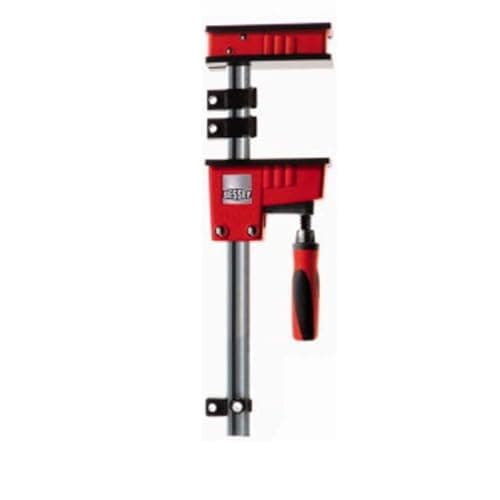
The verdict: buy Bessey K Body REVO parallel clamps if you build casework, and buy the Jorgensen Cabinet Master if you build casework on a budget. The REVO is for the person gluing up carcases that have to come out square without persuasion, and it is the only clamp here whose maker publishes a part number for every piece that wears. The budget pick is the Bessey GSCC2.524 clutch-style clamp — cast iron jaws and a slip clutch at the price of a disposable trigger clamp, and the one to buy six of. Every price below is live from the Amazon Product API with the date it was checked.
This page is only about bar clamps: a fixed head, a sliding head and a steel rail between them. That is a narrower question than the best woodworking clamps, which ranks every clamp family against each other and includes two tools that are deliberately absent here — the pipe fixture, whose bar is a plumbing part you supply, and the handscrew, which has no bar at all. Both are excellent and neither belongs in a bar-clamp ranking.
The four things that decide a bar clamp
Almost every clamp comparison you will read is a list of clamping-force figures. Force is the least interesting number on the page. Wood glue needs far less pressure than people think, and the failures that ruin a glue-up are almost never "not enough pounds" — they are racked carcases, bowed panels, bruised faces and clamps that have quietly stopped holding.
So the ranking below is built on four criteria, in this order.
- Do the jaws stay parallel, or does one of them pivot? This is the single biggest functional split in the category. A parallel clamp's jaws stay square to the rail under load, so the clamp holds the assembly square and flat as well as tight. An F-style or clutch clamp has one pivoting jaw: it delivers pressure along a line and leaves squareness entirely to you. Neither is wrong. Buying the second when the job needed the first is what produces a cabinet that rocks.
- Throat depth. How far in from the edge the clamp can reach. This is the number that decides whether a clamp can be used at all on a given job, and it varies by more than a factor of two across this page — from 2-1/2 in on the budget pick to 5-1/2 in on the deep-reach F-clamp.
- Is the rail stiff in torsion, not just in bending? A bar clamp under load is being twisted as well as bent. A profiled or cold-drawn rail resists that; a plain flat bar takes a set, and a bar with a set in it racks every assembly it touches afterwards.
- Are the wear parts catalog items? Nothing on a bar clamp wears out except the pads, the caps and the spindle thread. A clamp whose pads are listed with a part number is a tool you maintain. A clamp whose pads are moulded into a sealed body is a tool you replace, however good the first ten years were. This is the criterion that separates the two ends of this page, and it is the one the prices do not advertise.
Published clamping force appears in the table because people look for it, and because it tells you honestly which clamps are for glue-ups and which are for holding a jig. It is not what decides the order.
The clamp to buy: Bessey K Body REVO, 31 in
Bessey publishes the whole specification for this range and the numbers are consistent across every size: a 3-3/4 in throat depth, 1700 lb nominal, and for the KRE3531 a 31 in clamping capacity, 10-1/2 to 36-1/2 in of spreading, 6.86 lb each, shipped as a 2-pack. The rail is cold-drawn steel produced and tested at Bessey's own mills.
The reason it ranks first is not the 1700 lb figure, which you will almost never need. It is that Bessey lists every part that wears, by part number: KR-JP jaw pads, KRE-RPP rail protection pieces and the KRE-EC end clip, each specified as fitting the KR, KRV, KRE and KREV ranges. The three removable pressure caps are described as repellent to glue and resistant to paint and grease solvents. On a tool meant to last decades, a published parts list is worth more than any force figure, and almost nobody in this category provides one.
The honest costs: it is the most expensive way on this page to buy two clamps, and a real glue-up wants four. Bessey's limited lifetime cover on clamping products explicitly excludes normal wear and tear, which is precisely what happens to the pads — so the parts list is doing more work than the warranty. At 6.86 lb each they are heavy to hold in position one-handed while you find the handle. And single-clamp listings come and go, so the pair is often the only sane way to buy them.
Parallel jaws for a quarter of the money: Jorgensen Cabinet Master
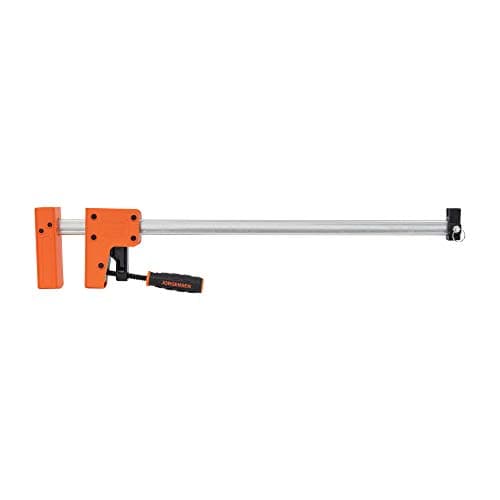
The 8024 is a 24 in parallel-jaw bar clamp with 3-7/8 in of reach, 1,500 lb of published force and a 1-3/16 by 3/8 in steel bar. The sliding head reverses into a spreader without tools, and there is a built-in clamp stand so it sits on the bench jaws-up while you place the workpiece — a small feature that matters a great deal when both your hands are holding a carcase.
It also carries the best warranty language on this page, and it is worth quoting what makes it unusual: Pony Jorgensen's limited lifetime warranty has no time limit and requires no receipt, and Pony Jorgensen pays the shipping on the replacement. It does not cover tools improperly used, abused, altered or damaged by improper repair.
The catch is the jaws. They are plastic where the REVO's are cast and faced — the same job in a less durable material — and no replacement jaws or pads are published, so a cracked jaw becomes a warranty claim rather than a repair. The bar will take a set if you overtighten it across a long panel, and a bent bar is a clamp that racks. Within those limits it is the cheapest honest route to parallel clamping, and for most people building cabinets it is the right purchase.
When you need to reach: Bessey TG5.512+2K
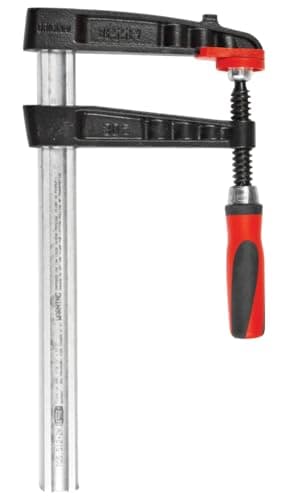
A 12 in F-style cast-jaw bar clamp with a 5-1/2 in throat, 1320 lb and about 4.85 lb of weight. Bessey specifies corrugated malleable cast iron for the fixed jaw and sliding arm, a profiled rail from the company's own German steel plant, a smooth-running Acme-threaded spindle, and — the detail that earns it a place here — replaceable pressure plates, so the part that touches your work is renewable. Bessey states the TG series is made in Germany of European steel.
A 5-1/2 in throat reaches well in from an edge, where a parallel clamp simply cannot go. That is the job: holding a joint in the middle of an assembly, clamping a batten across a panel, pulling a tenon shoulder tight.
Against it: one jaw pivots, so it will not hold a panel flat the way a parallel clamp does. Twelve inches of capacity makes it a joinery clamp rather than a panel clamp, and it costs roughly what a 24 in parallel clamp costs for less capacity. Bessey's lifetime cover excludes normal wear and tear, and on this clamp that is the spindle thread.
The budget pick: Bessey GSCC2.524, and why you buy six
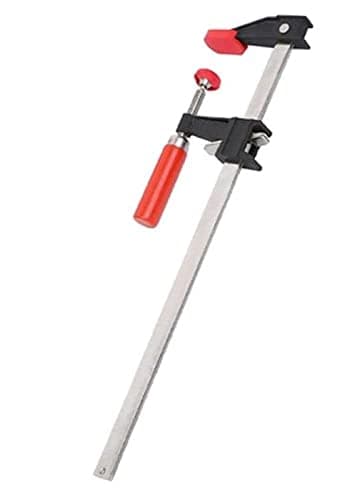
Powder-coated cast iron jaws and a two-piece slip-clutch on a nickel-plated, drawn and serrated rail: 24 in of capacity, a 2-1/2 in throat, 600 lb, and about 2.27 lb of weight. Cast iron jaws at a price where almost everything else in the aisle is resin, and Bessey lists replacement pads as GSCC2.5-PADS, two sets to a pack.
The slip clutch is the practical appeal. The sliding jaw holds position without a screw to tighten first, so you can place the clamp with one hand and tension it with the other. At this price the sensible purchase is several: a bench usually fails for want of a sixth clamp, not for want of a better one.
Be clear about what 600 lb and a 2-1/2 in throat mean, though. That is a third of what the parallel clamps here deliver, it clamps near an edge and nowhere else, and the single pivoting jaw holds pressure rather than holding square. It is an excellent supporting clamp and an insufficient only clamp.
The one that is not a lifetime tool, and why it is still here
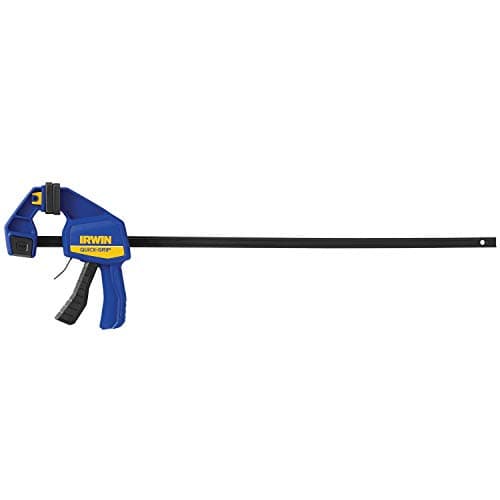
The Irwin Quick-Grip one-handed bar clamp is on this page because the convenience is real and the trade should be stated rather than hidden. Irwin publishes up to 300 lb of sustained force, an I-beam bar section to reduce flex, tool-free conversion to a spreader, and a Lifetime Limited Warranty at brand level.
It is genuinely one-handed, which nothing else on this page is, and that is worth owning two of: holding a stop, holding a jig, holding a fence while you reach for a screw. The I-beam bar flexes noticeably less than the flat-bar trigger clamps it competes with.
And it is the one tool here we would not call a buy-it-for-life purchase. 300 lb against 1700 lb puts it firmly in the holding category rather than the glue-up category. No replacement parts are published — body, trigger and pads are one sealed assembly — so when the pads glaze and compress there is no listed way to renew them. Irwin's warranty language excludes product that fails through normal wear and tear, which on a trigger clamp is the mechanism itself. Buy it for what it is good at and do not buy six.
The two clamps that are not on this page
Both are better buys than some of the clamps above, and neither is a bar clamp, which is the only reason they are excluded.
A pipe clamp fixture — a cast iron head with a multiple-disc clutch that grips any length of 3/4 in black pipe — is the cheapest genuinely generational clamp in the category, because the bar is not part of the tool. A bent or rusted pipe is a hardware-store part rather than a reason to retire the clamp, and Pony's own instruction is to buy pipe seven inches longer than the workpiece. The jaws are not parallel and bare steel pipe stains oak black wherever glue and moisture reach it.
An adjustable handscrew has no bar either: hard maple jaws on two cold-drawn steel spindles, with the angle between the jaws adjustable, so it closes on tapers and odd shapes nothing else here can hold. Wooden jaws spread pressure over a broad area and will not bruise a finished surface, and when they get glue-scarred you plane them flat again — a repair no metal clamp allows. Both are ranked, with prices, on the best woodworking clamps.
How many, and what sizes
The honest answer is more than you want to buy at once and fewer than the internet tells you. For casework, four parallel clamps long enough for your widest carcase will do the work; a fifth and sixth get used on every glue-up after that. For joinery, two deep-throat F-clamps and four cheap clutch clamps cover almost everything.
Sizes are easier than they look because capacity is cheap and reach is not. Buy clamps longer than you think you need — a 31 in clamp does a 20 in panel perfectly well and a 20 in clamp will never do a 31 in one — and treat throat depth as the specification you actually shop on. Where clamps sit in the order of purchases for a new bench is set out on building a hand tool kit on a budget.
Three of the five clamps above are Bessey, and the question that follows from that is what else gets you each of the things Bessey publishes. That is answered property by property on Bessey clamp alternatives.
If the work is specifically casework, the same clamps are re-ranked on cost per clamp at the quantity a carcass needs on the best clamps for cabinet making.