We earn a commission when you buy through our Amazon links, at no extra cost to you. It never decides a ranking, and where the best tool in a class is one we earn nothing on, we say so and link it anyway. How this works.
The coarse plate in the range, and the grit Atoma itself puts on stone flattening. The diamond sits in raised clusters with channels between them, so slurry has somewhere to go instead of clogging the plate — which is the entire problem with cheaper flatteners.
The coarse plate is the one that does the unglamorous work: reprofiling a chipped iron, grinding a new bevel, and flattening the waterstones you actually finish on.
#ad· Live prices from the Amazon Product API, as of November 22, 2026. Where we have no verified live price we show none, and the cost-per-decade figure is suppressed with it — we would rather leave a gap than print a number that has rotted.
The verdict: buy the Atoma #140 diamond plate. It is the right choice for anyone who sharpens on waterstones often enough to dish them, because the diamond sits in raised clusters with channels between them, so slurry has somewhere to go instead of clogging the plate — which is the entire problem with cheaper flatteners. The budget pick is the Norton flattening stone, the cheapest thing here that does the job: a grooved silicon carbide block with a holder and a case. Prices below are live, with the date they were checked.
A waterstone wears as it cuts. That is not a defect, it is the mechanism — fresh abrasive is exposed as the old abrasive breaks away, which is why a waterstone cuts faster than an oilstone. The consequence is that the stone goes hollow in the middle where you use it, and a hollow stone puts a convex bevel on everything it touches. You then chase a sharpness problem that is actually a flatness problem, usually for weeks.
The procedure, including how often and how to tell, is on how to flatten a waterstone. This page is just which of the three tools to buy.
The two things that decide a flattener
Does the abrasive clear? Flattening generates a slurry of stone and water, and a flat abrasive surface packs with it and stops cutting within seconds. Every good flattener solves this: the Atoma with channels between clusters of diamond, the Norton with grooves cut into the face, the DMT with an interrupted-surface pattern on its coarse plates. A plain unrelieved plate is the one thing not to buy.
Can the surface be replaced? A flattener is an abrasive tool working on an abrasive tool, so it wears too. Tsuboman sells the Atoma diamond sheet separately in all four grits, which means the machined aluminium base outlives the abrasive. Nothing else here has that.
One thing that is not a criterion: fineness. A flattener wants to be coarse. You are truing a surface, not polishing it, and the scratch pattern a coarse flattener leaves is removed by the first thirty seconds of sharpening on that stone.
The one to buy: Atoma #140
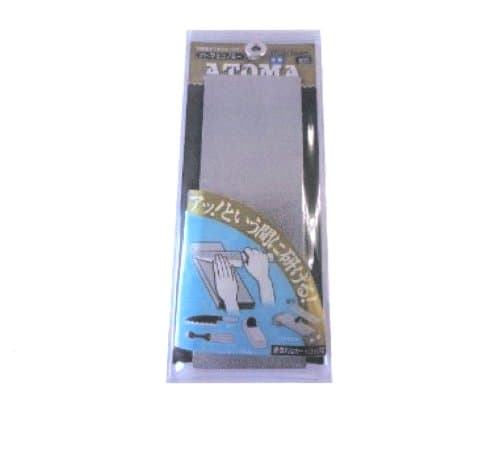
A 1 mm stainless diamond sheet on a 10 mm precision-flattened aluminium plate, 210 by 75 mm, at #140 — and #140 is the grit Atoma itself puts on aggressive removal and stone flattening. The diamonds sit in deliberately placed clusters with channels between them for waste to collect, which is why it keeps cutting when a continuous plate would have stopped.
It is expensive for a maintenance accessory, no warranty terms are published for the US market, and it is far too coarse to finish on — this is a flattener that can rough-grind, not a bench stone. If you sharpen only on diamond plates, there is nothing to flatten and you should not own one.
The one that does two jobs: DMT D8C
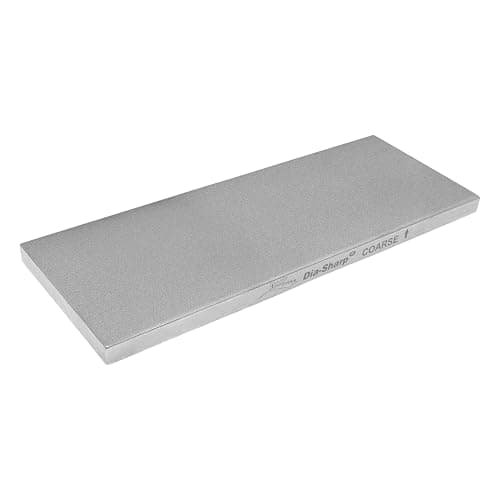
The coarse 325-mesh Dia-Sharp plate, 8 in of continuous diamond surface, manufactured in Marlborough, Massachusetts, with a published warranty page behind it. DMT lists flattening waterstones as a secondary use, and the practical appeal is that it is also a working coarse stone: reprofiling a chipped iron, grinding a new bevel, and truing the stones you finish on, all from one purchase.
It is far too coarse to finish on, it leaves scratches that take real work to remove on a finer stone, and it only makes sense alongside one. Buy it instead of the Atoma if you want the plate to earn its keep between flattening sessions; buy the Atoma if flattening is the job and you want the surface replaceable. The wider stone field is on the best sharpening stones.
The budget pick: Norton flattening stone
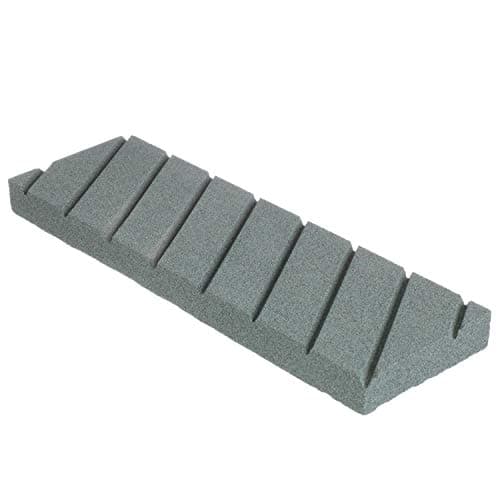
A coarse silicon carbide block for flattening waterstones, supplied with a holder and a case. It is the least interesting object on this site and skipping it ruins every stone you own. The grooved face clears slurry so it keeps cutting, the case keeps the grit out of everything else in the drawer, and it is the cheapest way to stop a dished stone ruining your bevels.
It wears down itself over time — a silicon carbide block is a consumable in a way a diamond plate is not — and it is messier than a diamond flattening plate. If your budget is tight, buy this and spend the difference on a finishing stone; the flatness matters more than what delivers it. Why grit sequence matters at all is on sharpening grits explained.
What you do not need to buy
Sandpaper on glass will flatten a stone. So will a concrete paver, and generations of woodworkers used exactly that. The reason to buy one of the three above is not that the improvised methods fail, it is that they are slow, messy and inconsistent enough that people stop doing them — and a flattener you do not use is worse value than the cheapest one you do. The improvised route and its limits are covered on the scary sharp method.
You also do not need a flattener at all if you sharpen on diamond plates or oilstones. Diamond plates cannot dish; oilstones dish so slowly that the question is a decade away. The comparison is on waterstones vs diamond stones and diamond stones vs oilstones.
The Atoma above is also the only stone in this registry whose abrasive sheet can be bought again, which makes it the direct answer to the one real complaint about a Shapton. That comparison is on Shapton alternatives.
If the Atoma is the tool you were trying to avoid paying for, the substitutes are sorted by which of its jobs you actually wanted on Atoma alternatives.
Every pick, in full
The write-ups
01Flattening waterstones properly
Grit
#140 coarse
Size
210 x 75 mm plate
Construction
1 mm stainless diamond sheet on 10 mm aluminium
Warranty
Not published
Atoma Diamond Sharpener, #140 Coarse
Atoma
7.5/10
The coarse plate in the range, and the grit Atoma itself puts on stone flattening. The diamond sits in raised clusters with channels between them, so slurry has somewhere to go instead of clogging the plate — which is the entire problem with cheaper flatteners.
Cost per decade
$37.45
Horizon · tier C
20 years — No lifetime warranty; parts purchasable and resharpenable
No warranty terms published for the US market at the date checked. Monocrystalline diamond clusters on a 1 mm stainless sheet bonded to a 10 mm machined aluminium base: the plate never needs flattening, and Tsuboman sells the diamond sheet on its own in all four grits, so when the abrasive is spent the base is re-surfaced rather than replaced.
Rebuy risk
Medium
parts listed, resharpenable
Cut rate
9.5
Maintenance
9.0
Finish
3.0
Longevity
9.0
Value
7.0
What it gets right
+Atoma's own guidance puts #140 on aggressive removal and flattening stones, which is what you are buying it for
+Clustered diamond pattern clears swarf instead of loading up with it
+Tsuboman sells the diamond sheet separately in all four grits, so the machined base outlives the abrasive
What it costs you
−Expensive for what is a maintenance accessory rather than a sharpening stone
−No warranty terms published for the US market
−Far too coarse to finish on; this is a flattener that can rough-grind, not a bench stone
Skip this if…
…you sharpen only on diamond plates. There is nothing to flatten and this is a solution to a problem you do not have.
The coarse plate is the one that does the unglamorous work: reprofiling a chipped iron, grinding a new bevel, and flattening the waterstones you actually finish on.
Cost per decade
Suppressed — no live price
Horizon · tier C
20 years — No lifetime warranty; parts purchasable and resharpenable
DMT publishes a warranty page and manufactures its bench stones in Marlborough, Massachusetts. We did not retrieve the specific term, so we do not rate it tier A. Diamond is bonded to a steel substrate: the plate never needs flattening and has no consumable element.
Rebuy risk
Medium
parts listed, resharpenable
Cut rate
9.5
Maintenance
10.0
Finish
4.0
Longevity
9.5
Value
8.0
What it gets right
+Removes metal fast enough to make bevel repair practical
+Doubles as a waterstone flattener, which saves a separate purchase
+Never needs maintenance itself
What it costs you
−Far too coarse to finish on
−Leaves scratches that take real work to remove on a finer stone
−Only makes sense alongside a finer stone
Skip this if…
…you only need to touch up an edge. Coarse plates are for repair, not maintenance.
03The purchase that keeps your other stones honest
Type
Silicon carbide flattening stone
Includes
Holder and case
Use
Truing dished waterstones
Warranty
Not published
Norton Waterstone Flattening Stone with Holder
Norton
8.3/10
A coarse silicon carbide block for flattening waterstones. It is the least interesting object on this site and skipping it ruins every stone you own.
Cost per decade
$39.99
Horizon · tier D
10 years — No warranty and no parts availability found
This is a consumable, not a tool: it is used up. The horizon is the floor value and the rating below is accurate rather than unkind — you will buy this again, and the cost-per-decade figure is only useful for comparing one consumable against another.
Rebuy risk
High
none of the three met
Effectiveness
8.5
Handling
7.0
Coverage
8.0
Value
9.5
What it gets right
+Cheapest way to stop a dished stone ruining your bevels
+Grooved face clears slurry so it keeps cutting
+Case keeps the grit out of everything else in the drawer
What it costs you
−Wears down itself over time
−Messier than a diamond flattening plate
−Unnecessary if you sharpen on diamond
Skip this if…
…your stones are diamond plates. There is nothing to flatten.
Coarse is correct. A flattener should be coarser than the stone it trues. #140 diamond or a coarse silicon carbide block is the right end of the scale; anything fine enough to polish is too fine to cut a dished stone flat in reasonable time.
Buy the relieved surface. Channels, grooves or an interrupted pattern are what stop the flattener packing with slurry within seconds. This is the single most important feature and the one cheap flatteners omit.
Flatten before you sharpen, not after. Thirty seconds at the start of each session costs nothing and means you never sharpen on a hollow stone. Pencil a grid on the stone face and flatten until the grid is gone.
Skip it entirely if you sharpen on diamond. There is nothing to flatten, and a flattener is then a solution to a problem you do not have.
Questions
Frequently asked
What is the best way to flatten a waterstone?+
A coarse diamond plate with a relieved surface — the Atoma #140 is the one made for the job, and #140 is the grit Atoma itself specifies for flattening. A grooved silicon carbide flattening stone does the same work more slowly and for much less money.
How often should you flatten a waterstone?+
Every session is the safe habit, because thirty seconds at the start costs nothing and a dished stone puts a convex bevel on everything. At minimum, flatten whenever a pencil grid drawn on the face does not wear off evenly.
Can you use a diamond plate to flatten stones?+
Yes, and a coarse one is the standard method. DMT lists waterstone flattening as a secondary use for its coarse Dia-Sharp plates, which makes the D8C a flattener that also works as a coarse bench stone. Fine plates are too fine to be efficient at it.
Do diamond stones need flattening?+
No. Diamond is bonded to a steel or aluminium plate that does not wear away, so there is nothing to true. If your whole sharpening setup is diamond, you do not need anything on this page.
We have not handled these tools. Nobody here has tested one, owned one, or taken one apart. Specifications come from the manufacturer or the retailer listing; warranty terms come from the maker's own warranty page; the cost-per-decade arithmetic is ours and reproducible. Where we could not verify a figure we say so on the page rather than quietly leaving it out. Read the full method.