Skip to content
PLANE & PATINA
Menu

Sharpening

The Best Bench Grinders For Chisels And Plane Irons

A grinder does not sharpen anything. It restores the shape a bevel lost — and at the wrong speed, on the wrong wheel, it destroys the hardness that makes the tool worth owning.

By Stephen V.Last reviewed How we pick
#ad

We earn a commission when you buy through our Amazon links, at no extra cost to you. It never decides a ranking, and where the best tool in a class is one we earn nothing on, we say so and link it anyway. How this works.

The short answer

Quick picks

#ToolBest forPer decadeScorePrice
01
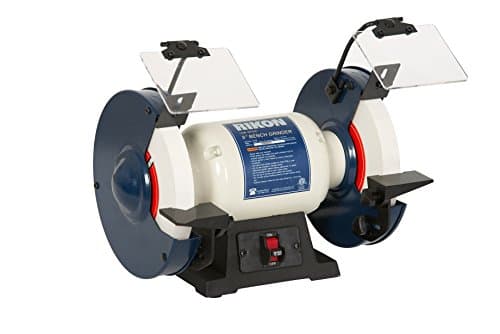
RIKON RIKON 80-805 8 in Slow Speed Bench Grinder
RIKON 80-805 8 in Slow Speed Bench Grinder

Half the wheel speed of a hardware-store grinder, wheels and a diamond dresser in the box, and the longest published warranty in this price bracket at five years. It is the machine most hand-tool owners should buy, and the one whose spec sheet leaves the fewest blanks.

The default grinder for chisels and plane irons$75.00tier B$149.99Amazon
02
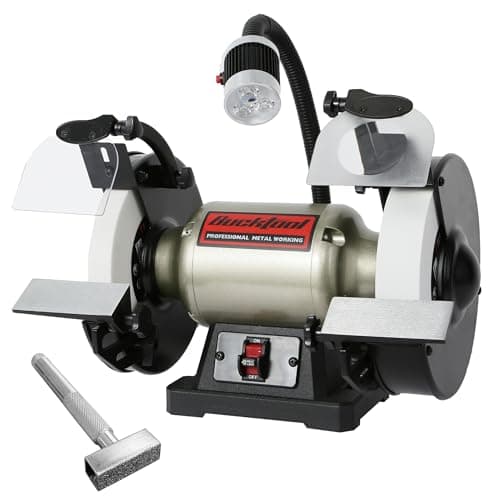
Bucktool Bucktool 8 in 3/4 HP Low Speed Bench Grinder
Bucktool 8 in 3/4 HP Low Speed Bench Grinder

The only grinder here that arrives with white aluminum oxide wheels rather than unspecified gray ones, on a cast iron base, with a wider 1-1/2 in wheel on the right and more motor than anything else at the price. What it does not have is a published parts list.

The most machine per dollar, with the right wheels included$137.87tier B$206.80Amazon
03
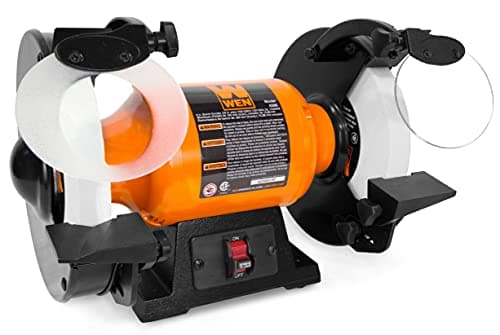
WEN WEN BG4286 8 in Slow Speed Bench Grinder
WEN BG4286 8 in Slow Speed Bench Grinder

The lowest price at which you can still buy the right wheel speed. The motor is the smallest here on published amps and the machine is the plainest, but it turns at 1,750 RPM, and that matters more to your chisels than everything else on the spec sheet put together.

The cheapest honest way into 1,750 RPM$78.17tier B$117.26Amazon
04
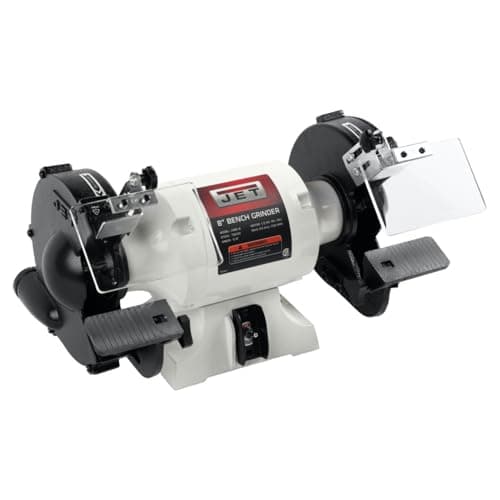
JET JET JWBG-8NW 8 in Bench Grinder, No Wheels
JET JWBG-8NW 8 in Bench Grinder, No Wheels

Forty-eight pounds of cast iron, milled cast-iron tool rests, an exploded parts diagram published in the manual, and deliberately no wheels — because the wheels a grinder ships with are almost never the ones an edge-tool owner wants. The most documented machine here, at double the money.

Buying the machine once and choosing your own wheels$120.00tier B$359.99Amazon
05
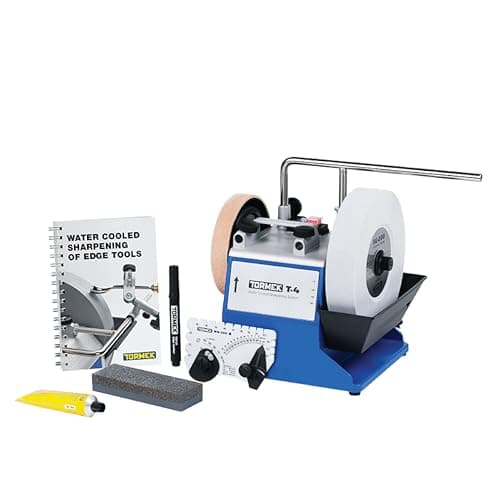
Tormek Tormek T-4 Original Water Cooled Sharpening System
Tormek T-4 Original Water Cooled Sharpening System

A 200 mm aluminum oxide stone turning at 120 rpm in a water bath. Overheating an edge stops being a skill you have to acquire and becomes something the machine cannot easily do, and Tormek backs it for eight years if you register it. You pay for that in money and in time.

The buyer who refuses to risk burning an edge$204.33tier B$613.00Amazon
06
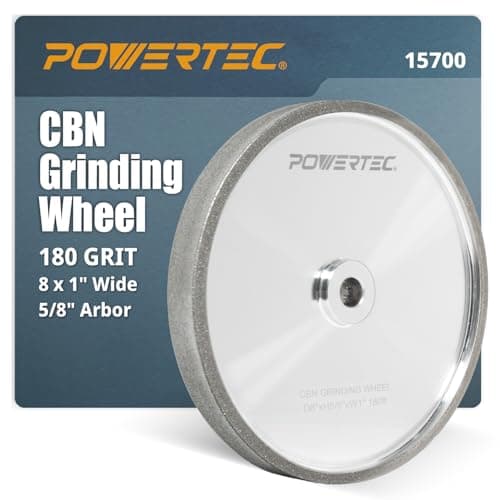
POWERTEC POWERTEC 15700 CBN Grinding Wheel, 8 in, 180 Grit
POWERTEC 15700 CBN Grinding Wheel, 8 in, 180 Grit

Cubic boron nitride electroplated onto a machined aluminum body. It never needs dressing, never loses diameter, and therefore never moves the rest setting you spent ten minutes getting right. On an edge-tool grinder it is the most useful thing you can bolt on.

The upgrade that changes the machine you already own$63.90tier C$127.79Amazon
07
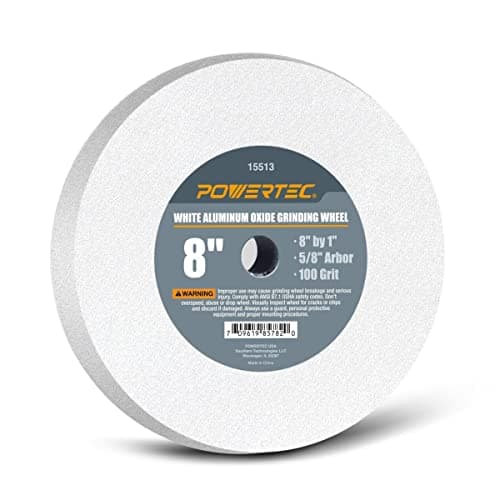
POWERTEC POWERTEC 15513 White Aluminum Oxide Wheel, 8 in, 100 Grit
POWERTEC 15513 White Aluminum Oxide Wheel, 8 in, 100 Grit

White aluminum oxide is friable: the grains fracture as they dull and keep presenting fresh cutting edges instead of glazing over and heating the steel. Swapping the gray wheel a grinder ships with for one of these is the cheapest meaningful upgrade in this hub.

The twenty-dollar fix for the wheel your grinder came with$21.50tier D$21.50Amazon
08
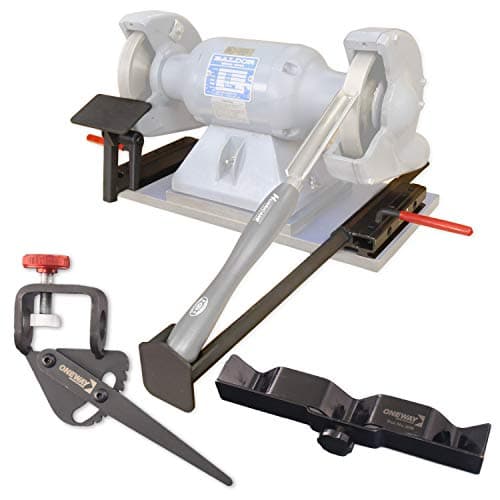
Oneway Oneway Wolverine Grinding Jig with Vari-Grind and Skew Attachments
Oneway Wolverine Grinding Jig with Vari-Grind and Skew Attachments

The stock rest on a bench grinder is the reason people ruin edges, not the motor. The Wolverine replaces it with a 3 x 5 in platform of quarter-inch steel, machined square after welding, on a base that bolts to the bench — so the angle you set is the angle you get, this time and the next.

Making the angle repeatable instead of hopeful$75.00tier B$224.99Amazon

#ad· Live prices from the Amazon Product API, as of October 16, 2026. Where we have no verified live price we show none, and the cost-per-decade figure is suppressed with it — we would rather leave a gap than print a number that has rotted.

Start with the uncomfortable part: most people who own chisels do not need a grinder, and a good number of the people who own one have already ruined an edge with it. A grinder does not sharpen. Sharpening happens on stones, at the very tip of the bevel, and it takes a couple of minutes. A grinder does something else entirely: it restores a bevel's shape when honing has quietly walked it out of true, or when a secondhand tool arrives with a chip in it, or when a bevel needs to change angle altogether.

That job comes up three or four times in the life of a chisel, and perhaps once a year across a whole tool cabinet. It is nonetheless the job that decides whether the tool is still a tool afterwards. Everything below is ranked on that narrow brief: reprofiling hardened edge tools without taking the temper out of them.

Decide these three things before you read the rankings

Wheel speed, and nothing else, comes first. Most hardware-store bench grinders turn at 3,450 RPM. Every machine on this page except the Tormek turns at 1,725 or 1,750. The difference is not marketing. An 8 in wheel has a circumference of just over 25 in, which is a little over two feet, so at 3,450 RPM the abrasive passes your chisel at roughly 7,200 feet per minute, and at 1,750 RPM at roughly 3,650. Half the rubbing speed is half the heat generated in the same cut, and heat is the only thing on this page that can permanently destroy a tool.

The wheel matters more than the machine. A grinder is a motor, an arbor and two rests. The abrasive does the work, and the gray wheel most grinders ship with is a general-purpose wheel intended for mild steel: it holds its grain long after that grain has stopped cutting, and a grain that has stopped cutting rubs instead, which is exactly how a bevel turns blue. A white aluminum oxide wheel is friable— the grain fractures as it dulls and keeps exposing fresh edges. It is the cheapest fix on this page by an order of magnitude.

The rest is why people burn edges, not the motor. A stamped tool rest that flexes, sits at an unknown angle and leaves a finger-width gap to the wheel turns grinding into a wrestle. A flat platform you can set, square and trust converts it into a repeatable operation. JET's own manual for the grinder ranked fourth here puts a number on the safety half of that: the rest should sit less than 1/8 in from the wheel face, or the work can be dragged down into the gap.

How we ranked them

We have not run any of these machines. This site has no lab and no workshop, and the methodology page says so in those words. What we did was open each maker's own specification table, warranty page and, where one exists, its parts manual, tabulate what each company is prepared to put in writing, and rank on that. Every document is linked at the bottom. Five things decided the order.

Published wheel speed. A non-negotiable filter. Nothing that runs only at 3,450 RPM was considered for the machine slots, regardless of price or brand.

What is in the box, and what it actually is. RIKON ships wheels and a diamond dresser but does not publish the abrasive grade. Bucktool ships white aluminum oxide and says so. JET ships no wheels at all, on the reasoning that you are going to replace them anyway. Those are three genuinely different propositions at three different prices.

The warranty, read to the end. This is where a spec sheet stops flattering a tool. RIKON publishes five years, then excludes “grinding wheels” from cover by name. JET publishes five years on woodworking machinery, and one year on motors, in the same chart. Tormek publishes eight years, conditional on registering the machine and on not earning money with it. All three are reasonable; none of them means what the headline number implies.

Whether parts exist. A warranty is a promise for a few years. A published parts diagram is a standing commitment, and it is the reason the JET carries the longest horizon on this page despite a shorter warranty than the Tormek. This is the same test we apply to every tool on the site.

Cost per decade, not sticker price. The arithmetic sits next to every pick and is computed from the live price, so it moves when the price moves. A $150 grinder that lasts twenty years is cheaper per year of ownership than a $60 one bought three times, and the comparison is worth making out loud before you sort the list by price.

Who should skip this page entirely

If your chisels cut and you sharpen them on stones, a grinder will not make them sharper. If you own two or three chisels and honing has taken five minutes rather than twenty-five, nothing here is urgent. And if the reason you are reading is a single chipped edge, a coarse diamond plate will fix it in an evening with no risk of overheating anything — slower than a wheel, and impossible to get wrong. The stones roundup covers that route, and how to sharpen a chisel covers the routine a grinder is not part of.

The case for buying one is narrower and stronger than the category usually admits: you have bought secondhand tools that need real steel removed, you own enough edge tools that hand-reprofiling has become a chore, or you want the freedom to change a bevel angle when a job asks for it rather than living with the one the factory chose.

Every pick, in full

The write-ups

01The default grinder for chisels and plane irons
RIKON RIKON 80-805 8 in Slow Speed Bench Grinder
Motor
1/2 HP, 3 A, 120 V
Speed
1,750 RPM
Wheels
8 x 1 in, 60 and 120 grit, 5/8 in arbor
Weight
34.2 lb
Warranty
5 years, consumer use

RIKON 80-805 8 in Slow Speed Bench Grinder

RIKON

Half the wheel speed of a hardware-store grinder, wheels and a diamond dresser in the box, and the longest published warranty in this price bracket at five years. It is the machine most hand-tool owners should buy, and the one whose spec sheet leaves the fewest blanks.

Cost per decade

$75.00

Horizon · tier B

20 years — Finite stated warranty, cited

RIKON publishes a five-year warranty on this machine for consumer use, dropping to two years if it is used commercially, industrially or in education. Read the exclusion: the limited warranty 'does not apply to accessory items such as blades, drill bits, sanding discs, grinding wheels' — the motor is covered, the wheels are not. Wheels are a standard 8 x 1 in, 5/8 in bore item, and RIKON publishes a parts line for everything else.

Rebuy risk

Medium

parts listed, resharpenable

Heat control
8.5
Wheels & rests
8.0
Build
7.5
Parts & warranty
8.5
Value
8.5

What it gets right

  • 1,750 RPM halves the surface speed of a 3,450 RPM grinder, which is the single biggest factor in not bluing an edge
  • Five-year published warranty — the longest stated term of any machine on this page
  • Ships with both wheels and a diamond-faced dressing tool, so there is nothing else to buy on day one
  • RIKON publishes a parts line and a phone number for spares rather than treating the machine as disposable
  • Left tool rest is grooved for drill bits, which is the one job a flat rest is bad at

What it costs you

  • RIKON does not publish what abrasive the supplied 60 and 120 grit wheels use, and the warranty explicitly excludes grinding wheels
  • At 34.2 lb it is the lightest of the cast-base machines here; it wants bolting down before you lean on it
  • The stock rests are adjustable but stamped rather than a flat, squared platform — fine for touching up, loose for repeatable bevel angles
  • Commercial, industrial or educational use cuts the five-year warranty to two

Skip this if…

…you already own a working grinder. A white wheel and a proper flat rest cost a fraction of this and will do more for your bevels than a new motor will.

$149.99See it on Amazon

Price as of October 16, 2026. Prices move; Amazon's is the one that counts.

#ad · we may earn a commission from this link to RIKON 80-805 8 in Slow Speed Bench Grinder

02The most machine per dollar, with the right wheels included
Bucktool Bucktool 8 in 3/4 HP Low Speed Bench Grinder
Motor
3/4 HP continuous, 1-1/4 HP peak, 4.0 A
Speed
1,750 RPM
Wheels
8 x 1 in and 8 x 1-1/2 in white aluminum oxide, 80 and 120 grit
Base
Cast iron with rubber feet
Warranty
2 years, per the maker's page

Bucktool 8 in 3/4 HP Low Speed Bench Grinder

Bucktool

The only grinder here that arrives with white aluminum oxide wheels rather than unspecified gray ones, on a cast iron base, with a wider 1-1/2 in wheel on the right and more motor than anything else at the price. What it does not have is a published parts list.

Cost per decade

$137.87

Horizon · tier B

15 years — Finite stated warranty, cited

Bucktool states '2 YEARS WARRANTY' on its own product page for this model and publishes a full specification table for it, but no replacement-parts listing we could find. The wheels are standard sizes and the motor is a conventional induction unit; the gap is in what happens if something other than a wheel fails.

Rebuy risk

Medium

parts listed, resharpenable

Heat control
8.5
Wheels & rests
9.0
Build
8.0
Parts & warranty
6.5
Value
8.0

What it gets right

  • White aluminum oxide wheels in the box — the friable abrasive you would otherwise buy separately for edge tools
  • The right-hand wheel is 1-1/2 in wide, which makes a plane iron far easier to keep square than a 1 in wheel does
  • Cast iron base and rubber feet at a price where sheet-metal bases are normal
  • Bucktool publishes a full specification table for the model, including continuous and peak horsepower
  • Rated by the maker for CBN wheels, so the upgrade path does not need a different machine

What it costs you

  • Two years of warranty against RIKON's five, and no replacement-parts listing we could find
  • The Amazon listing does not print a model number; Bucktool publishes these figures under TDS-200C4HL
  • At roughly 46 lb shipped it is a two-hand lift onto the bench
  • 80 grit is coarser than most people need on the left wheel for bench chisels

Skip this if…

…the thing that would let you sleep at night is a warranty you can read in one click and a parts diagram you can order from. Buy the JET or the RIKON.

$206.80See it on Amazon

Price as of October 16, 2026. Prices move; Amazon's is the one that counts.

#ad · we may earn a commission from this link to Bucktool 8 in 3/4 HP Low Speed Bench Grinder

03The cheapest honest way into 1,750 RPM
WEN WEN BG4286 8 in Slow Speed Bench Grinder
Motor
3 A, soft start
Speed
1,750 RPM
Wheels
8 x 1 in, 60 and 120 grit, 5/8 in arbor
Rests
Adjustable, pivoting
Warranty
2 years

WEN BG4286 8 in Slow Speed Bench Grinder

WEN

The lowest price at which you can still buy the right wheel speed. The motor is the smallest here on published amps and the machine is the plainest, but it turns at 1,750 RPM, and that matters more to your chisels than everything else on the spec sheet put together.

Cost per decade

$78.17

Horizon · tier B

15 years — Finite stated warranty, cited

WEN publishes a two-year warranty plus 'a stocked inventory of replacement parts' and a phone line, and lists the wheels, wire wheels and safety keys for this model as purchasable accessories. Two years is the shortest stated term of any machine on this page, which is why the horizon is shorter than the RIKON's rather than equal to it.

Rebuy risk

Medium

parts listed, resharpenable

Heat control
8.5
Wheels & rests
7.0
Build
6.5
Parts & warranty
7.0
Value
9.0

What it gets right

  • Slow speed at the price most 3,450 RPM grinders sell for
  • Soft start, so it does not snatch the bench when you switch it on
  • WEN publishes a two-year warranty, a stocked parts inventory and a support line, and sells the wheels for it as listed accessories
  • Both wheels included, so the entry cost really is the sticker price

What it costs you

  • 3 A is the smallest motor here; it is the one to think twice about if you reprofile damaged edges often
  • WEN does not publish the machine's weight, and a light grinder walks under load unless it is bolted down
  • The grade of the supplied aluminum oxide wheels is not published, so assume you will want a white wheel eventually
  • Two-year warranty and a plain stamped rest — this is a budget machine and it reads like one

Skip this if…

…you are buying a grinder to reprofile a boxful of secondhand chisels. Spend once on a bigger motor rather than twice on a small one.

$117.26See it on Amazon

Price as of October 16, 2026. Prices move; Amazon's is the one that counts.

#ad · we may earn a commission from this link to WEN BG4286 8 in Slow Speed Bench Grinder

04Buying the machine once and choosing your own wheels
JET JET JWBG-8NW 8 in Bench Grinder, No Wheels
Motor
1/2 HP, 6.5 A, 115 V
Speed
1,725 RPM
Wheels
None supplied; takes 8 x 1 in, 5/8 in bore
Weight
48 lb
Warranty
5 years, woodworking machinery

JET JWBG-8NW 8 in Bench Grinder, No Wheels

JET

Forty-eight pounds of cast iron, milled cast-iron tool rests, an exploded parts diagram published in the manual, and deliberately no wheels — because the wheels a grinder ships with are almost never the ones an edge-tool owner wants. The most documented machine here, at double the money.

Cost per decade

$120.00

Horizon · tier B

30 years — Finite stated warranty, cited

JET's own manual for this grinder prints the warranty chart: '5 Year – Woodworking Machinery', but also '1 Year – Motors' and '90 Days – Parts; Consumable items', and two years rather than five if the machine earns its living. The same manual publishes an exploded view and a numbered parts list, which is the part that sets the horizon here — a parts diagram is a longer commitment than a warranty period.

Rebuy risk

Medium

parts listed, resharpenable

Heat control
8.5
Wheels & rests
8.0
Build
9.5
Parts & warranty
8.0
Value
5.5

What it gets right

  • Cast iron base, guards and tool rests, the rests with a milled surface rather than a stamped one
  • JET publishes an exploded view and a numbered parts list in the manual, which outlasts any warranty period
  • 48 lb sits still on the bench instead of walking
  • No wheels in the box means you are not paying for wheels you intend to throw away
  • A 2 in dust port, which no other grinder on this page offers

What it costs you

  • JET's own warranty chart covers the machine for five years but the motor for one, and drops to two years for commercial use
  • You must budget for wheels before it will grind anything at all
  • Roughly double the RIKON for the same 1/2 HP and the same wheel speed
  • Parts and consumable items carry only 90 days

Skip this if…

…you want to grind tonight. There are no wheels in the box, and the right ones may take longer to arrive than the grinder did.

$359.99See it on Amazon

Price as of October 16, 2026. Prices move; Amazon's is the one that counts.

#ad · we may earn a commission from this link to JET JWBG-8NW 8 in Bench Grinder, No Wheels

05The buyer who refuses to risk burning an edge
Tormek Tormek T-4 Original Water Cooled Sharpening System
Stone
200 x 40 mm aluminum oxide, water cooled
Speed
120 RPM
Motor
120 W input
Weight
17.6 lb, machine only
Warranty
8 years registered, private use

Tormek T-4 Original Water Cooled Sharpening System

Tormek

A 200 mm aluminum oxide stone turning at 120 rpm in a water bath. Overheating an edge stops being a skill you have to acquire and becomes something the machine cannot easily do, and Tormek backs it for eight years if you register it. You pay for that in money and in time.

Cost per decade

$204.33

Horizon · tier B

30 years — Finite stated warranty, cited

Tormek publishes an '8-year warranty, 5 years + 3 years when you register at tormek.com' for private use, reduced to two years for commercial, industrial or educational use. Every wearing part is a catalog item sold on its own — the grindstone, the leather honing wheel, the stone grader — and the machine turns at 120 rpm in water, which is the slowest duty cycle of anything on this page.

Rebuy risk

Medium

parts listed, resharpenable

Heat control
10.0
Wheels & rests
7.5
Build
9.0
Parts & warranty
8.5
Value
5.0

What it gets right

  • At 120 rpm in water, the heat that ruins hardened edges on a dry wheel is not a thing you have to manage
  • Eight-year warranty when registered for private use, the longest published term on this page
  • Ships with the universal support, stone grader, AngleMaster, leather honing wheel and compound, so grinding and honing happen on one machine
  • The stone's working grit is changed with the supplied grader rather than by buying another wheel
  • Every wearing part is a separately cataloged Tormek item

What it costs you

  • The SE-77 square edge jig that holds a chisel or plane iron square is sold separately, and it is not cheap
  • Four times the price of the RIKON before you have bought that jig
  • Removing real metal takes far longer than it does on a dry wheel — this is a precision machine, not a reprofiling machine
  • Commercial, industrial or educational use cuts the warranty from eight years to two
  • Water means draining, drying and storing it somewhere it will not rust the bench

Skip this if…

…you grind a bevel twice a year. A slow-speed dry grinder and a careful hand do the same job for a quarter of the money.

$613.00See it on Amazon

Price as of October 16, 2026. Prices move; Amazon's is the one that counts.

#ad · we may earn a commission from this link to Tormek T-4 Original Water Cooled Sharpening System

06The upgrade that changes the machine you already own
POWERTEC POWERTEC 15700 CBN Grinding Wheel, 8 in, 180 Grit
Size
8 x 1 in, 5/8 in arbor
Grit
180
Body
6061 aluminum, nickel plated
Rated speed
1,000-3,600 RPM
Warranty
Not published

POWERTEC 15700 CBN Grinding Wheel, 8 in, 180 Grit

POWERTEC

Cubic boron nitride electroplated onto a machined aluminum body. It never needs dressing, never loses diameter, and therefore never moves the rest setting you spent ten minutes getting right. On an edge-tool grinder it is the most useful thing you can bolt on.

Cost per decade

$63.90

Horizon · tier C

20 years — No lifetime warranty; parts purchasable and resharpenable

No warranty term published at the date checked. A single electroplated layer of cubic boron nitride on a machined 6061 aluminum body, nickel plated; the maker states it 'does not need to be trued or dressed', so unlike a bonded wheel it does not lose diameter and there is no consumable element inside it. The same reasoning this site applies to a diamond plate: long-lived, renewable in the sense that nothing wears away, and unbacked by any published term.

Rebuy risk

Medium

parts listed, resharpenable

Cut rate
8.0
Maintenance
10.0
Finish
7.5
Longevity
9.0
Value
6.0

What it gets right

  • The maker states it does not need to be trued or dressed — no dressing tool, no wheel dust, no lost diameter
  • Because the diameter stays constant, an angle you set on the rest is still that angle next year
  • 180 grit is the right single grit for reprofiling bench chisels and plane irons
  • Nothing bonded to fracture: it is an abrasive layer plated onto a machined aluminum wheel
  • Rated to 3,600 RPM, so it fits a high-speed grinder as well as a slow one

What it costs you

  • Costs about as much as a budget grinder on its own
  • One grit, permanently — there is no grading it coarser or finer
  • POWERTEC lists it for carbon steel, HSS and tool steel; mild steel and aluminum load an electroplated wheel and there is no dressing it clean
  • No published warranty term of any kind

Skip this if…

…you grind occasionally and mostly need to fix chipped secondhand tools. A white wheel and the dresser you already own cost a tenth of this.

$127.79See it on Amazon

$135.996% off

Price as of October 16, 2026. Prices move; Amazon's is the one that counts.

#ad · we may earn a commission from this link to POWERTEC 15700 CBN Grinding Wheel, 8 in, 180 Grit

07The twenty-dollar fix for the wheel your grinder came with
POWERTEC POWERTEC 15513 White Aluminum Oxide Wheel, 8 in, 100 Grit
Size
8 x 1 in, 5/8 in arbor
Grit
100
Abrasive
White aluminum oxide
Max speed
3,600 RPM
Warranty
Not published

POWERTEC 15513 White Aluminum Oxide Wheel, 8 in, 100 Grit

POWERTEC

White aluminum oxide is friable: the grains fracture as they dull and keep presenting fresh cutting edges instead of glazing over and heating the steel. Swapping the gray wheel a grinder ships with for one of these is the cheapest meaningful upgrade in this hub.

Cost per decade

$21.50

Horizon · tier D

10 years — No warranty and no parts availability found

This is a consumable, not a tool: it is used up. The horizon is the floor value and the rating below is accurate rather than unkind — you will buy this again, and the cost-per-decade figure is only useful for comparing one consumable against another.

Rebuy risk

High

none of the three met

Cut rate
7.5
Maintenance
6.0
Finish
7.0
Longevity
4.0
Value
10.0

What it gets right

  • Costs less than a pack of sandpaper and changes how hot your bevels get
  • POWERTEC specifies it for maximum cut rate and cool cutting action on hardened and high-speed tool steels
  • 100 grit leaves a primary bevel fine enough that honing on a stone is quick
  • Dressable, so a loaded or out-of-round face is recoverable rather than binned
  • Standard 8 x 1 in with a 5/8 in bore — it fits every machine on this page except the Tormek

What it costs you

  • A genuine consumable: it wears, it dishes, and dressing it makes it smaller
  • As the diameter shrinks, an angle set on a fixed rest quietly drifts with it
  • Needs a ring test and careful mounting, like any bonded wheel
  • 100 grit is a grinding grit, not a finish — the edge still has to be honed

Skip this if…

…you already run CBN. You would be going backwards.

$21.50See it on Amazon

Price as of October 16, 2026. Prices move; Amazon's is the one that counts.

#ad · we may earn a commission from this link to POWERTEC 15513 White Aluminum Oxide Wheel, 8 in, 100 Grit

08Making the angle repeatable instead of hopeful
Oneway Oneway Wolverine Grinding Jig with Vari-Grind and Skew Attachments
Kit
Two bases, V-arm, platform, Vari-Grind and skew attachments
Platform
3 x 5 in, 1/4 in steel, machined square after welding
V-arm
27-1/2 in
Fits
6, 7, 8 and 10 in grinders
Warranty
2 years, Oneway manufactured products

Oneway Wolverine Grinding Jig with Vari-Grind and Skew Attachments

Oneway

The stock rest on a bench grinder is the reason people ruin edges, not the motor. The Wolverine replaces it with a 3 x 5 in platform of quarter-inch steel, machined square after welding, on a base that bolts to the bench — so the angle you set is the angle you get, this time and the next.

Cost per decade

$75.00

Horizon · tier B

30 years — Finite stated warranty, cited

Oneway warrants all products it manufactures for two years from purchase. The horizon is longer than the term because of what the tool is: quarter-inch steel machined square after welding, on anodized aluminum bases, with no bearing, no spring and no consumable part. Every attachment is a separately cataloged item, so a damaged platform or arm is replaced rather than the whole jig.

Rebuy risk

High

parts listed

Effectiveness
9.5
Handling
8.5
Coverage
7.5
Value
6.0

What it gets right

  • A platform stiff and square enough to trust with a plane iron, which no stamped stock rest is
  • Two bases in the kit, one for each side of the grinder
  • Repeatability is the whole point: set the angle once, come back to the identical bevel months later
  • Oneway publishes a two-year warranty and catalogs the bases, platforms and attachments individually
  • Nothing in it to wear out — steel, aluminum and two ratchet handles

What it costs you

  • Costs more than the RIKON grinder it bolts alongside
  • Two of the three attachments in this kit are for lathe tools, so a bench-chisel owner pays for parts they will not use
  • Oneway notes that heavy-duty grinders with cast iron rests and guards may need modifying to fit
  • The bases must be screwed down, which rules out a grinder you keep in a cupboard

Skip this if…

…you grind a couple of times a year and freehand it happily. This is a fix for a problem you may not have.

$224.99See it on Amazon

Price as of October 16, 2026. Prices move; Amazon's is the one that counts.

#ad · we may earn a commission from this link to Oneway Wolverine Grinding Jig with Vari-Grind and Skew Attachments

What actually decides it

Buying guide

Why 1,750 RPM is the whole argument

Hardened tool steel is hard because it was quenched and then tempered at a controlled temperature. Put enough heat back into the edge at a grinder and you temper it a second time, at a temperature nobody chose, and the steel at the very tip goes soft. The tell is color: oxide colors run across clean steel as it heats, and by the time the extreme edge shows blue, the hardness that made the tool worth buying is gone from the part that matters. There is no fixing it except grinding past the damage and starting again.

The thin tip of a bevel has almost no mass to absorb heat, so it reaches that point long before the body of the chisel feels warm to your fingers. That is why “it did not feel hot” is not evidence. Halving the surface speed, running a friable wheel that cuts rather than rubs, taking light passes and keeping the tool moving across the wheel face are four ways of attacking the same problem, and they compound.

How to grind a chisel without ruining it

The sequence, in the order that matters. First, dress the wheel if it is a bonded one, so it is round and its face is clean; a loaded, glazed wheel is a heat source. Second, set the rest to the primary angle you want — 25 degrees for most bench chisels, with the numbers by tool type laid out in sharpening angles explained — and check it with a gauge rather than by eye. Third, mark the existing bevel with a felt pen, touch the wheel briefly, and look at where the ink came off: that tells you whether you are grinding the heel, the tip or the whole bevel before you have committed any metal.

Then grind in passes of a second or two, moving the chisel steadily side to side so no one spot on the edge sits still against the wheel, and lifting off to look far more often than feels necessary. Stop while a thin bright line still remains along the very edge. That line is your insurance: as long as it is there, the tip is not thin enough to overheat, and the last of it disappears on the stones during honing. Then go to the stones. A grinder leaves a ground shape, never a sharp edge, and honing is still a separate job.

Quenching in water between passes is the traditional advice and it remains contested: careful people do it constantly with plain carbon steel and never with modern air-hardening alloys, where repeated thermal shock is a plausible route to microcracking at an edge. The uncontested version is simpler — do not let the edge get hot in the first place. If you are grinding so hard that quenching feels necessary, take lighter passes. Chisel steel explained and A2 vs O1 steel cover which alloy you are likely holding.

Wheels: gray, white, or CBN

Gray aluminum oxide is what most grinders ship with, and it is the wheel to take off. It is a general-purpose abrasive for softer steel, and on hardened tools it glazes and rubs.

White aluminum oxide is the upgrade that costs about the same as a set of sandpaper. The grain is friable, so it breaks down and keeps cutting rather than polishing itself smooth. POWERTEC specifies its white wheels for exactly that — cool cutting on hardened and high-speed tool steels. Around 100 grit is a sensible single wheel for chisels and plane irons: coarse enough to remove a chip, fine enough that the honing afterwards is quick. It is a consumable and it needs dressing, and every dressing makes it slightly smaller, which slowly changes any angle you set against a fixed rest.

CBN is a plated layer of cubic boron nitride on a machined aluminum wheel. It never needs dressing, never loses diameter and so never moves your rest setting, and it is the reason so many turners run one. The trade-offs are real: it is a single fixed grit forever, there is no published warranty on the one ranked here, and it is specified for hardened steel — grind mild steel or aluminum on it and you load a surface you cannot dress clean. If you only ever grind chisels, plane irons and turning tools, that restriction costs you nothing.

What a complete setup actually costs

In brackets rather than numbers, because live prices move and the buttons on this page carry the current ones. The cheapest honest setup is a slow-speed grinder in the hundred-dollar-ish class plus a white wheel in the cost-of-a-takeaway class, which is enough to reprofile every edge tool you own. The middle path adds a real flat rest, which is what turns grinding from a nervous operation into a repeatable one, and typically costs as much again as the grinder. The upper path swaps the bonded wheel for CBN, or replaces the whole approach with a water-cooled machine where the heat problem does not arise at all. Each step buys certainty rather than speed.

One purchase order to consider if the budget is tight: wheel first, rest second, machine last. A borrowed or inherited 3,450 RPM grinder fitted with a white wheel and a proper platform, used with light passes, will treat your tools better than a brand-new slow-speed machine used carelessly with the gray wheel it came in.

Safety, briefly, because a wheel is the one tool here that can hurt you

Bonded wheels can fail. JET's manual sets out the routine every grinder manual sets out: ring-test a new wheel before mounting it, check that the wheel's own maximum speed rating exceeds the machine's, let it come up to full speed before touching work to it, keep the rest adjusted to less than 1/8 in from the face, use the eye shields and wear real safety glasses underneath them, and never grind on the side of a wheel. None of that is specific to woodworking. All of it is specific to the one machine in this hub that spins.

Where grinding sits in the rest of the site

Grinding is the coarse end of a sequence that ends on stones and, usually, a strop. If the bevel shape is fine and the tool is merely dull, skip straight to honing a plane iron or a honing guide. If the edge is chipped or the bevel has crept, grind first and then hone. If the tool is a rusted flea-market find, start at how to restore a chisel, where grinding is one step among several. And if you would rather never own a grinder, microbevels are the technique that postpones reprofiling longest.
Questions

Frequently asked

What speed grinder do I need for chisels and plane irons?

1,725 or 1,750 RPM, which is what every machine on this page except the Tormek runs at. An 8 in wheel at 3,450 RPM moves its abrasive past the edge at roughly 7,200 feet per minute; at 1,750 RPM it is roughly 3,650. Half the rubbing speed means far less heat for the same amount of metal removed, and heat is the one thing that can permanently ruin a hardened edge. If you already own a 3,450 RPM grinder, a friable white wheel and light passes go a long way toward closing the gap.

Can you grind a chisel without burning it?

Yes, and the method is unglamorous: a clean, dressed, friable wheel; a rest set to the angle and close to the face; passes of a second or two; constant side-to-side movement; and stopping while a thin bright line still remains along the edge. The tip has almost no mass, so it overheats long before the chisel feels warm in your hand. If the extreme edge shows blue, that steel is softened and has to be ground away before the tool will hold an edge again.

What grit wheel should I use on chisels and plane irons?

Around 100 grit in white aluminum oxide, or 180 grit in CBN, covers everything a bench chisel or plane iron needs. Coarser wheels in the 36 to 60 grit range remove metal fast and leave deep scratches you then have to hone out; finer wheels generate more heat for the same cut. The grinder is only shaping the primary bevel — the edge itself comes off a stone, so the ground finish does not need to be pretty.

Is a CBN wheel worth it for hand tools?

It is if you grind often and want repeatability. CBN does not need dressing and does not lose diameter, so an angle you set on a rest stays that angle for the life of the wheel, which a bonded wheel cannot promise. It costs roughly what a budget grinder costs, comes in one fixed grit forever, and the one ranked here carries no published warranty. For someone reprofiling a few chisels a year, a white wheel at a tenth of the price is the rational buy.

Do I need a grinder at all, or will stones do?

Stones will do, slowly. A coarse diamond plate or a coarse waterstone will reprofile a bevel or remove a small chip with zero risk of overheating anything — it is simply a long evening rather than a short one. The case for a grinder is volume and angle changes: a cabinet of secondhand tools that all need work, or a bevel you want to move from 30 degrees to 25. If neither describes you, spend the money on a better sharpening setup instead.

Wet grinder or dry grinder?

A water-cooled machine like the Tormek T-4 turns its stone at 120 rpm in a bath, so overheating an edge is not a problem you have to manage; Tormek backs it for eight years when registered for private use. The cost is money and time — it removes metal far more slowly than a dry wheel, and the square-edge jig that holds a chisel or plane iron is sold separately. A slow-speed dry grinder with a white wheel does the same job faster and cheaper, and asks you to pay attention.

What angle should I grind a chisel to?

25 degrees is the standard primary bevel for a bench chisel, with a honed secondary bevel at 30 degrees on top of it. Mortise chisels and anything that gets struck hard want more — 30 to 35 degrees — and paring chisels less. Sharpening angles explained carries the chart by tool type, including the grind angles the makers themselves publish.

Receipts

Sources

We have not handled these tools. Nobody here has tested one, owned one, or taken one apart. Specifications come from the manufacturer or the retailer listing; warranty terms come from the maker's own warranty page; the cost-per-decade arithmetic is ours and reproducible. Where we could not verify a figure we say so on the page rather than quietly leaving it out. Read the full method.

Keep reading