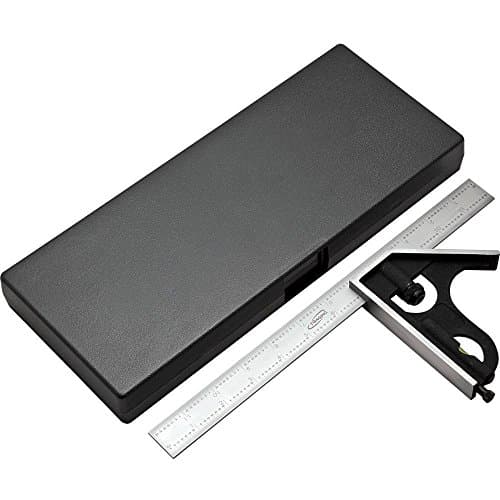
The verdict: buy the iGaging 12 in premium two-piece combination square. It is the right square for almost any bench under this budget: a hardened, precision-ground cast head with lapped measuring faces on a chrome-plated blade with etched 4R graduations in 8ths, 16ths, 32nds and 64ths, which is machinist practice rather than hardware-store practice. The budget pick is the Swanson TC132 — a cast zinc body, a stainless rule and a brass locking bolt for less than a sandwich, and the right square to knock about with so a better one stays on the bench. Prices below are live, with the date they were checked.
One thing has to be said before the picks, because it changes how you should read all of them. Not one square in this band publishes an accuracy tolerance. Above it, Woodpeckers publishes laser-engraved scales accurate to plus or minus 0.004 in of total accumulated error over the length of the blade, and guarantees to repair or replace the square any time you find it out of tolerance, with no fine print. Starrett publishes a one-year defect warranty and says plainly on its own site that no manufacturer's precision tools are guaranteed to work for life regardless of use or abuse — while also servicing and repairing tools passed down between generations.
Below fifty dollars you get neither statement. That does not make these squares inaccurate. It makes them unverified, which means the checking is your job, and the ranking below is built on the things a maker will put in writing instead. The full field, including the squares that do publish a number, is on the best woodworking squares.
How to check a square the day it arrives
This takes two minutes and it is the whole difference between a cheap square you can trust and one that quietly lies to you.
Find a board with one genuinely straight, planed edge. Register the square's head against that edge, hold the blade flat on the face, and strike a fine knife line. Now flip the square over, register it against the same edge from the other side with the blade over the same line, and strike a second line. If the square is true the two lines are one line. If it is out, the two lines diverge by twice the error, which is what makes the test so sensitive.
Do it again after any drop. Cast zinc heads are the commonest thing in a workshop to go out of true, and three of the five squares here have one. A straight reference edge comes from a jointer plane: see the best jointer planes.
The square to buy: iGaging 12 in 4R
Machinist construction at a woodworking price. The head is hardened and precision ground with lapped measuring faces; the blade is chrome plated with etched graduations, and etched marks do not wear off the way printed ones do. 4R — 8ths, 16ths, 32nds and 64ths — is the right scale for joinery layout, and the sliding head covers depth setting, 45 degrees and edge marking, so one tool does four jobs. It ships in a fitted case, which is how a square stays square.
No accuracy tolerance is published anywhere we could reach, and no warranty terms. The chrome plating reduces glare and hides wear; it is a finish, not a hardness claim. And a cast head can be knocked out of true without telling you, which is why the flip test above matters more on this square than on anything above the band. If the square is going to be your shop reference, buy one with a published tolerance instead, because a reference has to be checkable against something.
The second square, which is the one you will actually reach for
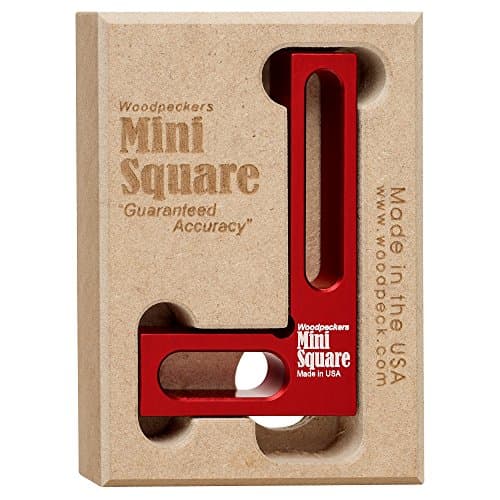
The Woodpeckers Mini Square is a pocket-sized fixed square machined from the same stock and in the same Ohio shop as the full-size Precision Woodworking Square. It exists for the checks you make constantly and never want to fetch a tool for: is the plane blade square to the sole, is the fence square to the table, is this shoulder true.
It is too short to lay out a line across a board, it has no sliding head, and the out-of-tolerance guarantee Woodpeckers publishes is stated for the Precision Woodworking Square line rather than for this. It also costs more than a full-size budget combination square that does more. Buy it second or third, never first — bought first it leaves you unable to lay anything out.
The most disclosure for the least money: Johnson 400EM-S
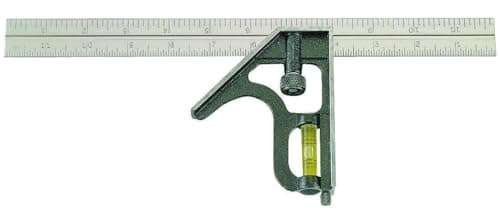
The point at which a combination square stops being a toy, and the square in this band whose maker says the most. Johnson publishes the head material and the machining method — CNC machined cast zinc with a chip-resistant e-coating — the blade material and graduations, permanently stamped in 1/8, 1/16 and 1/32 in plus millimetres, an Auto-Lock blade assembly, a screw-in hardened scriber that cannot fall out, an acrylic vial, and a stated one-year warranty.
Cast zinc is softer than the cast iron of a machinist head and takes a knock less well, one year is a defect warranty rather than a promise the tool stays square, and inch-and-metric on one blade is more clutter to read through in a layout. It is a very good site and shop square, and the iGaging above it is noticeably finer to read and to trust.
The long one: Irwin 16 in
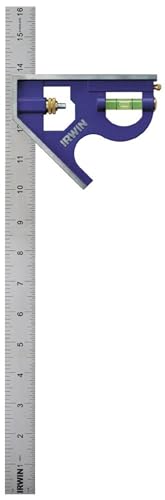
A cast zinc body with a stainless blade and black precision-etched scales, under Irwin's published Lifetime Limited Warranty — which is unusual at this price, and which covers defects in material and workmanship rather than the tool going out of square. Read that distinction carefully, because on a square it is the whole question.
The reason to own it is reach: 16 in of blade spans work a 12 in square runs out on, and it is cheap enough to keep in the toolbox so the accurate square stays on the bench. The reason not to make it your only square is that a longer blade amplifies any error in the head, so it is the wrong square to trust blindly — and no accuracy tolerance is published for it either. What a published warranty does and does not buy is on warranties and repairability.
The budget pick: Swanson TC132
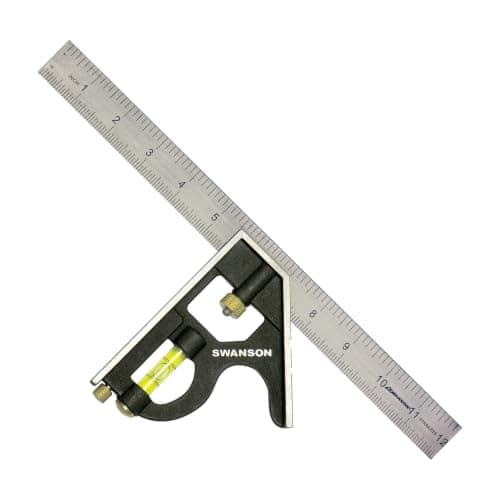
A cast zinc body, a stainless rule and a brass locking bolt at the bottom of the metal-bodied market. The brass bolt is the detail worth noting: it will not seize or rust into the head the way a plated steel one can. It is widely stocked, so replacing it is never a project, and it is cheap enough that you will actually use it for the rough work instead of your good square — which is the entire reason to own one.
No accuracy figure and no warranty terms published anywhere we could find, the lock relies on a single bolt, and nothing about it is repairable: when it is out of true, it is out. Buy it as the second square, never the first, because a layout tool you cannot verify is worse than no layout tool — you will trust it.
What fifty dollars cannot buy here
A published tolerance and a guarantee tied to it. That is the real boundary of this band, and it is a sharper boundary than anywhere else on this site: in chisels or hand planes the cheap tool simply needs more setup, whereas a square that is out by half a degree will put that error into every joint you cut and never announce itself.
So the honest advice is a split: buy one of the squares above for everything, and check it with the flip test the day it arrives and after every drop. If you cut joinery to a knife line and want a tool that is guaranteed to a number, that purchase sits just above this band and is worth saving for. Why that matters more on layout tools than on edge tools is argued on what makes a tool buy it for life.
If you came here from the Starrett listing rather than from a budget, the comparison you actually want is Starrett combination square alternatives, which sets each of these against what Starrett itself publishes.