Sharpening
Freehand vs Honing Guide
One is faster once learned, one is repeatable from day one — and most people should not choose the same one.
We earn a commission when you buy through our Amazon links, at no extra cost to you. It never decides a ranking, and where the best tool in a class is one we earn nothing on, we say so and link it anyway. How this works.
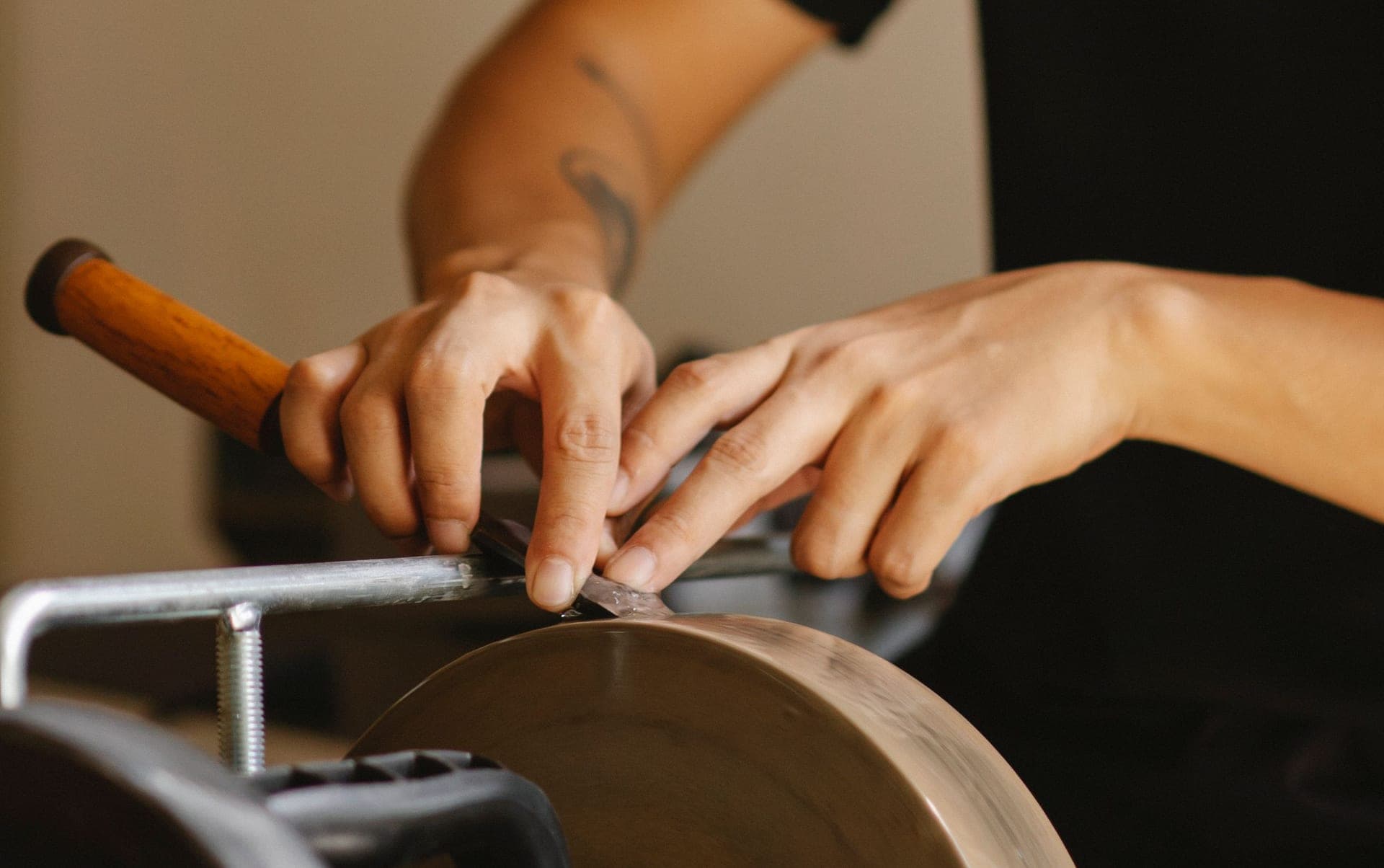
There are two ways to hold a blade to a stone. You can hold it in your hands and trust your muscles to keep the angle — freehand — or you can lock it into a honing guide and let a roller keep the angle for you. Both produce edges that shave. The difference is not the result on a good day; it is the reliability, the speed, and how long it takes before you can count on it. Most woodworkers argue this like it is a rivalry, but the honest answer is that the two suit different moments, and a lot of people end up using both.
What each approach really is
Freehand means registering the bevel flat on the stone by feel and pushing back and forth while holding that angle steady. It is a learned motor skill, like planing a straight edge or sawing to a line. A honing guide converts that skill into a setting: clamp the blade, set the projection, and the tool holds the angle mechanically. If the whole idea of a jig is new, the mechanics are covered in how to use a honing guide before you weigh it against freehand.
Speed versus consistency
This is the core trade. A honing guide is slower to set up — you have to clamp the blade square and dial in the projection — but once it is set, it delivers the exact same bevel every stroke and every session. Freehand is the reverse: nothing to set up, so a touch-up takes ten seconds, but consistency lives entirely in your hands. A skilled freehander is genuinely faster overall because the setup time disappears. A beginner freehander rounds the bevel, misses the edge, and ends up slower than they would have been with a guide, because a rounded bevel never comes sharp.
The learning curve
The guide has almost no learning curve for the thing that matters — the angle — which is exactly why it is the right starting point for most people. It lets you learn what a truly sharp edge feels like in the wood before you also have to master holding an angle. Freehand has a real curve. It takes practice to hold thirty degrees without rocking, and the feedback loop is slow because a subtly rounded bevel still looks fine. The upside is that once the skill is in your hands, it never leaves and it needs no hardware. Understanding what angle you are even aiming for helps either way, which is why it is worth reading sharpening angles explained early.
When freehand wins
- Quick touch-ups. A few passes to refresh an edge mid-project, with no clamp to fuss over.
- Curved and shaped edges. Gouges and carving tools have no flat bevel for a guide to grip.
- Cambered plane irons. Rolling the edge to a slight curve by hand is natural freehand and awkward in most guides.
- Speed at volume. When you sharpen many tools a day, skipping setup adds up.
When a guide wins
- Beginners. It removes the one variable you cannot yet control and shortens the road to a sharp edge.
- Precise, repeatable bevels. Paring chisels and smoothing irons that you want identical every time.
- Narrow chisels and short bladesthat are hard to balance by hand — a side-clamp guide steadies them.
- Microbevels. Tipping a guide up a degree for a polishing pass is trivial and exact.
Side by side
| Factor | Freehand | Honing guide |
|---|---|---|
| Setup time | None | Clamp and set projection each time |
| Consistency | Depends on your hands | Identical every session |
| Learning curve | Steep at first | Almost none for the angle |
| Best for | Touch-ups, curves, camber | Beginners, precise repeats, narrow chisels |
| Gear needed | Just a stone | A guide plus the stone |
| Failure mode | Rounded, dull bevel | Faithfully repeats a skewed clamp |
The honest downside of each
Freehand's weakness is invisible failure. A bevel that has quietly rounded over still looks polished and still feels sharp on your thumb, yet it will not pare end grain cleanly, and you may not know why until you go back to a flat bevel. The guide's weakness is the opposite kind of honesty: it will reproduce whatever you give it, including a blade clamped a hair out of square, so it grinds a skewed edge with total confidence. Neither flaw is fatal, but they fail in different directions — freehand drifts, and a guide commits — and knowing which way each leans tells you what to check when an edge comes out wrong.
The sensible middle path
Here is what most experienced woodworkers actually do, whatever they say in an argument: they start with a guide, and they drift toward freehand for the quick stuff. The guide teaches you the target — you can even study the bevel it produces to learn what the correct angle feels like — and once your hands know that feel, freehand touch-ups become fast and reliable. You keep the guide for the jobs that reward precision, like resetting a chipped iron or honing a fussy paring chisel, and you go bare-handed for the ten-second refresh in the middle of a glue-up. Neither tool is a badge of skill. The guide is not training wheels you must outgrow, and freehand is not a purity test; they are two settings on the same task.
If you are buying once and keeping tools for life, the choice is not either-or. Learn the guide first because it gets you to a genuinely sharp edge fastest, and let freehand grow underneath it as your hands catch up. A good guide is cheap insurance and lasts decades, so it is worth picking a solid one — the options are compared in the best honing guides — and the same edge you produce with either method feeds straight into the everyday routine in how to sharpen a plane iron. Pick the method that gets you cutting clean today, and let the other one come with time.
Questions
Frequently asked
Which should a beginner start with?
A honing guide. It removes the one variable you cannot yet feel — the angle — so you can learn what a truly sharp edge does in the wood first. Freehand skill can grow underneath it over time.
Is freehand actually faster?
For a skilled sharpener, yes, because there is no setup. A quick touch-up takes seconds. For a beginner it is slower in effect, because a rounded bevel never comes sharp and you end up starting over.
Can I do both?
Most experienced woodworkers do. They keep a guide for precise, repeatable jobs and resetting chipped edges, and go freehand for fast touch-ups mid-project. The two are settings on the same task, not rival philosophies.
Is freehand better for cambered plane irons?
Usually. Rolling the edge to a slight curve by leaning left and right is natural by hand, while many guides fight camber. Some single-roller guides allow it, but freehand gives you the most control over the shape.
Does a guide produce a sharper edge than freehand?
No, the ceiling is the same — both can produce a fully keen edge. The guide just reaches a consistent result sooner. In skilled hands, freehand matches it and skips the setup.
Keep reading
Related
Back to Sharpening · how we pick · editorial policy